



CompoBus: Reviving a Radical Idea
What looked like another buried public transportation research project that died in its commercial cradle, the CompoBus has now received new life. What it means for the industry.
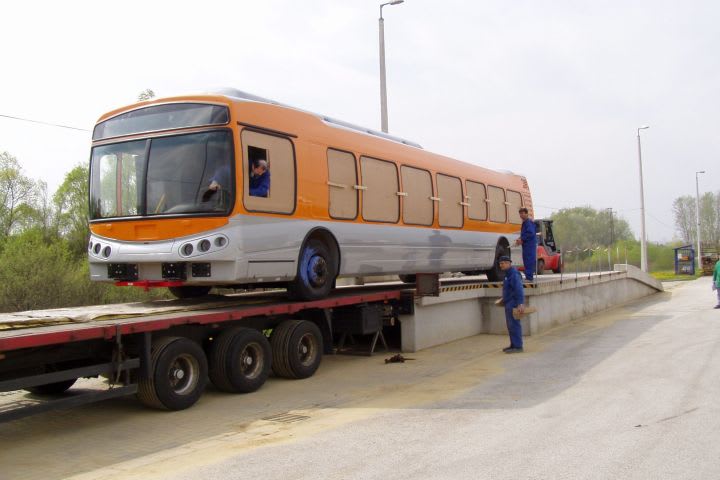
[IMAGE]MET9compo-flatbed.jpg[/IMAGE]As reported in the previous two articles in this series, which appeared more than two years ago [May/June 2005], the apparent post-mortem of the CompoBus had this ambitious bus development project dying because it was just too expensive to produce, while its revised price could not be justified in the marketplace. This past spring, however, the Los Angeles County Metropolitan Transportation Authority (L.A. Metro) firmly disagreed when it announced it may purchase up to 1,000 45-foot CompoBuses over the next five years.
“The cost issues have not gone away, and we are addressing them,” says Bill Coryell, vice president of western region sales for NABI. “We have received a great deal of interest from other transit agencies.”
Back from the
graveyard
The CompoBus had become a name synonymous with new hope for achieving
passenger appeal and more cost-effective operations, a vindication of an
expensive federal research program. However, it was also considered the latest
symbol of what ails the transit vehicle manufacturing industry, raising serious
questions about whether procurement policies and manufacturing practices are
stifling the very innovation that agencies and the Federal Transit
Administration (FTA) say the industry needs.
After the $60 million FTA-funded Advanced Technology Transit Bus Project (ATTB) was concluded, NABI was the only manufacturer to step forward with an advanced composite structure, which was considered key to the major ATTB project objective of significantly lowering bus weight, which had climbed in some cases well past 30,000 pounds with lifts or ramps for wheelchair passengers, alternative fuel systems, such as compressed natural gas, and the growing variety of advanced electronic components being specified by transit agencies.
Company officials initially believed that despite the federal program’s assertions of even more, composite technology could take as many as 7,000 pounds out of the curb weight of a transit bus. NABI licensed the same technology used for the ATTB, called Seaman Composite Resin Infused Molding Process (SCRIMP), a patented technology developed by TPI Composites of Warren, R.I., which has since been acquired by Martin Marietta Composites. NABI will continue to use the SCRIMP technology in its restart of the CompoBus.
Only one platform will be available, with two models featuring different lengths. The Model 45C-LFW is the one just ordered by Los Angeles, which accommodates 20 percent more passengers than a traditional 40-footer. The extra capacity is also well-suited for bus rapid transit, which typically involves higher-capacity vehicles with rail-like styling to overcome the stigma of traditional bus service.
Meanwhile, in early 2002, the company applied to the FTA for
a waiver of Buy America regulations for content and final assembly for 10 years
in order to develop the technology. The company argued that such a waiver would
achieve public interest goals, namely increased ridership and other goals of
the ATTB program, as well as supporting foreign trade policy goals in Eastern Europe. The FTA approved the waiver in March of
that year, but for only two years, subject to renewal and review. In July 2001,
even before the FTA waivers were under consideration, NABI broke ground on a
new $10 million manufacturing facility in Kaposvar,
Hungary, southwest of
Budapest; purpose-built
for composite bus fabrication and final assembly.
These developments, combined with similar waivers granted to foreign suppliers entering other segments of the U.S. transit market, set off a firestorm of protest in the industry. Rep. Carolyn Cheeks Kirkpatrick (D-Mich.) took up the coalition’s cause and introduced legislation to subject waivers to more formal notice-and-comment rulemaking required of revised or new regulations.
Meanwhile, unforeseen manufacturing problems compounded by the slide of the U.S. dollar in Europe began to adversely impact costs of CompoBus production. While other NABI buses only begin production in Hungary, with more than 60 percent of the component value sourced in the U.S. for compliance with Buy America regulations, the original manufacturing of the CompoBus had virtually everything installed in Kaposvar, including all components from American suppliers except seats and the powertrain. Moreover, the inherent time fabrication of advanced composites added nearly 50 percent to the production time of these buses.
To reflect true costs, NABI management was forced to raise CompoBus prices by as much as 30 percent over what it originally quoted. The decision severely undermined the economic rationale for the 40-foot “shoebox” CompoBus design, because its business case was purely based on weight-related fuel and other operational savings. For the 45-footer, the only documented productivity gain was its 20 percent additional capacity, which could not justify a 30 percent premium purely based on costs per passenger. NABI began to reconsider alternative strategies, including discontinuance of the product line.
Meanwhile, in December 2005, the FTA denied NABI’s extension of its waivers, which expired in March 2004. Based on its inability to commercialize the technology at a price that the industry was willing to pay and in a manner compliant with federal law, NABI announced that it would cease production in Kaposvar after it completed existing contracts.
[PAGEBREAK] Why L.A. persisted
Los Angeles Metro, however, was not pleased with the
decision. Under a court-approved service plan, the agency committed to expand
bus service in the county. To do so it planned to expand its fleet’s seating
capacity by 2010, but with more cost-effective higher-capacity vehicles that
would replace retirement-eligible 40-foot buses during the next two years. The
agency had already had some success on its higher capacity lines with the
45-foot CompoBuses, finding that the 20 percent additional seating capacity
boosted these lines’ productivity.
“Metro is very progressive. They were operating 100 of the 45-foot CompoBuses, and found they offered such positive operational benefits that they encouraged us many times to restart the manufacture of them,” Coryell says. The agency began a dialogue with the company about how it could restart federally compliant production, or even use local funds to purchase the vehicles directly from Hungary. It also looked at the rest of the bus manufacturing industry for similar vehicles. (Indeed, this year’s new procurement will be made with non-federal transit funding.)
Beginning with an advertised solicitation for “up to 260 high-capacity low-floor composite structure CNG and gasoline-hybrid transit vehicles” to convince the market it was serious, Los Angeles Metro awarded a $174.4 million order for 260 CompoBuses, with options of up to 740 more. The base order will be CNG-powered; the agency intended to purchase at least some of them with gasoline-hybrid propulsion, but deemed the technology too expensive and currently immature.
Metro staff’s procurement report submitted to its board succinctly summarized its decision: “The vehicle offers high capacity (minimum of 46 seats) in a vehicle constructed of high strength resin laminate composite material...[yet weighs] slightly less than the weight of a 40-foot steel-framed transit vehicle.” With the 45-footers, the procurement’s 260 will have the effect of 312 with marginally more capital cost on a per-seat basis and 20 percent additional operating costs per seat. NABI will deliver the vehicles by June 30, 2010.
In addition to its operational benefits, Metro spokesman Marc Littman notes that the CompoBus’ visual styling and passenger amenities played a role in the decision to make the CompoBus the workhorse of their fleet. “We really like the futuristic look this bus has. We think it makes a statement about the quality passengers can expect from Metro.”
“Los Angeles is the home to maybe the strongest car culture in the country. In order for bus transit to begin to be successful here, we have to be able to offer the styling and comfort of a car in a bus,” adds Roger Snoble, L.A. Metro’s CEO. “The CompoBus reshapes the clunky old image of the bus into that of a modern, fast and comfortable conveyance.”
Coryell also noted that the agency has found an additional compelling business case for composite buses. “In addition to the increased seating capacity, the lightweight composite material is extremely crash-resistant.”
“These buses are incredibly rugged. I’ve seen cars bang into them, and bounce off,” Littman adds. So, the added safety for our operators and passengers is very important to us.”
Anecdotal observations from various incidents have shown that downtime in the shop is substantially less than with steel buses, according to Metro reports.
Coryell stresses that the new vehicles will be an improved version he calls “Generation II.” These improvements include:
• Next-generation multiplex system;
• LED Interior lighting;
• Quick-change window glazing (with optional guards);
• Stiffening of interior components;
• Hot-dip galvanized CNG engine cradle mounts;
• Redesigned BRT driver’s barrier with integrated radio box;
• Recessed license plates in the front and rear;
• Improved interior front wall;
• Hinged front access panel;
• Improved front wheel-housing covers;
• Compartment for dedicated start-up batteries;
• Stronger passenger doors and attachments.
Another set of design changes will be made in part to fulfill L.A.’s procurement goals of having new buses no noisier than the advanced-design articulated buses it has purchased in recent years. While these will not meet that objective, they will be substantially quieter than the current fleet of 40-foot buses.
Sound dampening design changes for these buses will include closed-cell foam injection into the closed sections, such as the “hat” sections of the roof, areas above the rear wheel arches of the body structure, the front wheel wells, and sections between the floor panels and composite shell. Noise-absorbing mattes, covers and materials on the walls of the engine compartment and engine door will also be installed. Sprayed noise attenuation material on several locations and new acoustic isolation power-train mounts comprise the final decibel-reducing touches.
Policy questions
still linger
The death and subsequent resurrection of the CompoBus
continue to raise several important marketplace and policy questions for U.S. public transportation. Does this significant new order in L.A. finally vindicate the $100 million
public and private investment in lighter-weight buses with advanced materials,
as well as justify their 25-percent-higher price tags over standard-length
steel-structure buses based on a new business case? If so, was the federal
money spent even necessary?
NABI continues to call the CompoBus the “commercial heir to the ATTB,” and officials in both the public and private sectors insist that the money will eventually be proven to be a good investment. In addition, another manufacturer, Denver-based Proterra, submitted a proposal to L.A. Metro, but has yet to deliver any buses for revenue service. These developments have only come, however, after nearly two decades of development, delay and unforeseen costs.
The real question is whether its commercial path could have been smoother, and especially at the pre-commercial stages, the feds could be a stronger player. The defense industry is held up as a model of this sort of partnership, yet its track record, cratered with billions of dollars in waste, fraud and abuse uncovered over the years, is not exactly perfect, either. Nor is the European or Japanese approach entirely useful, as their economies have been plagued with production overcapacities in the wave of opening markets to global competition after national industrial policies encouraged and protected the champions in their home markets, leaving these weaknesses exposed. Moreover, their builders’ have much more vertically integrated supply chains, which are not tolerated by U.S. transit agencies that have enjoyed the freedom to tailor specifications to their own preferences during the past half-century.
The real lesson of CompoBus and other U.S.-led transit innovations has yet to be told. The jury is very much still out on whether the industry can assume the commercial risks demanded — at least encouraged — by their public-sector customers with a supply chain largely derived from American companies and workers in a small market relative to the rest of the world’s. Nearly all bus and railcar manufacturers continue to struggle, posting a loss, undergoing restructuring, sale or a combination of these.
With the adjustments NABI has made, the CompoBus and other advanced vehicles can lead to more productive, attractive service that is competitive with auto commutes. Hopefully, neither the industry nor the federal government will lose sight of this paramount objective.
Cliff Henke, a contributing editor to METRO, is senior analyst at PB. His views herein are solely his own.
More Management

NITA Names New Leadership, Expands Reduced-Fare Program at First Board Meeting
The new regional transit authority appointed its first board chair and interim executive director while extending reduced fares across CTA, Metra, and Pace for eligible riders.
Read More →
Beyond the Checklist: A Structured Approach to Transit Maintenance
Reliability-Centered Maintenance helps transit agencies move beyond routine checklists to focus limited resources on the assets and failures that have the greatest impact on safety, reliability, and service.
Read More →
APTA 2026 Nominating Committee Selects Leadership Slate, Names Chair and Vice Chair Nominees
Leadership changes will help shape the association’s priorities and its representation of the transportation industry during the 2026–2027 term.
Read More →

DART Launches Major Security, Fare Enforcement Initiative
The 90-day demonstration will deploy coordinated security teams at five light rail stations while testing controlled access and gathering data to guide future investments.
Read More →
Advancing Fare Collection Through Technology and Innovation
Learn about delivering 1300 gates at 91 stations while managing fare evasion. Explore the large scale deployment, solution customization and real-world results that affect the region. Prepare for deployment in your region now.
Read More →
Game Day in Motion: Moving Millions During the 2026 World Cup
Between packed transit stations and team motorcoaches, see how agencies and operators across North America tackled the transportation demands of the 2026 FIFA World Cup.
Read More →
Surface Transportation Extension Averts Shutdown, Leaves Transit Funding Gap
The stopgap keeps federal transportation programs moving, but missing advance funding could complicate the transit and rail projects agencies are planning next.
Read More →
Bus Tech Talk: Keeping Transit Technicians Ahead of the Technology Curve
LA Metro’s Obed Mejia discusses technician training, evolving maintenance technology, fleet replacement, and strategies for getting the most out of today’s transit fleets.
Read More →
Why Simulating Pedestrian Movement Has Become Essential for Modern Rail Stations
Pedestrian microsimulation is helping rail planners identify bottlenecks, test station designs, and prepare complex transit hubs for growing passenger volumes.
Read More →
People Movement: Holly Arnold Joins Transdev and More
In this edition, we also cover recent appointments and announcements at Pace, CamTran, MCI, and more, showcasing the individuals helping to shape the future of transportation.
Read More →