



Monterey Salinas Transit harvest mustard seeds for bio conversion
After planting, mustard seed requires little to no irrigation or tending, in contrast to other higher-maintenance biofuel crops such as corn.
California-based Monterey-Salinas Transit (MST) is working to convert its fleet to biodiesel fuel derived from refined mustard seeds grown from its own crop. “To our knowledge, MST will be the first public transit agency in the country — and perhaps the world — to sustainably produce biodiesel for fleet operations,” said MST’s General Manager/CEO Carl Sedoryk.
The agency, which harvested 10 acres of its first crop in mid-August, plans to introduce the mustard seed-based biofuel into its fleet in October, said Hunter Harvath, asst. GM, finance and administration.
Once the fuel is processed, “we think we’ll have enough to fuel one vehicle for a year, but we’re not going to segregate it into one,” he said. The fleet consists of 78 Gillig buses, six Optima trolleys and 15 gasoline-powered minibuses.
While MST awaits the oil processing phase, the fleet began operating on biodiesel fuel derived from waste oil. To prepare for the conversion to biofuel, the agency cleaned its fuel storage tanks and installed new filters on its hoses and dispensers, said Mike Hernandez, MST’s asst. GM, chief operating officer. “Our ultimate goal is being able to realize 150,000 gallons of renewable fuel versus non-renewable fuel.”
MST entered the testing phase of the biodiesel project in early February, by planting two varieties of mustard seed, Pacific Gold and Wild California, along with barley as a control, on 30 acres of land owned by San Bernabe Vineyards in south Monterey County. This test will determine which variety of mustard will produce the highest crop yield, and thus produce the most fuel.
After planting, the crop requires little to no irrigation or tending, in contrast to other higher-maintenance biofuel crops such as corn. And, because mustard seed is planted as a “cover crop” during the off-season, it would not displace other commodity crops (i.e., corn, soybeans, etc.) nor drive up prices for food — recently cited as a potentially adverse impact of the biofuel industry.
Once harvested, the mustard seeds are pressed into raw oil, which is then refined into biofuel. The resulting blend will combine 20 percent bio and 80 percent diesel, Harvath said.
MST has partnered with Energy Alternatives Solutions Inc., (BioEASI) to convert the crop into biodiesel in an effort to reduce overall energy consumption in the transportation and production of the crop. “We want [the mustard] grown in Monterey County, we want it processed in Monterey County and we want it used in Monterey County,” said Harvath of the sustainable aspect of the project.
Furthermore, mustard seed is a fully sustainable product in that the “spicy” mustard meal created as a byproduct after the oil is extracted can then be used as a biopesticide and fertilizer for crops, including the many local organic farming operations in the county.
“These biopesticide and fertilizer properties, along with the fact that it can be grown in rotation as a cover or fallow crop in the winter, has the potential to make this process economically viable for farmers throughout many parts of the state and the U.S.,” said Farm Fuel Inc. representative Robert Van Buskirk, who has been leading the technical research and development of the mustard seed biofuel process.
The mustard seed biofuel initiative is a project of Competitive Clusters: C2 – a public/private partnership for economic development in Monterey County, sponsored by the Monterey County Office of Economic Development and the Monterey County Business Council. Through this project, MST hopes to further reduce vehicle and coach emissions with the goal of operating buses using biodiesel in 2008.
More Management

Joshua Schank on Transportation Innovation, Risk, and the Future of Mobility
In this edition of METROspectives, Joshua Schank discusses lessons from launching LA Metro’s Office of Extraordinary Innovation, the challenges of advancing new mobility technologies, and much more.
Read More →
Reinventing Fleet Maintenance with Real-time Visibility and AI
Transit leaders need to know what needs fixing, where to look, who is responsible, when work is completed, and what it costs without having to chase information across disconnected systems.
Read More →
Alstom Acquires Delaware Site to Support Amtrak NextGen Acela Fleet
The company is investing more than $55 million to acquire and improve the property and will employ approximately 100 people at this site once it is operational.
Read More →
SamTrans Sets Priorities for Potential Connect Bay Area Revenue
The board-approved framework allocates future funding to maintaining service, rider improvements, equity initiatives, and infrastructure repairs.
Read More →
Federal Transit Officials Launch MARTA Safety Probe
FTA has given MARTA 15 days to provide records on crime prevention, fare evasion enforcement, and security funding as part of a broader safety investigation.
Read More →
ABA's Ferguson Testifies in Support of BUS Act, National Standards for Bus Operators
The BUSES Act would create a nationwide framework preventing state and local governments from enforcing bus idling restrictions of less than 15 minutes, a threshold consistent with existing Environmental Protection Agency guidance.
Read More →
When Routine Fails: How Public Transit Must Adapt for the World Cup
The 2026 FIFA World Cup will test transit agencies’ ability to manage unpredictable travel patterns, making real-time data and operational flexibility critical to moving millions of visitors efficiently.
Read More →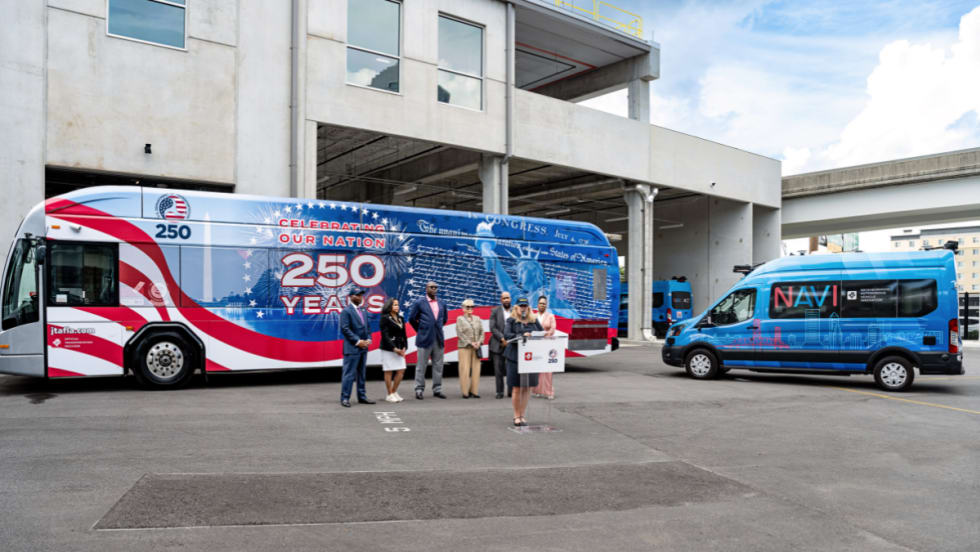
Florida’s JTA Puts Innovation in Motion Ahead of America250
The agency unveiled a commemorative America250 bus during a visit from U.S. DOT's Seval Oz and showcased its autonomous mobility programs.
Read More →
California Selects Team for Nation’s First True High-Speed Rail Track and Systems Contract
The board action follows completion of track installation at the 150-acre southern railhead in Kern County, which will serve as the staging and distribution hub for high-speed track and systems installation.
Read More →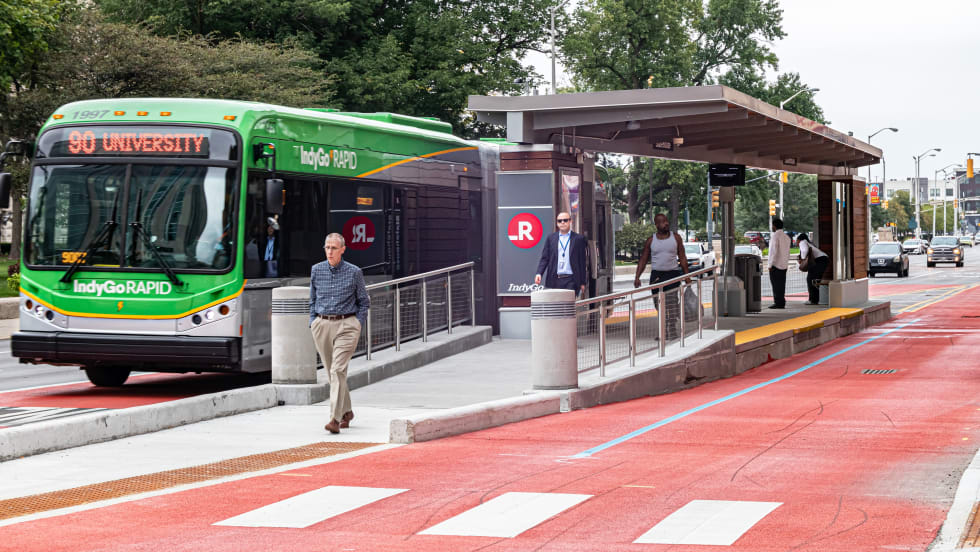
IndyGo, Cleveland RTA Expand Digital Fare Payment Options with Masabi
The new systems combine mobile apps, smart cards, and automatic fare capping to simplify payments, expand flexibility, and help riders access the lowest available fares.
Read More →