



TriMet to increase security measures
The agency will expand its staff to include more police officers and field supervisors, and will add more security cameras.

Portland, Ore.-based TriMet, with the support of the Transportation Security Administration (TSA).has announced further expansion of the agency's security measures, including hiring more police officers, increasing fare inspection and adding more cameras to MAX stations.
The agency will hire 15 police officers, bringing the total number of budgeted officers from 43 to 58, doubling the number of actual officers who were working for the Transit Police Division (TPD) a year ago. TriMet pays for all costs related to police officers.
TriMet will also hire additional field supervisors and combine them with fare inspectors, doubling the number of staff from 15 to 30, who will check fares and issue warnings, tickets and exclusions for those found without a valid fare.
Mike Irwin, Oregon Federal Security Director for the TSA, announced a $1 million grant for TriMet to add more security cameras to MAX platforms, as well as tools to work with first responders to better respond to a transit-related attack or emergency. When these cameras are installed, every Gresham station will have CCTV. Currently, 41 of the 64 MAX stations have CCTV cameras, many funded with TSA grants.
More Management
OCTA Approves $2 Billion Budget for FY 2026-27, Prioritizing Transit Investments
More than half of the agency’s upcoming spending plan is dedicated to transit as OCTA balances infrastructure investment with fiscal stability.
Read More →
Joshua Schank on Transportation Innovation, Risk, and the Future of Mobility
In this edition of METROspectives, Joshua Schank discusses lessons from launching LA Metro’s Office of Extraordinary Innovation, the challenges of advancing new mobility technologies, and much more.
Read More →
Reinventing Fleet Maintenance with Real-time Visibility and AI
Transit leaders need to know what needs fixing, where to look, who is responsible, when work is completed, and what it costs without having to chase information across disconnected systems.
Read More →
Alstom Acquires Delaware Site to Support Amtrak NextGen Acela Fleet
The company is investing more than $55 million to acquire and improve the property and will employ approximately 100 people at this site once it is operational.
Read More →
SamTrans Sets Priorities for Potential Connect Bay Area Revenue
The board-approved framework allocates future funding to maintaining service, rider improvements, equity initiatives, and infrastructure repairs.
Read More →
Federal Transit Officials Launch MARTA Safety Probe
FTA has given MARTA 15 days to provide records on crime prevention, fare evasion enforcement, and security funding as part of a broader safety investigation.
Read More →
ABA's Ferguson Testifies in Support of BUS Act, National Standards for Bus Operators
The BUSES Act would create a nationwide framework preventing state and local governments from enforcing bus idling restrictions of less than 15 minutes, a threshold consistent with existing Environmental Protection Agency guidance.
Read More →
When Routine Fails: How Public Transit Must Adapt for the World Cup
The 2026 FIFA World Cup will test transit agencies’ ability to manage unpredictable travel patterns, making real-time data and operational flexibility critical to moving millions of visitors efficiently.
Read More →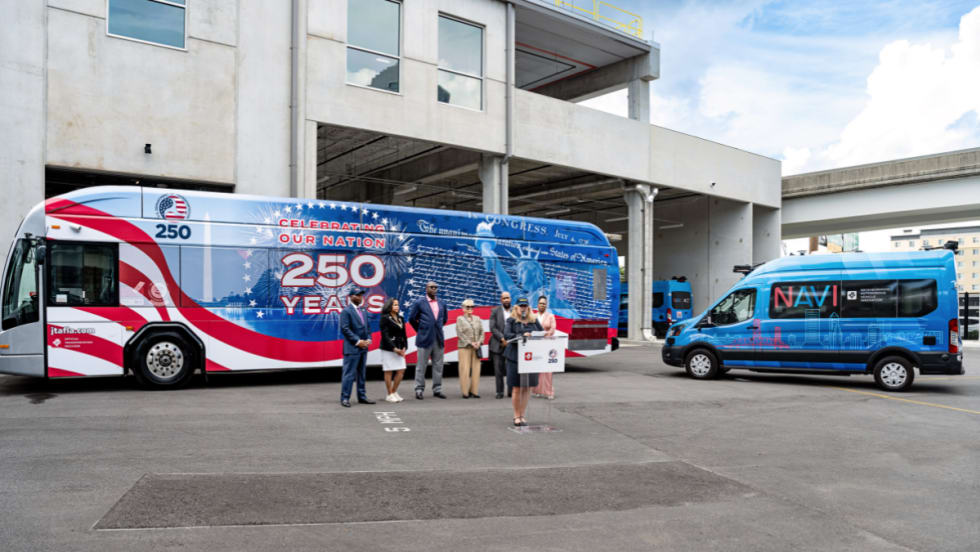
Florida’s JTA Puts Innovation in Motion Ahead of America250
The agency unveiled a commemorative America250 bus during a visit from U.S. DOT's Seval Oz and showcased its autonomous mobility programs.
Read More →
California Selects Team for Nation’s First True High-Speed Rail Track and Systems Contract
The board action follows completion of track installation at the 150-acre southern railhead in Kern County, which will serve as the staging and distribution hub for high-speed track and systems installation.
Read More →