



N.J. Transit begins quiet car testing on Northeast corridor
Quiet Commute cars will be offered weekdays on the first and last cars of Northeast Corridor express trains in the “3900-series” – which operate to and from the outer-zone stations of Trenton, Hamilton and Princeton Junction.

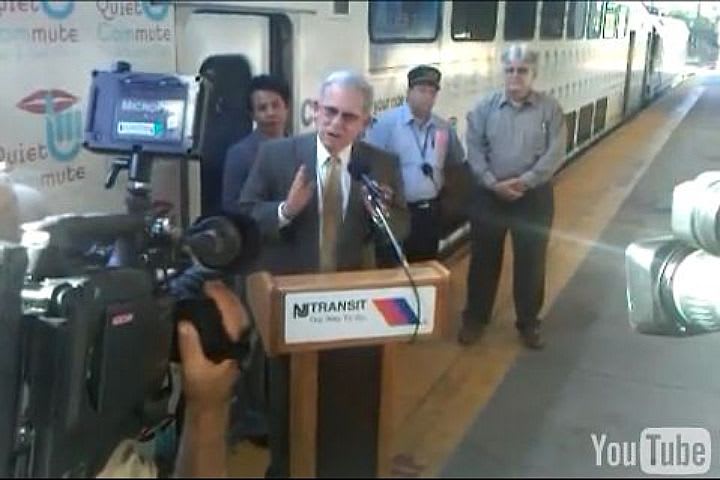
NJ TRANSIT Executive Director James Weinstein and Board Member Flora Castillo spoke at press conference before boarding a Quiet Commuter car that departed from the Trenton Transit Center at 9:14 a.m.
[IMAGE]NJ-Transit-Quiet-Car-commute-full-2.jpg[/IMAGE]Starting Tuesday, New Jersey Transit (NJ Transit) introduced the agency’s first “Quiet Commute” amenity this morning with a rail trip from Trenton Transit Center. The 90-day pilot program on select express trains between Trenton and New York Penn Station will test the feasibility of offering Quiet Commute cars on the transit system's trains.
Customers on the designated Quiet Commute cars — the first and last cars of the train — displaying the Quiet Commute logo, departed Trenton Transit Center at 9:14 a.m. with NJ Transit Executive Director James Weinstein and other officials on board.
“Our customers have asked us to offer a Quiet Commute option in an effort to balance the needs of people who want to stay connected while aboard our trains with those who want to relax or work in a quiet atmosphere,” said Weinstein. “We are offering this amenity as a pilot program and will rely on customer feedback to determine whether to make Quiet Commute a permanent NJ Transit amenity.”
Quiet Commute cars will be offered weekdays on the first and last cars of Northeast Corridor express trains in the “3900-series” – which operate to and from the outer-zone stations of Trenton, Hamilton and Princeton Junction. The 3900-series was selected because the trains’ relatively long trip times and regularly high ridership provide an ideal testing environment.
Quiet Commute cars are intended to provide a subdued environment for customers who wish to refrain from using cell phones and are willing to disable the sound feature on pagers, games, computers and other electronic devices. Conversations should be conducted in subdued voices, and headphones should be used at a volume that cannot be heard by other passengers, according to an agency statement.
Conductors will inform customers of Quiet Commute expectations by using specially designed business cards that explain the program in English and Spanish. The cards, first used by the Southeastern Pennsylvania Transportation Authority (SEPTA) in their own Quiet Car program, are intended to gently remind customers of their location without disturbing others on the car.
The transit system will be collecting feedback from customers over the pilot period via njtransit.com and through electronic surveys, as well as onboard from customers and train crewmembers.
NJ Transit is now the largest transit agency in the nation to offer a Quiet Commute option. Other transit agencies that currently offer “Quiet Cars” include SEPTA, Virginia Railway Express, Maryland Area Regional Commuter, Altamont Commuter Express (Calif.) and the Capital Corridor (Calif.).
The idea of offering a Quiet Commute program has consistently ranked high among NJ Transit customer suggestions.
The Quiet Car concept was born in late 1999 when a small group of regular Amtrak commuters asked their conductor if one car of their early morning Philadelphia-Washington train could be designated as “cell phone-free.” The conductor agreed and Amtrak quickly expanded the concept. Within months, most weekday Amtrak trains on the Northeast Corridor featured Quiet Cars.
More Rail

New York MTA Advances Final Contract for Second Avenue Subway Expansion
Contract Four is the largest in the Second Avenue Subway Phase 2 project and includes construction of station infrastructure, tracks, and signals for the subway expansion, MTA officials said. Work on Contract Four will begin in 2027.
Read More →
San Diego MTS Breaks Monthly Trolley Ridership Record
Agency officials said July’s ridership indicates MTS’s continued recovery from the pandemic.
Read More →
Report Examines NJ TRANSIT Reliability, Funding Challenges
The Garden State Initiative analysis examines the roles of Amtrak infrastructure, fleet management, and agency operations while recommending a more performance-based approach to improving reliability.
Read More →
Stadler, CapMetro Sign Long-Term Rail Fleet Support Agreement
Beginning in 2027, Stadler will provide on-site technical expertise, spare parts support, training, and obsolescence management to help extend the reliability and longevity of CapMetro’s GTW fleet.
Read More →
Biz Briefs: Alstom Lands Canadian Contract, LYT to Supply California TSP, and More
In METRO's latest installment, we take a look at recent news from Complete Coach Works, Beep, FlixBus, and more partnerships making headlines across the transportation sector.
Read More →
CATS Gold Line Marks 5 Years of Service, 2.8M Passenger Trips
With a six-mile expansion planned, the Charlotte streetcar is positioned to connect more neighborhoods and major transit hubs across the region.
Read More →
Why Simulating Pedestrian Movement Has Become Essential for Modern Rail Stations
Pedestrian microsimulation is helping rail planners identify bottlenecks, test station designs, and prepare complex transit hubs for growing passenger volumes.
Read More →
Amtrak Begins Major Construction at New York’s Sunnyside Yard
The new maintenance facility will support Amtrak’s Airo trainsets while improving maintenance efficiency and turnaround times in New York.
Read More →
Chicago Leaders Unveil Plans for O’Hare Airport Express Train
The privately developed project would offer a 15-minute trip between downtown and O’Hare’s Terminal 2, with trains operating every 15 minutes on a dedicated track. The service would use battery-electric trains and three existing freight rail rights-of-way.
Read More →
OCTA Maps Out 30-Year Strategy to Protect Coastal Rail Corridor
The draft feasibility report identifies strategies to protect the coastal rail line for decades as the agency continues near-term stabilization and sand placement efforts.
Read More →