



Report: Global expansion of high-speed rail surging
By 2014, high-speed trains will be operating in nearly 24 countries, including China, France, Italy, Japan, Spain, and the United States, up from only 14 countries today.

As interest in high-speed rail (HSR) surges around the world, the number of countries running these trains is expected to nearly double over the next few years, according to new research by the Worldwatch Institute for Vital Signs Online.
By 2014, high-speed trains will be operating in nearly 24 countries, including China, France, Italy, Japan, Spain and the U.S., up from only 14 countries today. The increase in HSR is due largely to its reliability and ability to cover vast geographic distances in a short time, to investments aimed at connecting once-isolated regions and to the diminishing appeal of air travel, which is becoming more cumbersome because of security concerns.
"The rise in HSR has been very rapid," said Worldwatch Senior Researcher Michael Renner, who conducted the research. "In just three years, between January 2008 and January 2011, the operational fleet grew from 1,737 high-speed trainsets worldwide to 2,517. Two-thirds of this fleet is found in just five countries: France, China, Japan, Germany and Spain. By 2014, the global fleet is expected to total more than 3,700 units."
Although there is no universal speed definition for HSR, the threshold is typically set at 250 kilometers (155 miles) per hour on new tracks and 200 kilometers (124 miles) per hour on existing, upgraded tracks. The length of HSR tracks worldwide is undergoing explosive growth in order to meet increasing demand. Between 2009 and 2011, the total length of operational track has grown from some 10,700 kilometers (6,648 miles) to nearly 17,000 kilometers (10,563 miles). Another 8,000 kilometers (4,970 miles) is currently under construction, and some 17,700 kilometers (11,000 miles) more is planned, for a combined total of close to 43,000 kilometers (26,718 miles). That is equivalent to about 4% of all rail lines — passenger and freight — in the world today.
By track length, the current high-speed leaders are China, Japan, Spain, France and Germany. Other countries are joining the high-speed league as well. Turkey has ambitious plans to reach 2,424 kilometers (1,506 miles) and surpass the length of Germany's network. Italy, Portugal and the U.S. all hope to reach track lengths of more than 1,000 kilometers (621 miles). Another 15 countries have plans for shorter networks.
But in Europe, France continues to account for about half of all European high-speed rail travel. HSR reached an astounding 62% of the country's passenger rail travel volume in 2008, up from just 23% in 1990, thanks to affordable ticket prices, an impressive network, and reliability. And in Japan, the Shinkansen trains are known for their exceedingly high degree of reliability. JR Central, the largest of the Japanese rail operating companies, reports that the average delay per high-speed train throughout a year is just half a minute. On all routes in Japan where both air and high-speed rail connections are available, rail has captured a 75% market share.
Further highlights from the research:
• A draft plan for French transportation infrastructure investments for the next two decades allocates 52 percent of a total of $236 billion to HSR.
• In 2005, the Spanish government announced an ambitious plan for some 10,000 kilometers (6,213 miles) of high-speed track by 2020, which would allow 90% of Spaniards to live within 50 kilometers (31 miles) of an HSR station.
• Currently, China is investing about $100 billion annually in railway construction. The share of the country's railway infrastructure investment allocated to HSR has risen from less than 10% in 2005 to a stunning 60% in 2010.
• Intercity rail in Japan accounts for 18 percent of total domestic passenger-kilometers by all travel modes — compared with just 5 to 8 percent in major European countries and less than 1 percent in the U.S.
• In France, rail's market share of the Paris-Marseille route rose from 22% in 2001 (before the introduction of high-speed service) to 69% in 2006. In Spain, the Madrid-Seville rail route's share rose from 33 to 84%.
More Rail

Why Simulating Pedestrian Movement Has Become Essential for Modern Rail Stations
Pedestrian microsimulation is helping rail planners identify bottlenecks, test station designs, and prepare complex transit hubs for growing passenger volumes.
Read More →
Amtrak Begins Major Construction at New York’s Sunnyside Yard
The new maintenance facility will support Amtrak’s Airo trainsets while improving maintenance efficiency and turnaround times in New York.
Read More →
Chicago Leaders Unveil Plans for O’Hare Airport Express Train
The privately developed project would offer a 15-minute trip between downtown and O’Hare’s Terminal 2, with trains operating every 15 minutes on a dedicated track. The service would use battery-electric trains and three existing freight rail rights-of-way.
Read More →
OCTA Maps Out 30-Year Strategy to Protect Coastal Rail Corridor
The draft feasibility report identifies strategies to protect the coastal rail line for decades as the agency continues near-term stabilization and sand placement efforts.
Read More →
The Business Voice Behind Public Transportation
As chair of APTA’s Business Members Board of Governors, Ray Melleady explains how more than 850 business members are partnering with transit agencies to advance funding, innovation, and industry-wide collaboration.
Read More →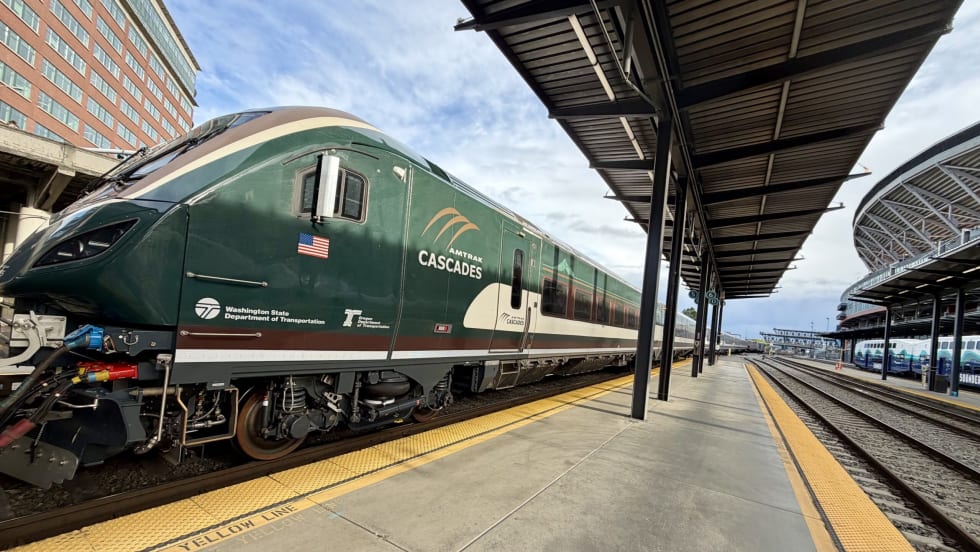
FRA Announces $5.3B in Rail Investments, Including $2B for Amtrak
Funding will support grade-crossing improvements, infrastructure upgrades, and new Amtrak equipment in 23 states.
Read More →
Finding the ‘Happy Medium’: Optimizing Maintenance Without Sacrificing Reliability
The key to maintenance optimization isn’t doing less work—it’s doing the right work at the right time on the right assets.
Read More →
OKC Streetcar Makes Zero-Fare Service Permanent
Ridership increased an average of 71% compared with the same period a year earlier during the fare-free pilot.
Read More →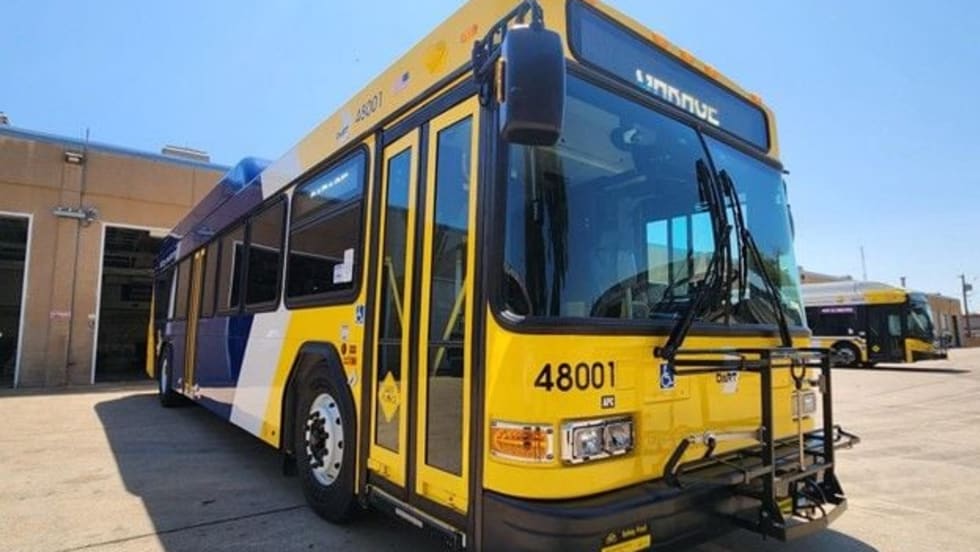
DART Customer Satisfaction Reaches Six-Year High
Overall satisfaction rose to 74.9%, while the agency’s Net Promoter Score reached a record 33.7.
Read More →
How DART's GoPass Is Redefining Regional Mobility
Serving 14 transit agencies, GoPass simplifies multimodal travel by allowing riders to plan, pay for, and manage an entire trip through one app.
Read More →