



RELATED: New Maintenance Forum, Expanded Product Showcase Bolster BusCon 2016
New Lowered-Floor Minibus Combines Style, Passenger Accessibility
The Frontrunner comes standard with smart air suspension, which helps improve aerodynamics and increase fuel efficiency.
by Alex Roman, Managing Editor
February 6, 2017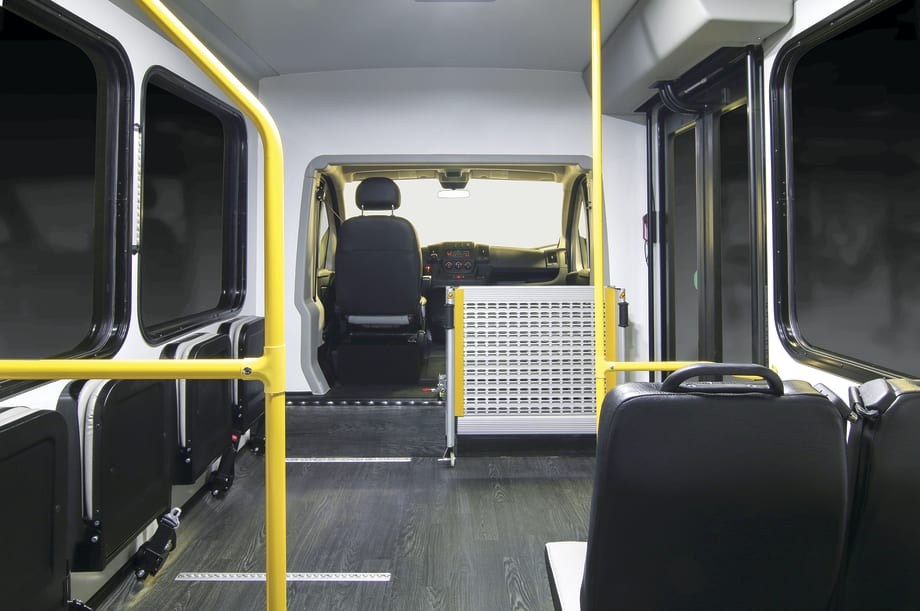
New England Wheels’ Frontrunner minibus features room for 15 passengers and up to three wheelchairs.
3 min to read
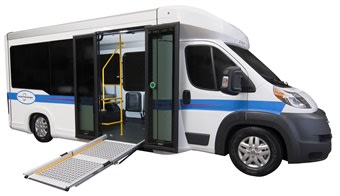
At BusCon 2016 in Indianapolis last September, New England Wheels unveiled the next-generation lowered-floor Frontrunner minibus — which features cutting-edge styling, composite engineering, and a versatile front-wheel drive transmission.
“Few have ventured into the sub-10,000 GVW chassis,” explains Paul LaRose, president/CEO for New England Wheels, who adds that the use of composite materials has enabled his company to build a vehicle that he believes is the “best-in-class.”
With room for 15 passengers and up to three wheelchairs, the Frontrunner does not require a commercial driver’s license, making it ideal for assisted-living communities and other operators servicing a large amount of the senior and ADA market.
“The first step into this bus is 9.25 inches, which is the lowest ramp angle in the industry. And, with a 60-inch-long ramp, it meets the proposed six-to-one standard, and even in the non-kneel position, it still meets the current four-to-one ADA standard,” LaRose says.
The flat floor also offers wheelchair occupants the comfort, security, and convenience unavailable in a typical theater seating design, he adds.
The Frontrunner, which is built on the Ram ProMaster chassis, features a European-inspired design that challenges the typical American bus look, offering exceptional passenger visibility, attractive appearance, low maintenance costs, and improved fuel efficiency, according to LaRose.
It is equipped with smart air suspension, a standard feature, which communicates with the vehicles’ on-board body computer to self-level, even lowering the vehicle’s nose at highway speeds for improved aerodynamics and fuel efficiency.
LaRose explains that much market research went into the development of the new Frontrunner, with the company believing the aging population in the country combined with the challenge wheelchair lifts often pose for operators make a lowered-floor vehicle more desirable.
New England Wheels’ Frontrunner minibus features room for 15 passengers and up to three wheelchairs.
“About three years ago, I spent a good month in Europe traveling to different countries and looking at the state of community transportation around the continent, and I have to say they do a much better job than we do in the U.S.,” says LaRose. “We found wheelchair lifts to be both too bulky and heavy, and felt it would be ideal for us to develop a vehicle with a true lowered floor — the ProMaster gave us a good opportunity to do that.”
With vehicles already in service since it launched in September, New England Wheels is currently building up its dealer network throughout the country and is selling the Frontrunner itself in the northeast.
“The dealers we’ve signed up are very capable and focused on retail,” LaRose says. “Private schools and universities/colleges are secondary candidates for this vehicle. And, when the vehicle does meet Buy America standards in 2017, there will be a lot of interest from transit agencies in smaller towns.”
There is also significant interest for the Frontrunner in the Canadian market, where LaRose adds the company has three dealers ready to blanket the entire country as soon the vehicle is approved by Transport Canada — a process that is already underway.
In the short term, New England Wheels is currently ramping up production to build more vehicles and leverage its operating efficiencies.
Subscribe to Our Newsletter
More Paratransit

People Movement: Dan Dipert Coaches Adds Third-Generation Leader, Keolis Names New Valley Metro VP/GM, and More
In this edition, we also cover recent appointments and announcements at the Wabtec, SilverRide, HNTB, and more, showcasing the individuals helping to shape the future of transportation.
Read More →
Biz Briefs: RIPTA Unveils New Frontrunners, Clevland RTA Adds New Siemens, and More
In METRO's latest installment, we take a look at recent news from Siemens, Prevost, Dodge, and more partnerships making headlines across the transportation sector.
Read More →
King County Metro Makes ADA Paratransit Easier to Navigate
METRO's Innovative Solutions Award winner replaces complex service-area descriptions with an accessible, interactive map that puts paratransit information directly in customers’ hands.
Read More →
Jacksonville’s NAVI Project Charts a New Course for Autonomous Public Transportation
Through its NAVI program, JTA is showing how autonomous vehicles, intelligent infrastructure, and coordinated operations can work together to deliver everyday public transportation.
Read More →
Driving Smarter Paratransit
John Hanlon shares how AlphaRoute is leveraging AI-powered technology to help paratransit providers optimize operations, support frontline staff, and enhance the rider experience.
Read More →
METRO Magazine Announces 2026 Innovative Solutions Awards Winners
Projects Recognized for Advancing Mobility Through Technology, Accessibility, Workforce Innovation, and Operational Excellence
Read More →
Biz Briefs: STV teams with Amtrak, Motorcoach Operators Boost Fleet and Land Contracts, and More
From manufacturers and suppliers to transit agencies and motorcoach operators, these updates offer a snapshot of the projects, partnerships and business moves driving the industry forward.
Read More →
Biz Briefs: Masabi Teams with St. Louis Metro and More
In METRO's latest installment, we take a look at recent news from Transdev, Hitachi, and more partnerships making headlines across the transportation sector.
Read More →
New York MTA Leverages Zoning Program to Advance Station Accessibility
Accessibility enhancements at Nevins St Station will be financed through a development agreement tied to the MTA's Zoning for Accessibility initiative.
Read More →
Reinventing Fleet Maintenance with Real-time Visibility and AI
Transit leaders need to know what needs fixing, where to look, who is responsible, when work is completed, and what it costs without having to chase information across disconnected systems.
Read More →