



<font color=red>Web Extra:</font> D.C. Metro pilot to provide travel training for 600 customers with disabilities
Participants in the program will receive on average between 32 hours and 34 hours of comprehensive travel training, Metro estimates.

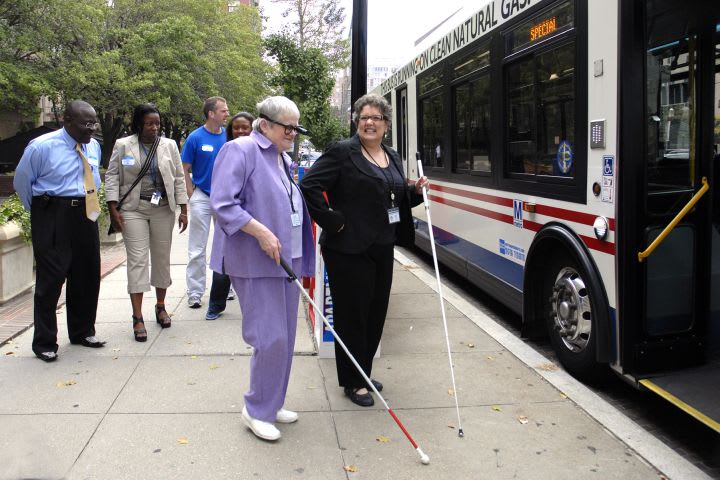
System Orientation Specialist Brigid Doherty conducts travel training with a visually-impaired Metro customer.
[IMAGE]Metro-resize.jpg[/IMAGE]In January, the Washington Metropolitan Area Transit Authority (Metro) will launch a two-year, $1.2 million project to expand its travel training offerings for people with disabilities and seniors.
Largely funded with a grant from the Federal Transit Administration's New Freedom and Job Access Reverse Commute (JARC) programs, the project will allow three regional non-profit Centers for Independent Living (CILs) in the jurisdictions Metro serves — Maryland, Washington, D.C., and Virginia — to hire six travel trainers who will work one-on-one with those who need training.
A major portion of the project will focus on helping low income people with significant disabilities learn how to travel to and from job sites and employment-related activities. Eligible participants who complete travel training will receive a free reduced fare SmarTrip card preloaded with $50 in fare to pay for rides on public transportation, according to Metro.
"Currently we offer a day-long travel training for people with disabilities and senior citizens to teach them how to use the regular accessible bus and rail system," says Rikki Epstein, Metro's ADA operations manager. "For many people, that's sufficient. But there are a lot of people for whom one day is just not going to cut it in terms of being able to use public transportation independently. We knew there was an unmet need."
During the course of the two-year project, Metro hopes to train 600 customers, with each individual receiving on average between 32 hours to 34 hours of personalized training. "The trainers will do an introductory screening interview and assessment to determine the individual's needs, interests and skill level related to traveling, and then they will set up a plan with that person to provide extensive travel training - how to plan trips and travel safely and independently on the bus and rail systems throughout our region," Epstein says.
Metro and CIL staff will conduct outreach to publicize the project and refer people with disabilities to the appropriate organization for training. Metro customers who are blind or have low vision will be referred to Metro's certified orientation and mobility specialist.
More Paratransit

Scenes from APTA TRANSform & EXPO 2026
Transit leaders, manufacturers, and industry professionals gathered in Chicago to explore new technologies, share ideas, and discuss the future of public transportation.
Read More →
Indian River Transit’s Community-Focused Approach Earns National Recognition
Named APTA’s 2026 Outstanding Public Transportation System in its size category, Florida’s Indian River County transit system continues to grow ridership through fare-free service and a focus on evolving community needs.
Read More →
Everett Transit, Community Transit Outline Consolidation Agreement
The proposed agreement calls for a 50% increase in bus service in Everett, a new microtransit zone, continued paratransit service, and the transfer of Everett Transit operations to Community Transit.
Read More →
Driving Smarter Paratransit
John Hanlon shares how AlphaRoute is leveraging AI-powered technology to help paratransit providers optimize operations, support frontline staff, and enhance the rider experience.
Read More →
People Movement: Dan Dipert Coaches Adds Third-Generation Leader, Keolis Names New Valley Metro VP/GM, and More
In this edition, we also cover recent appointments and announcements at the Wabtec, SilverRide, HNTB, and more, showcasing the individuals helping to shape the future of transportation.
Read More →
Biz Briefs: RIPTA Unveils New Frontrunners, Clevland RTA Adds New Siemens, and More
In METRO's latest installment, we take a look at recent news from Siemens, Prevost, Dodge, and more partnerships making headlines across the transportation sector.
Read More →
King County Metro Makes ADA Paratransit Easier to Navigate
METRO's Innovative Solutions Award winner replaces complex service-area descriptions with an accessible, interactive map that puts paratransit information directly in customers’ hands.
Read More →
Jacksonville’s NAVI Project Charts a New Course for Autonomous Public Transportation
Through its NAVI program, JTA is showing how autonomous vehicles, intelligent infrastructure, and coordinated operations can work together to deliver everyday public transportation.
Read More →
Driving Smarter Paratransit
John Hanlon shares how AlphaRoute is leveraging AI-powered technology to help paratransit providers optimize operations, support frontline staff, and enhance the rider experience.
Read More →
METRO Magazine Announces 2026 Innovative Solutions Awards Winners
Projects Recognized for Advancing Mobility Through Technology, Accessibility, Workforce Innovation, and Operational Excellence
Read More →