



Paratransit best practices often not implemented, fed report says
There have been great gains in best practices in the areas of eligibility, telephone hold time, on-time performance, no-show policies, and origin-to-destination service, but they are often not implemented, according to the newly released National Council on Disability report.

Photo courtesy: National Countil on Disability
Photo courtesy: National Countil on Disability
The National Council on Disability (NCD), an independent federal agency that advises the President, Congress and other federal agencies on disability policy, released its comprehensive assessment surface transportation for people with disabilities as a part of NCD's quarterly meeting in Pittsburgh. The report picks up ten years after NCD's 2005 publication of "The Current State of Transportation for People with Disabilities in the United States", which led, in part, to major improvements in accessible transportation.
The report, released Monday, May 4 titled, "Transportation Update: Where We've Gone and What We've Learned" outlines both the progress de in the last decade and details the persistent barriers that remain.
The focus of this report is surface transportation. The findings address accessibility-related progress as well as problems associated with fixed route and deviation bus and rail transit (including AMTRAK); paratransit; public right-of-way; enforcement of existing laws; and other issues for all modes of public transit. The report also addresses concerns with rural, coordinated, and privately funded transportation, and commercial driver license rules. Finally, the report makes recommendations to Congress and the Executive Branch designed to improve federal collaborative efforts and to close gaps in transportation access in ways which benefit people with disabilities and families.
"Much has happened in the last decade. More people with disabilities are riding public transit than ever before and yet, in many areas, significant barriers to ground transportation for Americans with disabilities remain pervasive," said NCD Chair, Jeff Rosen. "For Americans with Disabilities many transportation services remain stuck in neutral. For many Americans with Disabilities the prospects and possibilities for going to and from work, school and recreational activities are stuck in neutral. NCD's report addresses the broad range of surface transportation, including these, and makes recommendations policymakers should use to address these barriers promptly."
"Taxi alternatives like Uber, SideCar, Lyft, and others, could open up exciting business opportunities and provide much-needed travel options for passengers with disabilities," added Marilyn Golden, Senior Policy Analyst for the Disability Rights Education and Defense Fund (DREDF) the research contractor for the report, "but recent court cases and news reports show potential customers being routinely discriminated against because of service dogs and wheelchairs. As our nation gears up to celebrate the 25th anniversary of the Americans with Disabilities Act later this year, let us resolve to move equal transportation access forward."
Among the findings:
Taxi Alternatives: Emerging transportation models like Uber, SideCar, and Lyft have vigorously resisted regulations typically imposed on the taxicab sector, harming the taxi industry and evading requirements that serve the public interest, including deficits in service to people with disabilities. Uber openly claims it is not covered by the ADA.
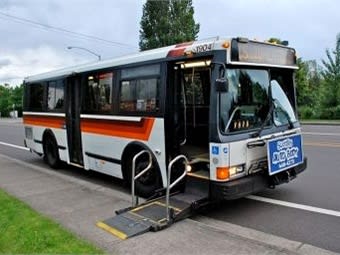
Photo courtesy: National Countil on Disability
Fixed-Route Buses: Ridership of fixed-route bus transit and rail systems by people with disabilities has grown far faster than ridership on ADA paratransit.
Paratransit: There have been great gains in best practices in the areas of eligibility, telephone hold time, on-time performance, no-show policies, and origin-to-destination service, but they are often not implemented.
Rural Transportation: Minimal or non-existent transit service in rural and remote areas still creates serious barriers to employment, accessible health care, and full participation in society.
Rail Transit: Amtrak has lagged behind in meeting ADA requirements for its stations, platforms, train cars, reservations practices, and communications access.
Best practices: Oregon, Iowa, and Maine provide examples of positive coordination of transportation programs for people with disabilities. Many cities still lack adequate wheelchair accessible taxi programs, despite progress in some locations, including Chicago, New York City, and Rhode Island.
More Paratransit

Biz Briefs: RIPTA Unveils New Frontrunners, Clevland RTA Adds New Siemens, and More
In METRO's latest installment, we take a look at recent news from Siemens, Prevost, Dodge, and more partnerships making headlines across the transportation sector.
Read More →
King County Metro Makes ADA Paratransit Easier to Navigate
METRO's Innovative Solutions Award winner replaces complex service-area descriptions with an accessible, interactive map that puts paratransit information directly in customers’ hands.
Read More →
Jacksonville’s NAVI Project Charts a New Course for Autonomous Public Transportation
Through its NAVI program, JTA is showing how autonomous vehicles, intelligent infrastructure, and coordinated operations can work together to deliver everyday public transportation.
Read More →
Driving Smarter Paratransit
John Hanlon shares how AlphaRoute is leveraging AI-powered technology to help paratransit providers optimize operations, support frontline staff, and enhance the rider experience.
Read More →
METRO Magazine Announces 2026 Innovative Solutions Awards Winners
Projects Recognized for Advancing Mobility Through Technology, Accessibility, Workforce Innovation, and Operational Excellence
Read More →
Biz Briefs: STV teams with Amtrak, Motorcoach Operators Boost Fleet and Land Contracts, and More
From manufacturers and suppliers to transit agencies and motorcoach operators, these updates offer a snapshot of the projects, partnerships and business moves driving the industry forward.
Read More →
Biz Briefs: Masabi Teams with St. Louis Metro and More
In METRO's latest installment, we take a look at recent news from Transdev, Hitachi, and more partnerships making headlines across the transportation sector.
Read More →
New York MTA Leverages Zoning Program to Advance Station Accessibility
Accessibility enhancements at Nevins St Station will be financed through a development agreement tied to the MTA's Zoning for Accessibility initiative.
Read More →
Reinventing Fleet Maintenance with Real-time Visibility and AI
Transit leaders need to know what needs fixing, where to look, who is responsible, when work is completed, and what it costs without having to chase information across disconnected systems.
Read More →
SamTrans Sets Priorities for Potential Connect Bay Area Revenue
The board-approved framework allocates future funding to maintaining service, rider improvements, equity initiatives, and infrastructure repairs.
Read More →