



FMCSA Pushes for Greater Carrier Safety, Compliance
The federal agency's CSA2010 program, includes a series of evaluation measurements covering the areas of unsafe driving, drugs and alcohol and driver fitness.
Trimming the number of traffic accidents involving trucks and buses is the challenge faced by the Federal Motor Carrier Safety Administration (FMCSA). While the emphasis over the past decade or more has been on trucking safety, high profile bus crashes, spread across the country over the past year or two, have raised the enforcement profile of the passenger transportation industry.
The results of recent driver and vehicle inspections have not been encouraging either, with an August 2008 “strike force” placing almost 1,200 buses and 225 drivers out of service for serious violations of federal safety regulations.
But such labor intensive FMCSA activities, such as strike forces and multiple-day compliance reviews, have limitations. The agency, with a staff numbering a few hundred, is responsible for the oversight of the activities and operations of more than 600,000 motor carrier companies.
When state enforcement officials, funded through grants from the Motor Carrier Safety Assistance Program are added to the total, the numbers are still too small and the resources spread too thin to have the kind of impact and results the public and Congress demand. In short: too many places to be and too few people to be there.
Measurement basics
To increase the efficiency and effectiveness of the compliance/enforcement of motor carrier safety regulations, the FMCSA developed the Comprehensive Safety Analysis program (CSA2010), set for implementation in 2010. The program, which has been in planning for five years, seeks to use data and a broad array of agency-to-motor carrier contact tools to tilt the scale toward greater safety and compliance.
The program begins with a new series of evaluation measurements, called BASICs. The BASIC evaluation areas include unsafe driving, fatigued driving, driver fitness, drugs/alcohol, vehicle maintenance, cargo securement and crash experience.
As data is received by the FMCSA, it would be scored, weighted and added to a carrier’s record. As data elements increase in number and severity, the measurement system would trigger intervention activity.
Planned intervention strategies include warning letters to the carrier demanding a response to safety concerns; development of cooperative safety plans by the FMCSA and the carrier to remedy the perceived problems; and as necessary, on-site evaluations specific to the deficiencies noted in the data on file. Problems such as a series of roadside driver citations or other driver concerns, might lead to a visit and evaluation limited to the carrier’s hiring and qualification processes. The plan for CSA2010 is to limit full-scale agency compliance reviews to worst case situations.
Test implementation began early in 2008, with planned 30-month field testing of the new procedures conducted in Georgia, Missouri, Colorado and New Jersey. Randomly selected carrier groups were established in each state, half subject to the CSA2010 process and half to current established enforcement strategies.
In an FMCSA “listening session” conducted in October, the enrolled states reported satisfactory or better results from the new intervention approach. In a report published in the Commercial Vehicle Safety Alliance’s Guardian newsletter, Maj. Scott Hernandez, of the Colorado State Patrol Motor Carrier Safety Branch, reported positive results from CSA2010 procedures, stating that carriers appreciated the targeted intervention process and the data driven approach. Hernandez calls the program “a model of how government entities should work with carriers to improve safety.”
[PAGEBREAK] Dearth of data
There is no question that CSA2010 will allow the FMCSA and its state enforcement partners to “touch” more carriers, but as a data-driven process the program’s effectiveness with the passenger transportation industry may not achieve its desired result. There are millions of data entries in the DOT database, with thousands more added almost every day. But the vast majority of that data is based on truck enforcement activity. When compared to the massive amounts of data that would drive trucking safety enforcement, bus enforcement information is almost invisible.
In the safety community, private or public data can and should drive actions. Data can be evaluated to assure appropriateness of activity. More critically, safety action should be cost effective, allowing limited resources to be applied to problems that will have the most impact. That said, the safety community has also traditionally recognized that certain situations and conditions make a data-driven approach secondary to more direct intervention: applications such as high energy sources, catastrophic potentials or unacceptably high risks. It may be that passenger transportation is one of those cases where the potential losses are so unacceptable that, when combined with the dearth of data, make CSA2010 an approach whose time has not yet arrived.
In comments filed in response to requests for feedback, Trailways Transportation said, “…the passenger transportation industry needs the FMCSA to succeed in assuring maximum safety of the passenger carrier industry. We are not convinced that CSA2010 is the right approach for passenger carriers, given what we know and presume about data limitations.”
Ultimately, decisions about implementing the program and the inclusion of passenger transportation providers under its auspices will be made over the coming months by the FMCSA and, perhaps, by other powers, including Congress.
Debate program effectiveness
In the coming months, the FMCSA is going to see changes to its leadership, programs and relationship with the holders of the agency’s purse strings — Congress. In an election year, especially in the aftermath of a presidential election, there are two realities one can rely upon: first, a temporary holding action in programs and activities will occur as civil servants await new agency leadership; and second, once new leadership is in place, a re-evaluation of virtually all agency programs, policies and strategies.
This year promises all of the above and more, as changes at the top of the government are accompanied by “reauthorization,” the Congressional debate and consideration over what has typically been multi-year funding for all transportation programs. Reauthorization of transportation funding, which typically includes transit, highway, state enforcement and federal safety programs, this year promises to include debates over the progress and effectiveness of FMCSA enforcement programs.
In these times, when debate is sure to rage over whether “deregulation” has gone too far, the off-site enforcement efforts that are central to the CSA2010 program are sure to create some controversy. In times when even on-site compliance reviews are viewed by many “outlaw” companies as inconvenient, safety seems to demand more — not fewer — intervention strategies. The agency will surely argue that CSA2010 offers that stronger intervention, but members of Congress, already skeptical of the agency’s historic performance, may find such assertions hard to agree with.
Opposing CSA2010 are sure to be people like Michael Purser, whose recently published article in the Atlanta Journal Constitution, said in the aftermath of losing his mother and sister in a commercial vehicle crash and an FMCSA safety audit he demanded, “…the review found the carrier was careless in screening and monitoring its drivers for illegal drugs. It also discovered the carrier was associated with another fatality caused by a driver who tested positive for cocaine. This accident should have been in the FMCSA’s records on the carrier, but wasn’t…the FMCSA…fined it $3,040 and extracted a promise from it to do better…”
New safety leadership at the nation’s top commercial vehicle safety agency may find it hard to argue that it can accomplish more by limiting compliance reviews and, instead, extracting promises and sending letters to carriers whose records do not meet the simple test of doing all they can to avert and avoid traffic crashes.
Jack Burkert is director of Safety and Security Programs for the Trailways Transportation System. Jack may be reached at jackburkert@verizon.net
More Motorcoach

Reinventing Fleet Maintenance with Real-time Visibility and AI
Transit leaders need to know what needs fixing, where to look, who is responsible, when work is completed, and what it costs without having to chase information across disconnected systems.
Read More →
ABA's Ferguson Testifies in Support of BUS Act, National Standards for Bus Operators
The BUSES Act would create a nationwide framework preventing state and local governments from enforcing bus idling restrictions of less than 15 minutes, a threshold consistent with existing Environmental Protection Agency guidance.
Read More →
A True Low-Floor Minibus Design Delivers Better Accessibility and Efficiency for Everyone
As transit demands evolve, so should your fleet. Download the whitepaper to see how the Low-Floor Frontrunner Minibus compares to traditional options.
Read More →
2026 METRO Buyer’s Guide & Directory
Searching for the right vehicles, technology, equipment, or services for your public transit or motorcoach operation? This industry guide brings together manufacturers and suppliers from across the transportation market — all in one place. Download it to connect with the companies that help agencies and operators improve mobility, enhance operations, and move their organizations forward.
Read More →
ABA Foundation’s 2025 Motorcoach Census Highlights Industry Growth, 77K Jobs
Conducted annually by Tourism Economics, the study found that 1,769 companies operating 49,543 motorcoaches are based in the US, while 122 companies operating 1,425 motorcoaches are located in Canada.
Read More →
ENC Lands Additional 10-Bus Order From Academy Bus
The latest purchase brings Academy Bus’ AXESS fleet orders to 35 vehicles as ENC continues expanding its heavy-duty transit lineup.
Read More →
American Bus Association Files Lawsuit Against NYC Over Bus Idling Rules
The lawsuit, filed in the U.S. District Court for the Southern District of New York, challenges the City’s use of its Citizens Air Complaint program.
Read More →
Avoiding Mid-Season Breakdowns: A Fleet Readiness Q&A
John Hatman, COO of Master’s Transportation, breaks down the priorities, warning signs and common mistakes fleet managers should address now to stay ahead of summer demand.
Read More →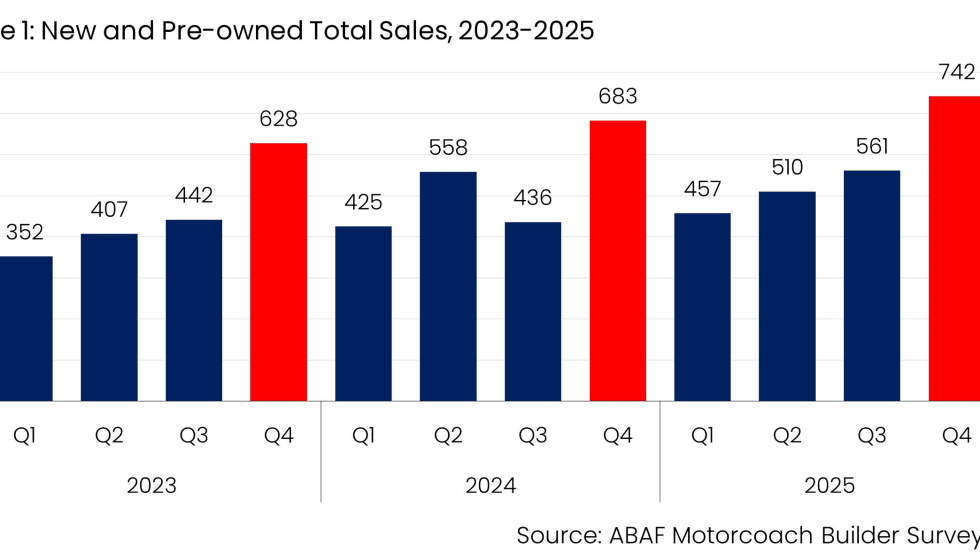
ABA Report: Motorcoach Sales Tick Up in Q1 2026 as Market Stabilizes
The Foundation produces the report each quarter, using data collected from surveys of major motorcoach manufacturers that sell vehicles in the US and Canada.
Read More →
How the Motorcoach Industry Supports Disaster Response and National Preparedness
Fred Ferguson, president and CEO of the American Bus Association (ABA), discussed how the industry prepares for emergencies, the growing recognition of motorcoaches as critical infrastructure, and steps operators can take to strengthen disaster readiness.
Read More →