



Bentech at Forefront of Driver Partition Design
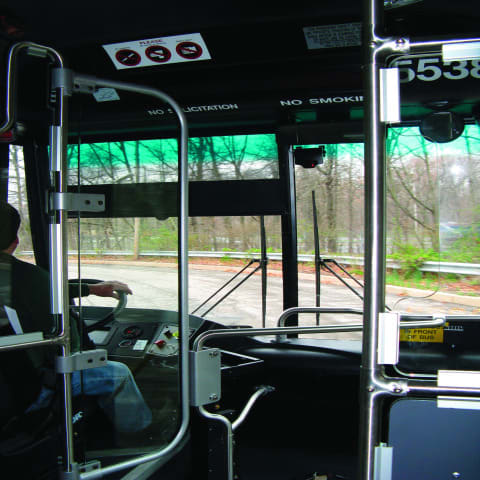
The Philadelphia-based design and fabrication company is working with New Jersey Transit on a pilot program to test two different designs - a hinged-door and sliding-door model - on two different buses.
Courtesy Bentech
[IMAGE]bentech.jpg[/IMAGE]When bus operators head out on their routes, they are unaware what challenges they may face. As we have read in the headlines, operators have been subjected to verbal abuse, spitting, a thrown soda or, in some cases, even physical violence. Some transit agencies are looking into driver partitions as a way of providing better protection for operators.
Philadelphia-based design and fabrication firm Bentech Inc. has been at the forefront of developing driver partitions. "We've actually worked on driver compartments and assemblies for 15 years," says Robert Benninghoff, Bentech manager of sales & engineering. In 1995, Bentech supplied Siemens with several components for the St. Louis Metro light rail vehicles, including the hinges and the vertical support stanchion for the doors.
"It was kind of an R&D process that gave us a working knowledge of the hinge system that would support glass and panels," Benninghoff says.
The company also worked with San Francisco Muni on its Neoplan buses for driver's door compartments in 1999. "It's a product arena that's gone from hot to cold over the years," Benninghoff says.
Testing Two Designs
The company worked with New Jersey Transit (NJ Transit) on a pilot program that tested two prototypes of driver partition designs for two different buses. "About a year ago, we were invited by [the transit agency] to develop a working driver's compartment system for two different buses," Benninghoff says.
One model that was developed — the hinged-door design — was created for NJ Transit's North American Bus Industries' (NABI) low-floor bus, meets ADA requirements and can be furnished with locking latches. The second model is a sliding-door design, which they developed to equip the agency's Neoplan bus. A large transfer cutter situated close to the driver was accommodated by the sliding design. According to Mike Sosnowsky, Bentech sales engineer, this version can be stowed in an open position as an option. Both designs feature upper and lower portions that can be used for advertising, he says.
The partitions are made with laminated tempered safety glass, which complies with the FMVSS AS2 requirements for impact and scratch resistance. With Bentech's design, the glass doors are rimmed with aluminum extrusions (TH12 Series) designed by the company to conform to the shape of the door. All of the edges are covered, creating a rigid and robust design, he adds. The cost of the drivers' doors will be in the $1,000 to $2,000 range, depending upon the transit authority's final design requirements and the quantity ordered, Benninghoff says.
The MS Series of Driver's Partitions comply with National Highway Traffic Safety Administration's regulation (Z26.1-1996) for driver visibility, via the use of safety glass. The partitions, which are easily installed in the field, can accommodate existing partitions and fare collection systems. "We could retrofit existing product work with the OEM in the development stages to develop a door system," Sosnowsky says.
Materials, Costs, Benefits
Sosnowsky says the benefits of the driver partition products include providing a deterrent for abusive passengers, preventing objects from being thrown at drivers and providing noise reduction to allow the driver to focus on the road. Other benefits from a cost analysis point of view include reduced personal injury claims, reduced traffic accidents and a decrease in insurance premiums, he adds.
Bentech will provide complete engineered design with installation assistance, says Sosnowsky. "I can share solid files with the customer, so that's a complete service. We are offering engineered design, install and support thereafter," he says. The company will design a system that will work with the current configuration of the bus.
Orders
Bentech has received orders for five Drivers' Door assemblies for NJ Transit's NABI buses and one prototype door for MTA New York City Transit.
When asked what prompted NJ Transit to look into driver partitions, spokesperson Dan Stessel says, "Like many transit agencies, we are concerned about the safety of our bus operators."
The transit agency specified that the driver partition must cover and protect the operator, with minimal blind spots, and be shatter resistant.
NJ Transit will begin testing the driver partitions on five buses and run these buses for 90 days before determining its next step, Stessel says.
More Bus

The High Cost of Transit Buses: Industry Leaders Look to Procurement Reform
Transit leaders and policymakers examine how standardized bus designs, streamlined procurement, and predictable funding could help agencies stretch budgets and deliver better service.
Read More →
The Business Voice Behind Public Transportation
As chair of APTA’s Business Members Board of Governors, Ray Melleady explains how more than 850 business members are partnering with transit agencies to advance funding, innovation, and industry-wide collaboration.
Read More →
From Surviving to Thriving: Building Stronger Transportation Organizations
Bus Business Consultants founder Brian Dickson shares lessons on leadership, organizational health, and creating options for long-term success in a changing transportation industry.
Read More →
Finding the ‘Happy Medium’: Optimizing Maintenance Without Sacrificing Reliability
The key to maintenance optimization isn’t doing less work—it’s doing the right work at the right time on the right assets.
Read More →
LA Metro, City of West Hollywood, and Partners Advance Smarter Bus Lane Enforcement
The award-winning partnership combines AI-powered detection with human oversight to improve bus reliability, accessibility, and enforcement efficiency.
Read More →
PSTA Modernizes Workforce Management with Digital Bidding System
The award-winning Workforce Transit Modernization project replaced paper bidding with a transparent digital platform, cutting administrative effort while improving access for operators.
Read More →
Washington's Community Transit Sets Six-Year Roadmap for Growth, Expansion
Approved TDP targets more bus service, new mobility options, Swift BRT expansion, and a potential Everett Transit annexation.
Read More →
DART Customer Satisfaction Reaches Six-Year High
Overall satisfaction rose to 74.9%, while the agency’s Net Promoter Score reached a record 33.7.
Read More →
How DART's GoPass Is Redefining Regional Mobility
Serving 14 transit agencies, GoPass simplifies multimodal travel by allowing riders to plan, pay for, and manage an entire trip through one app.
Read More →
Biz Briefs: OCTA Taps Clean Energy for Hydrogen Station, Stadler to Supply Via Rail Vehicles, and More
From manufacturers and suppliers to transit agencies and motorcoach operators, these updates offer a snapshot of the projects, partnerships and business moves driving the industry forward.
Read More →