



Support Transit Development and Operation?
When properly employed, such partnerships between government and the private sector can expedite projects, transfer development and operations risk, and provide better opportunities to leverage limited funds.
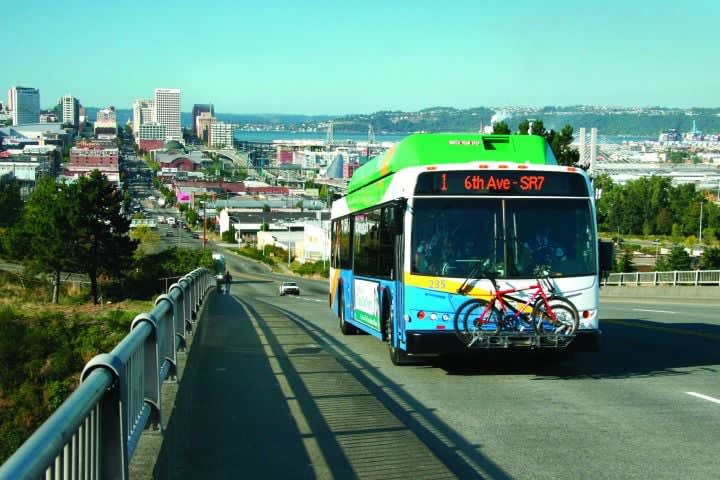
PPPs involve a single private entity or a consortium of private companies holding developmental responsibility and often financial liability for performing functions in connection with a project. Photo Courtesy: Pierce Transit
[IMAGE]partnerships-2.jpg[/IMAGE]A number of communities throughout the U.S. are currently exploring the potential to fund, finance and deliver urban, intercity and high-speed rail projects utilizing the active participation of the private sector. When properly employed, such partnerships between government and the private sector can expedite projects, transfer development and operations risk in constructive and effective ways, and provide better opportunities to leverage limited capital and operating funds.
Public-private partnerships — PPPs or P3s — are contractual arrangements between a governmental agency or authority and a private entity for the primary purpose of developing, operating and maintaining public infrastructure normally in the domain of the governmental sector. PPPs involve a single private entity or a consortium of private companies holding developmental responsibility and often financial liability for performing functions in connection with a project. In return for accepting such responsibility and risk for multiple project elements, the private partner generally receives the opportunity to earn a financial return commensurate with the assumed risks.
A variety of PPP models have been utilized throughout the world, having the common objective of facilitating private sector participation in the provision of public works. Thus, some or all of the traditional public responsibility and risks for financing; designing; constructing; maintaining and operating various infrastructure projects are transferred to or shared with the private partners. Agencies use PPP delivery approaches to obtain potential time and cost savings and more innovative, higher quality projects, while reducing public agency risk.
The typical spectrum of PPP models is defined below. This typology defines a continuum of private sector participation models ranging from the growing utilization of typical design-build delivery approaches, to models involving potential private sector ownership and transfer of public infrastructure assets. These include:
Design-Build (DB), with variations including Design-Build-Maintain (DBM), Design-Build-Operate (DBO), and Design-Build-Operate-Maintain (DBOM).
Design-Build, incorporating private financial participation including such variations as Design-Build-Finance (DBF), Design-Build-Finance-Maintain (DBFM), and Design-Build-Finance-Operate-Maintain (DBFOM).
Build-Operate-Transfer (BOT), with a variety of options for private sector involvement in design, construction, operation and maintenance, including ownership or leasing rights for both greenfield and brownfield assets.
In today's infrastructure world, non-PPP arrangements are typically referred to as "traditional" methods of project delivery. Design-Bid-Build (DBB) is the common traditional project delivery practice, in which separate contracts are procured by the owner/government agency for the project development phase (planning and environmental clearance), the design/engineering phase, and the construction phase of a project. The owning agency might also choose to contract out the operations or maintenance of the asset. Typically, DBB project delivery involves a design phase managed and overseen directly by the owner and generally carried to 100 percent design completion, often by "owner's engineering" firms, prior to soliciting bids for construction and potential operation and management (O&M) by private contractors.
Project Delivery Advantages
Time savings. The potential for time savings results from early contractor involvement in the project. This reduces conflicts between design and construction, increases constructability, allows concurrent work on design and construction phases, and eliminates the additional procurement process for construction. Shorter project delivery schedules can result in cost savings, not only by reducing project duration, but also by avoiding large increases in material costs due to inflation.
Cost savings. The potential for cost savings can result from increased communication between design, engineering, environmental and construction team members; a shortened project timeline that may reduce construction costs and reduced change orders due to early contractor involvement. Moreover, and perhaps most importantly, P3 approaches utilizing private financial participation typically require firm fixed pricing, or a "guaranteed maximum price" for design, construction, and for a stipulated period of operations and maintenance. This owes primarily to the fact that capital market and bank financing require a not-to-exceed ceiling price to invest or provide debt financing. Thus, the private sector often assumes the ultimate risk of "non-recourse" project financing, in which the contractor or concessionaire has no recourse to obtain additional money from the government sector.
In addition, cost savings can be realized both in direct costs, such as in the case of a project being finished under budget, and in indirect costs, such as less time needed to complete the project by overlapping design and construction and avoiding inflation by purchasing materials early in the process. The competition involved in PPPs serves to drive down the price of services from the private companies. Savings are also obtained through lower life-cycle costs, both from innovative design elements that incorporate cost savings and from ongoing maintenance and operations meeting stipulated criteria.
Shared risks. Potential project risks can be assigned to the party best able to assume such risks. Properly allocating risks can result in reduced costs and minimization of contingencies. More importantly, transferring risk from the public sector to a private sector entity for finance, design, construction, and O&M of a project eliminates much of the critical "interface risk" that accrues to the owning agency when the agency implicitly assumes the management role among a variety of individually-bid project elements.
Improved quality. With a single team involved from engineering through project construction (and potentially O&M), there exists a clear potential for improved quality and the incorporation of innovative technologies. The specialized resources of the private companies enable the agency involved in the PPP to provide better and more cost-effective services. Involvement of the design-builder in ongoing operations and maintenance can also result in ongoing quality improvements. For example, once a transit agency completes a conceptual design for a subway tunnel, if a single responsible private entity is provided the mission of project finance, engineering, construction, maintenance and operation of the civil works — whether or not operation of the trains is included — it is arguable that the risks of pointing fingers between designers, contractors, maintainers and operators can be drastically reduced, if not completely eliminated.
PPPs are Different for Transit
Public-private partnerships began in the building industry as an outgrowth of design-build contracting, migrated to the highway and toll road arenas, and have been used in nearly every building sector in the infrastructure marketplace over the past few decades. Typically, they have involved risk transfer with financial opportunities and thus have been used on toll roads, toll bridges, skyscrapers and other infrastructure assets with the potential for generating user revenues, whether building rents or road tolls. As risk transference, life-cycle cost savings and other P3-related benefits aside from simply generating new sources of funds have been shown, the transit industry has begun developing new approaches to leverage public resources using the capabilities and resources of the private sector. However, certain barriers must be overcome in order to tap such resources in a systematic manner.
As transit lines are often built as extensions of existing systems, private operation of portions of a system can be problematic, as contractors do not want to be responsible for part of a system operated by an entity they do not control. A greenfield system or a new technology would appear to be a better opportunity for private operation than an extension.
Public investment necessary
Toll roads and other revenue-raising PPPs can often be developed as full DBFOM projects, in which the concessionaire accepts risks related to usage as well as fees collected. Transit systems have historically needed public funding in addition to farebox revenues to maintain and operate the system. As such, PPPs with financial involvement by the private side typically require payments to the concessionaire far in excess of typical farebox revenues. In this context, PPPs in public transportation might be viewed in the "social infrastructure" realm, in which partnerships between the public and private sectors have been used to significant financial and schedule advantage with respect to water and power provision, public and military housing, detention facilities, and the like.
Because public transit is a hybrid of both social and transportation infrastructure, the risk of meeting ridership forecasts is not typically transferred to the concessionaire, as is often done for toll roads and other user fee-based infrastructure. The public sector remains responsible for ensuring that the transit system, as a whole, meets established ridership goals and retains responsibility for a fare structure that serves a variety of public and social purposes.
Fed, State regulations behind
The FTA New Starts process was created to be applied exclusively within the traditional DBB process. The New Starts process is essentially linear, sequentially moving projects from preliminary engineering to final design to full funding grants, without allowing for concurrency in the developmental process. Construction cannot begin until the local agency enters into a FFGA (Full Funding Grant Agreement) with FTA, and extensive and sequential risk assessment is required prior to issuance of the FFGA. Additionally, design development to a fairly high level is required prior to FFGA, which effectively limits the opportunities for innovative technical solutions or efficiencies by restricting early contractor involvement in construction technology.
To date, very few transit agencies have sought to utilize the New Starts process paired with DB or DBOM project delivery. Nonetheless, the "Penta-P" Program (Public-Private Partnership Pilot Program), authorized under the most recent surface transportation act (SAFETEA-LU), demonstrates the intent of the U.S. Department of Transportation (U.S. DOT) and FTA to seriously consider the ways in which private sector participation can augment the rigorous New Starts process. The Penta-P program represents a conscious effort to recognize the potential positive impacts private involvement could have on the expediency of the federal funding of transit capital project development. The program implicitly acknowledges that the greater the extent to which the private sector is willing to put "skin in the game," (i.e., funding, financing, and acceptance of increased risk project construction and operational risk), the lesser the need for rigorous, sequential, and expensive federal oversight and risk assessment.
Regs need to be aligned
Environmental regulations (both federal and state) often require that a full environmental document be completed prior to commencing construction. The typical environmental process timetable, however, does not always match the ideal timetable associated with project delivery utilizing a PPP approach.
While work on an Environmental Impact Statement is in progress, the government may not take actions which would preclude the implementation of reasonable alternatives. This means that project sponsors may not acquire right-of-way or proceed to final design until a Record of Decision (ROD) or a Finding of No Significant Impact (FONSI) has been issued. If a transit project is included in the FTA's Pilot Program and Letters of No Prejudice are issued, owners may issue procurement documents prior to the environmental findings provided alternatives are not precluded. However, final design and construction cannot proceed until the conclusion of the environmental process.
The time savings associated with performing work concurrently can be a major advantage of PPPs. With the sequential approach maintained by FTA, this advantage is difficult to realize. As such, transit agencies are examining the efficacy of PPPs that are funded locally.
The reauthorization of the surface transportation act, now pending, could include provisions similar to SEP-15, a Federal Highway Administration process, which provides opportunities for environmental streamlining and more expedient project approval and delivery of highway projects, without comprising potential environmental impacts.
Legal and procurement issues
Public-private partnerships and DB project delivery is not permissible in many states. Thus, several of these states have engaged in a limited number of pilot cases to use alternative delivery methods. The legal ability to transfer private contract responsibilities, including financing, to other parties is an important aspect of PPPs and must be addressed to realize the full potential of partnering between the public and private sectors. Flexibility in procurement is also necessary for effective leveraging of private resources. For infrastructure projects, many states still require the selection of a low bidder for construction rather than a selection based on qualifications and best overall value. This approach affects the way both design-build and P3 project delivery is undertaken — if at all — throughout the country, since regulations vary substantially from state to state and even region to region.
Development, Operation impact
The recent success of Denver RTD in selling private activity bonds (PABs) for its Eagle P3 program and the approach Los Angeles Metro is taking to enable PPPs as an integral and programmatic aspect of its Long Range Transportation Plan both demonstrate the potential that exists to utilize private sector participation in the delivery of new rail projects. In Denver, the revenues derived from its regional sales tax program dedicated to transit development and from federal New Starts funding is being used as leverage to generate additional investment and financing support from the private sector. In Los Angeles, a similar approach is being undertaken initially to develop three new rail and three new highway tolling programs using a variety of P3 models and innovative bonding approaches to significantly advance the projects' respective timetables.
Transit authorities, local communities and the U.S. DOT are watching. Continued success will likely result both in provisions in the surface transportation reauthorization that better facilitate partnerships between government and the private sector, and an increased level of activity from local authorities looking for means to stretch limited resources.
Michael Schneider is managing partner of InfraConsult LLC, and chair of the APTA Committee on Public-Private Partnerships. Tesse Roberts Rasmussen is a senior consultant with InfraConsult and deputy project manager for the LA Metro Public-Private Partnership Program.
More Bus

New York MTA Plans Largest Bus Fleet Upgrade in More Than a Decade
The agency is seeking manufacturers for 650 new CNG buses to replace aging vehicles, improve reliability, and advance its broader fleet modernization strategy.
Read More →
Building a Flexible Path to Transit Electrification
John Hroncich discusses BAE Systems’ modular and scalable approach, lessons learned from decades of real-world operations, and how agencies can identify electrification strategies that fit their fleets.
Read More →
Bus Tech Talk: Keeping Transit Technicians Ahead of the Technology Curve
LA Metro’s Obed Mejia discusses technician training, evolving maintenance technology, fleet replacement, and strategies for getting the most out of today’s transit fleets.
Read More →
Biz Briefs: RIPTA Unveils New Frontrunners, Clevland RTA Adds New Siemens, and More
In METRO's latest installment, we take a look at recent news from Siemens, Prevost, Dodge, and more partnerships making headlines across the transportation sector.
Read More →
People Movement: Holly Arnold Joins Transdev and More
In this edition, we also cover recent appointments and announcements at Pace, CamTran, MCI, and more, showcasing the individuals helping to shape the future of transportation.
Read More →
The High Cost of Transit Buses: Industry Leaders Look to Procurement Reform
Transit leaders and policymakers examine how standardized bus designs, streamlined procurement, and predictable funding could help agencies stretch budgets and deliver better service.
Read More →
The Business Voice Behind Public Transportation
As chair of APTA’s Business Members Board of Governors, Ray Melleady explains how more than 850 business members are partnering with transit agencies to advance funding, innovation, and industry-wide collaboration.
Read More →
From Surviving to Thriving: Building Stronger Transportation Organizations
Bus Business Consultants founder Brian Dickson shares lessons on leadership, organizational health, and creating options for long-term success in a changing transportation industry.
Read More →
Finding the ‘Happy Medium’: Optimizing Maintenance Without Sacrificing Reliability
The key to maintenance optimization isn’t doing less work—it’s doing the right work at the right time on the right assets.
Read More →
LA Metro, City of West Hollywood, and Partners Advance Smarter Bus Lane Enforcement
The award-winning partnership combines AI-powered detection with human oversight to improve bus reliability, accessibility, and enforcement efficiency.
Read More →