



NABI Chief Steering Bus Manufacturing to the U.S.
With a three-phase plan to move manufacturing of bus structures to its Anniston, Ala. plant, company CEO/President Jim Marcotuli believes the removal of some freight and duty from its current cost structure will position NABI to be more cost and lead-time competitive.
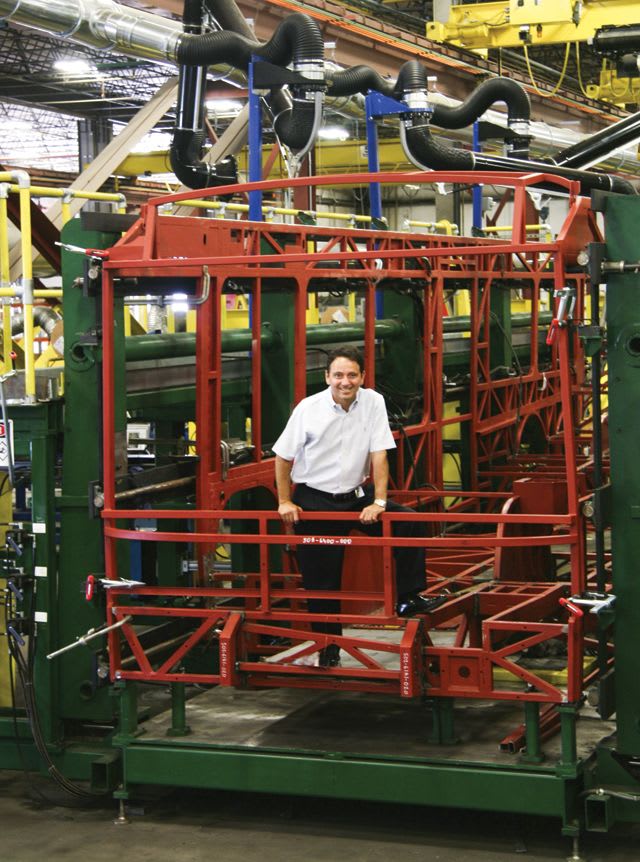

North American Bus Industries Inc.'s (NABI) CEO/President Jim Marcotuli has more than 24 years of experience in manufacturing management with companies both domestic and international. He has previously been associated with several firms with the responsibility for company performance, strategic projects and process improvements, where he has served in position from president to VP of manufacturing and plant operations to global procurement.
METRO Magazine's Managing Editor Alex Roman recently spoke with "Marco," as he is known, about the company, including the three-phase move of its manufacturing processes from Hungary to Anniston, Ala., and restyling of its low-floor product line.
METRO: How does your sensitivity to process play a part in running NABI?
Jim Marcotuli: I started here in January 2009, and from that point forward, we focused on process improvement and have implemented what I consider a continuous improvement model, which causes us to continually look at process improvements. Naturally, we can't work on everything, so we prioritize the processes that are the most critical or beneficial.
How has the nation's economic situation impacted NABI since you have been there?
Since 2009, we have seen vast economic challenges in the U.S. The problem with state and local budget shortfalls, triggered by high unemployment levels, has posed many challenges for the transit operators to overcome. Many customers have reassessed their route structures, reduced service and some have delayed purchases because they were having financial difficulty operating the buses already in their fleets.
Have orders for new buses slowed in recent months due to funding issues?
Over a larger time frame, bus procurement activity has been down, relative to two or three years ago. But just recently, it is up because of a couple large solicitations, meaning large properties seeking proposals for large quantities of buses.
Did you see a pickup with ARRA funding and are you seeing a slowdown outside of these larger solicitations?
The truth is it was difficult to really decipher whether agencies that used ARRA money wouldn't have otherwise bought buses. We know some of the solicitations were funded from stimulus money and some weren't. Whether they would have done it anyhow is a question we can't answer. So, to summarize, it's hard to determine the macro-impact it had.
I understand NABI is starting to manufacture some of its bus structures in the U.S.
We have a plant that we call Plant-6, and back two-and-a-half years ago when I started at NABI, we were starting up that plant, which builds welded structures for one of our major customers and one of our product lines. The balance of our structures comes from Hungary, and we are in the process of transitioning work share from Hungary on what's not yet produced in the U.S., so that we can eventually produce and assemble much more here in Anniston, Ala. We are in that transition period now. We have built a time-phased three-step plan. We are in 'phase-two' of that plan today, where we are receiving large structural assemblies, such as walls, roof, underbody, front and rear caps, and we are welding these together here in Anniston.
We have produced six buses already in phase-two. Phase-three is out on the horizon. We haven't put a hard timetable to it yet only because we want to make sure we have fine-tuned where we are in phase-two first.
[PAGEBREAK]

What will phase-three entail and what is the importance of moving manufacturing to the U.S.?
I'd like to mention a couple things about Plant-6 before I address your question. When we started out in 2009 building structures from the ground up, — purchasing all components, welding all components, doing the entire manufacturing operation for that one product line — it gave us a nice base and gave us time to refine all of our processes related to building structures. This experience has allowed us to build a very nice base of knowledge from multiple vantage points.
The importance is that we'll be more competitively positioned than we have been in the past. It will remove some freight and duty from our current cost structure and position us to be more cost and lead-time competitive.
Even though these changes are being driven by the previously noted economic issues, Buy America is another potential benefit. Although our traditional business model has allowed us to comfortably comply with Buy America, obviously, these changes will further increase our U.S. percentage. This will increase the selection of components that we can apply to our vehicles and it will also position us solidly, if eventually there is any toughening of Buy America requirements.
Have you been able to expand the number of employees in Anniston as a result of these changes?
Yes, we've already started hiring a dozen welders here just recently, with the intention to hire further as we transition.
How has this shift in production to Anniston gone? Have there been any big surprises?
We had a plan with 1,224 specific action items assigned to specific individuals to accomplish this transfer — everything from converting Hungarian engineering to U.S. standard engineering to designing and building new fixtures — with efficiencies built in from our lessons learned from our earlier product startup in Plant-6, called the standard floor startup. We took all the lessons learned and incorporated them into this new fixture and model. So, yes there was a tremendous amount of activity that went on to ensure we built efficiencies into this new manufacturing shift in process.
How has it gone? It's gone well. Have we had some issues? Yes. Not unforeseen, we've had some minor issues, all of which have been resolved, and we're continuing production. We recently have started our seventh unit.
How will the shift of the manufacturing of the bus structures impact your operations in Budapest?
Our strategic plan was to offset the work share transfer loss in Hungary by developing a new bus for the Hungarian market called the Sirius. That bus is built on a MAN chassis with our BRT-design body attached. We've sold two of those buses, a suburban and a transit version. One of them has now gone through trials with customers in Hungary and was received very well within the local Hungarian market.
Is that bus specifically for the Hungarian market? Any plans to expand throughout Europe?
The approach was to start with Hungary. Quite honestly, I am a big believer in not working on everything at once and taking steps, instead of trying to lay out extremely long term plans. We are trying to approach this from the perspective of once we get good and comfortable in the Hungarian market, then we'll assess the European market and make plans to expand. Right now, we don't have plans to expand outside of Hungary until we're comfortable.
I understand NABI is undertaking a restyle of the LFW low-floor bus product. What prompted this?
There has been renewed interest in aesthetics and styling, and we've tried to shift in that direction as well. So, we decided to restyle our low-floor product line to look more like our stylized BRT product. It in no way has the same amount of rake and styling, but it is more similar to the BRT than the old standard LFW.
Your BRT models seem to have been very popular in recent years. Do you foresee continued interest in BRT?
We have had some recent orders, and we see continued interest in that product line for various transit agencies that want to build BRT systems. I would say our bus is still ahead of the pack, in terms of its sleek styling and a more modern look.
What do you foresee as far as the evolution of the industry over the next few years?
It's hard to predict, but I think we'll see continued pressure on funding and operating budgets, especially. We continue to see customers having to optimize and refine their route structures and reduce their operating costs. We also see alternate propulsion continuing to be stronger, such as CNG, hybrid-electric, and even pure electric. We see the future probably being in that direction.
More Bus
Frontrunner Bus Group Expands with New Massachusetts Headquarters
The significantly larger facility will provide the infrastructure needed to support the company’s growing workforce, advanced technologies, and expanding product line.
Read More →
Joshua Schank on Transportation Innovation, Risk, and the Future of Mobility
In this edition of METROspectives, Joshua Schank discusses lessons from launching LA Metro’s Office of Extraordinary Innovation, the challenges of advancing new mobility technologies, and much more.
Read More →
Reinventing Fleet Maintenance with Real-time Visibility and AI
Transit leaders need to know what needs fixing, where to look, who is responsible, when work is completed, and what it costs without having to chase information across disconnected systems.
Read More →
SamTrans Sets Priorities for Potential Connect Bay Area Revenue
The board-approved framework allocates future funding to maintaining service, rider improvements, equity initiatives, and infrastructure repairs.
Read More →
When Routine Fails: How Public Transit Must Adapt for the World Cup
The 2026 FIFA World Cup will test transit agencies’ ability to manage unpredictable travel patterns, making real-time data and operational flexibility critical to moving millions of visitors efficiently.
Read More →
Photo Highlights from APTA's 2026 Mobility Conference
The photo gallery captures scenes from the conference, including the International Bus Roadeo, exhibit hall activities, the Bus Showcase, and much more.
Read More →
Chicago's NITA Act Moves Into Next Phase as Service Improvements Begin
Rider-focused improvements will begin rolling out across the system immediately as CTA, Metra, and Pace increase service this summer in the six-county region.
Read More →
Philadelphia's SEPTA Approves Annual Transit Service Plan
Between 2021 and 2024, SEPTA held more than 200 public meetings — including 144 in-person sessions — throughout the SEPTA service region.
Read More →
A True Low-Floor Minibus Design Delivers Better Accessibility and Efficiency for Everyone
As transit demands evolve, so should your fleet. Download the whitepaper to see how the Low-Floor Frontrunner Minibus compares to traditional options.
Read More →
WMATA Debuts 'Fares Pay for Service' Awareness Campaign
The campaign was highlighted during a media event at the Paul S. Sarbanes Transit Center in Silver Spring, where WMATA’s GM/CEO Randy Clarke joined Metro Transit Police officers, WMATA management team, board members, and staff to expand fare enforcement and customer education efforts on Metro Bus routes throughout the region.
Read More →