



Philadelphia installs green bus shelter to promote storm water management
The office of Philadelphia Mayor Michael A. Nutter along with the City of Philadelphia Water Department (PWD) and green roofing company, Roofmeadow, partnered on the project.

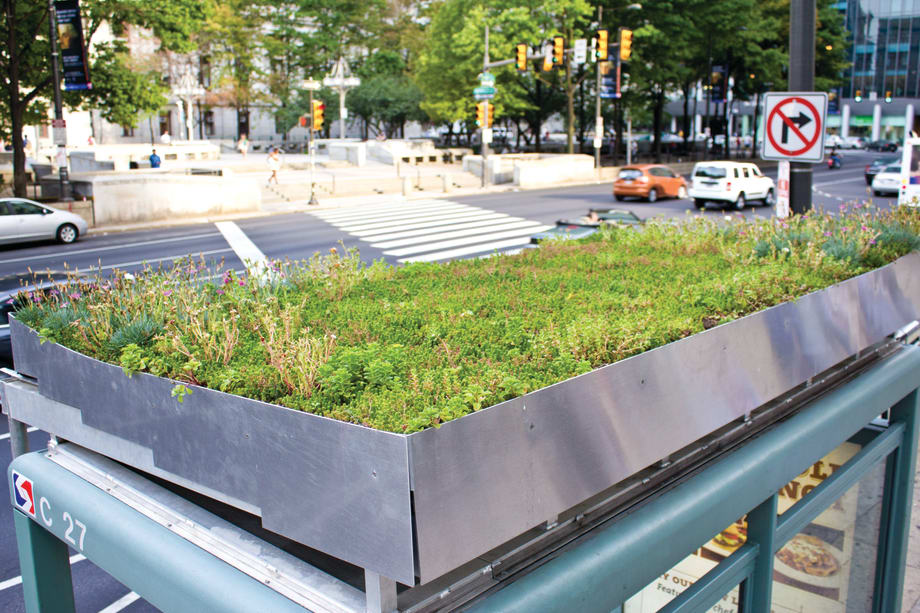
The green roofs are packed with a soil alternative similar to crushed pottery. Since the water can't be held in the structure, the material allows the water to drain through.
The green roofs are packed with a soil alternative similar to crushed pottery. Since the water can't be held in the structure, the material allows the water to drain through.
In an effort to help transform the health of its citizens and waterways, Philadelphia city officials installed a green roof bus shelter as part of a demonstration project to better showcase the environmental benefits of green storm water management.
The living roof, which features wildflowers and succulents, was installed on a shelter in the downtown area across from city hall last May. The office of Philadelphia Mayor Michael A. Nutter along with the City of Philadelphia Water Department (PWD) and green roofing company, Roofmeadow, partnered on the project.
The shelter project is part of a plan, recently rolled out by the PWD, to improve the health of the city's streams, creeks and rivers using primarily a green approach, explained Tiffany Ledesma-Groll with Trans-Pacific Engineering Corp., and Matt Condiotti an environmental engineer with CDM, both project managers for the green roof bus shelter project.
The goal is to plant trees and gardens that can hold rainwater before it hits the ground to prevent overflows into creeks and rivers. The PWD is investing about $2 billion over the next 25 years to implement the program.
Ledesma-Groll, Condiotti and other representatives for the green storm water infrastructure program saw an opportunity for more visibility by placing a green roof on a bus shelter, and approached the Mayor's office with the idea, Andrew Stober, an exec., chief of staff for the city's Office of Transportation & Utilities, explained.
"A lot of the green roofs in Philadelphia are on high-rises and not very visible," Ledesma-Groll said. "We thought if we put one on top of a bus shelter, where a lot of people congregate in a busy location across from City Hall, we could draw attention to it and get people to think about green roofs and how they can contribute in their own way to manage storm water on their properties."
PWD also hopes the shelter will educate the public about the efforts that the city is making to install green infrastructure and help manage storm water.
The green roofs are packed with a soil alternative similar to crushed pottery for the succulents and wildflowers planted throughout. Since water can't be held in the structure because it adds weight to the roof, the material allows the water to drain through. The plants don't need much water and will be green all year long, Stober said.
PWD displayed an educational poster on the back panel of the bus shelter, explaining the roof, its benefits and information resources with guidance for the public on how they can implement their own patch of green on their property, whether it's a rain barrel, green roof or rain garden (see www.phillywatersheds.org/greenbusshelter).
Staff engineers from the city's Water, Street and Public Property departments conducted a safety review on the shelter, Stober said. "We needed to get a review done by an independent engineer just to make sure the structure was going to be safe with this kind of roof on it, because we don't want folks standing beneath an unsafe structure," he explained. "The review was great because we have a pretty uniform bus shelter type [in case] we have the opportunity to do additional green roof bus shelters, which we certainly want."
All that needs to be done to ensure the shelter's safety is a quick check of the columns to make sure they are in good repair and will be able to take the weight of the shelter, Stober added.
Roofmeadow, a Philadelphia-based private sector firm, was brought in as a partner by the water department and donated their services. The firm installed and will maintain the roof for the next few years.
Titan sells the advertising on Philadelphia's bus shelters and is offering advertisers the opportunity to put their name on the green roof portion of the shelter and help support development of a future green roof.
"[It's] one of the few things that I've done with the city where everyone seems to like it...We have the wettest August on record here in Philadelphia and the shelter's thriving," he said. "It's a really low maintenance operation."
More Bus

New York MTA Plans Largest Bus Fleet Upgrade in More Than a Decade
The agency is seeking manufacturers for 650 new CNG buses to replace aging vehicles, improve reliability, and advance its broader fleet modernization strategy.
Read More →
Building a Flexible Path to Transit Electrification
John Hroncich discusses BAE Systems’ modular and scalable approach, lessons learned from decades of real-world operations, and how agencies can identify electrification strategies that fit their fleets.
Read More →
Bus Tech Talk: Keeping Transit Technicians Ahead of the Technology Curve
LA Metro’s Obed Mejia discusses technician training, evolving maintenance technology, fleet replacement, and strategies for getting the most out of today’s transit fleets.
Read More →
Biz Briefs: RIPTA Unveils New Frontrunners, Clevland RTA Adds New Siemens, and More
In METRO's latest installment, we take a look at recent news from Siemens, Prevost, Dodge, and more partnerships making headlines across the transportation sector.
Read More →
People Movement: Holly Arnold Joins Transdev and More
In this edition, we also cover recent appointments and announcements at Pace, CamTran, MCI, and more, showcasing the individuals helping to shape the future of transportation.
Read More →
The High Cost of Transit Buses: Industry Leaders Look to Procurement Reform
Transit leaders and policymakers examine how standardized bus designs, streamlined procurement, and predictable funding could help agencies stretch budgets and deliver better service.
Read More →
The Business Voice Behind Public Transportation
As chair of APTA’s Business Members Board of Governors, Ray Melleady explains how more than 850 business members are partnering with transit agencies to advance funding, innovation, and industry-wide collaboration.
Read More →
From Surviving to Thriving: Building Stronger Transportation Organizations
Bus Business Consultants founder Brian Dickson shares lessons on leadership, organizational health, and creating options for long-term success in a changing transportation industry.
Read More →
Finding the ‘Happy Medium’: Optimizing Maintenance Without Sacrificing Reliability
The key to maintenance optimization isn’t doing less work—it’s doing the right work at the right time on the right assets.
Read More →
LA Metro, City of West Hollywood, and Partners Advance Smarter Bus Lane Enforcement
The award-winning partnership combines AI-powered detection with human oversight to improve bus reliability, accessibility, and enforcement efficiency.
Read More →