



San Francisco Proposal Allows Muni, Private Carriers to Share Stops
By creating a pre-approved network of shared bus stops, SFMTA would be allowed to prevent private carriers from using Muni stops that have high frequencies, as well as those that are simply not long enough to share without creating additional traffic congestion.

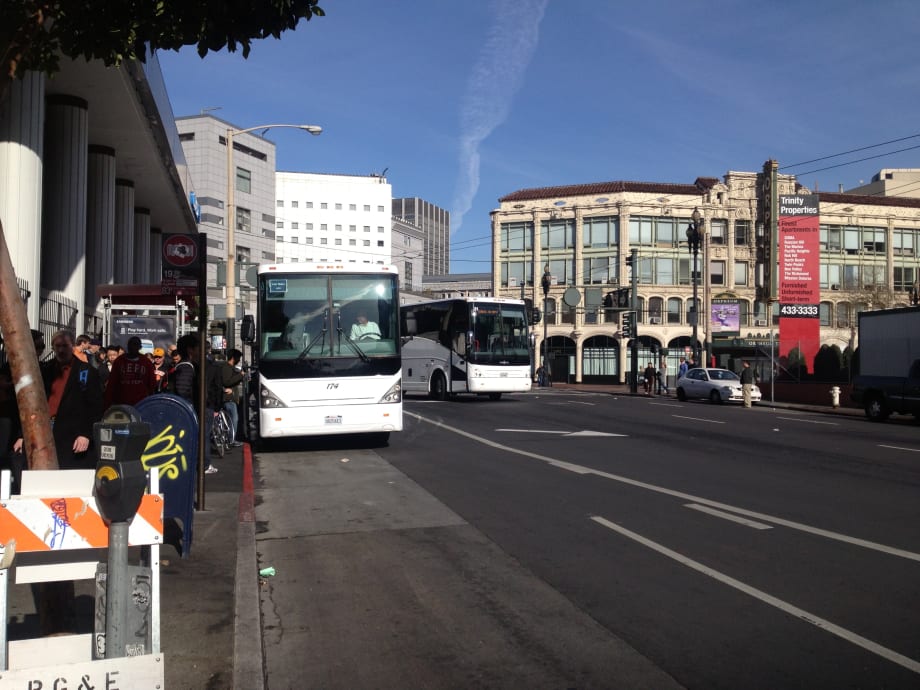
As the number of private commuter shuttles in the city continues to grow, the San Francisco Municipal Transportation Agency (SFMTA) is proposing a plan that would enable private carriers to share some of the agency’s Muni bus system stops.
“Currently, the real core of our issues is these shuttles don’t have accepted places to stop and load or unload, so a majority of the stops they use are in Muni zones, which is currently not legal,” explained Carli Paine, transportation demand management project manager at SFMTA. “We are constantly striving to make Muni more reliable for our riders, so we take the recurring issues creating delays very seriously.”
The policy concept would see the agency work with private carriers, who transport passengers to companies including Facebook, Google, Yahoo and Apple as well as to the University of California, San Francisco and the Academy of Arts University, to create a network of more than 100 Muni zones they would be able to use. By creating a pre-approved network of shared bus stops, SFMTA would be allowed to prevent private carriers from using Muni stops that have high frequencies, layovers or are used for rapid bus systems as well as those that are simply not long enough to share without creating additional traffic congestion.
“We have been interacting with these shuttles in a one-off, ad-hoc fashion when problems come up, and now, it has grown so large it deserves a consistent approach,” said Paine.
To participate in the program, private carriers would be asked to pay a permitting fee and comply with a number of guidelines, including giving Muni buses priority, staying within the network, pulling to the front of the stop, and actively loading and unloading at all times — the carriers would also not be allowed to idle, stage or otherwise park their vehicles at the bus stops for any reason.
“We would also ask them to display a placard on their vehicles with a unique identifier so we could identify who to follow up with when there are issues,” said Paine. “We regularly hear complaints or concerns from residents or other members of the public about a big white bus at a certain location, but it is really hard to follow up on the complaint because some of the vehicles don’t have any identifiers.”
In addition to being able to identify the possible offender of the proposed program, the identification system would allow SFMTA to reach out to the operators to help resolve issues as well as plan together to prevent future problems.
While illegally using Muni stops currently carries a $271 fine, SFMTA’s proposal would also create an active enforcement program that would cite carriers using stops without paying for the permit or using stops that are not part of the network.
Paine explained that SFMTA’s proposal has been well received by the businesses and universities as well as the private carriers they contract to provide the shuttle services; however, there is concern as to what the cost to obtain the permit will be.
“They are also concerned about losing the flexibility they have,” added Paine. “Right now, they can quickly change where their stops are, and if we create a network of stops, they would only be able to shift within that network.”
To address these issues, SFMTA is currently trying to flesh out what costs the city would incur to develop and run the program before establishing a recovery-based fee. Paine added that, ideally, the network of stops would also be somewhat fluid so that the private carriers could continue to have at least some of the flexibility they presently enjoy.
The agency is currently finalizing key aspects of the proposal with the hopes of bringing it to the SFMTA board as well as the city’s board of supervisors in the fall. Paine said if that timeline sticks, the agency would roll out the program for an 18-month pilot by early to mid-winter.
More Bus

New York MTA Plans Largest Bus Fleet Upgrade in More Than a Decade
The agency is seeking manufacturers for 650 new CNG buses to replace aging vehicles, improve reliability, and advance its broader fleet modernization strategy.
Read More →
Building a Flexible Path to Transit Electrification
John Hroncich discusses BAE Systems’ modular and scalable approach, lessons learned from decades of real-world operations, and how agencies can identify electrification strategies that fit their fleets.
Read More →
Bus Tech Talk: Keeping Transit Technicians Ahead of the Technology Curve
LA Metro’s Obed Mejia discusses technician training, evolving maintenance technology, fleet replacement, and strategies for getting the most out of today’s transit fleets.
Read More →
Biz Briefs: RIPTA Unveils New Frontrunners, Clevland RTA Adds New Siemens, and More
In METRO's latest installment, we take a look at recent news from Siemens, Prevost, Dodge, and more partnerships making headlines across the transportation sector.
Read More →
People Movement: Holly Arnold Joins Transdev and More
In this edition, we also cover recent appointments and announcements at Pace, CamTran, MCI, and more, showcasing the individuals helping to shape the future of transportation.
Read More →
The High Cost of Transit Buses: Industry Leaders Look to Procurement Reform
Transit leaders and policymakers examine how standardized bus designs, streamlined procurement, and predictable funding could help agencies stretch budgets and deliver better service.
Read More →
The Business Voice Behind Public Transportation
As chair of APTA’s Business Members Board of Governors, Ray Melleady explains how more than 850 business members are partnering with transit agencies to advance funding, innovation, and industry-wide collaboration.
Read More →
From Surviving to Thriving: Building Stronger Transportation Organizations
Bus Business Consultants founder Brian Dickson shares lessons on leadership, organizational health, and creating options for long-term success in a changing transportation industry.
Read More →
Finding the ‘Happy Medium’: Optimizing Maintenance Without Sacrificing Reliability
The key to maintenance optimization isn’t doing less work—it’s doing the right work at the right time on the right assets.
Read More →
LA Metro, City of West Hollywood, and Partners Advance Smarter Bus Lane Enforcement
The award-winning partnership combines AI-powered detection with human oversight to improve bus reliability, accessibility, and enforcement efficiency.
Read More →