



Transit safety is a community effort
Rail fatalities, accidental and intentional, are a national problem. To combat the rise in fatalities and remind the public of the dangers of walking along, playing by or cutting across its train and trolley tracks and through its rail yards and depots, SEPTA held its first-ever Safety Awareness Day on May 1.

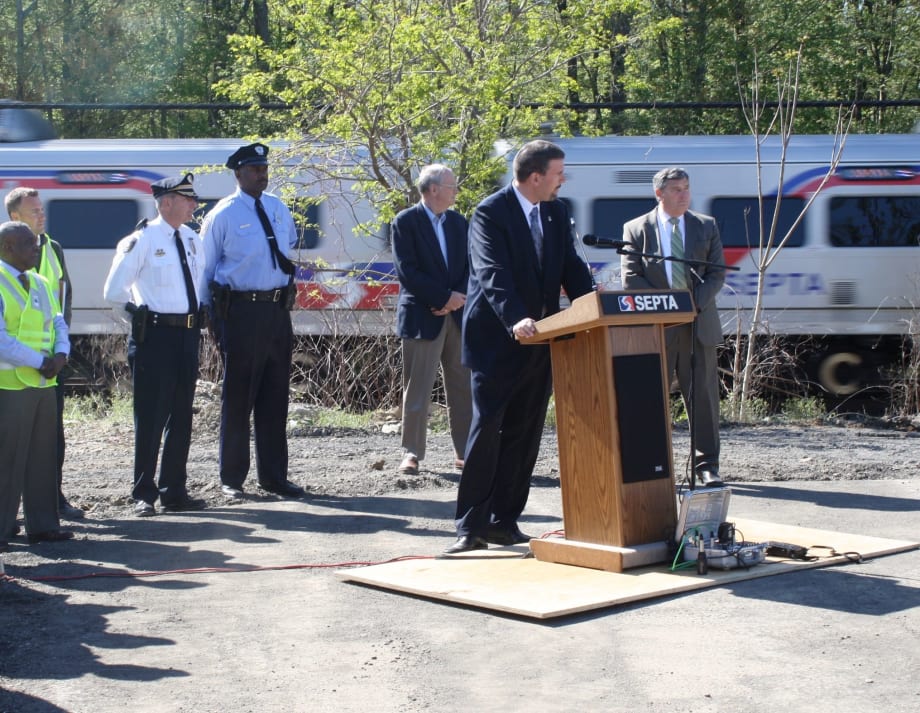
SEPTA System Safety Director Scott Sauer demonstrates that electric trains are very quiet during the press conference held along the West Trenton Line.

Rail fatalities, accidental and intentional, are a national problem. According to the Federal Railroad Administration, in 2012, there were 442 pedestrian trespass fatalities across the U.S. — 70% of those incidents occurred in 15 states, with California (74 deaths), Texas (32) and Pennsylvania (28) being the top three states.
Sadly, Southeastern Pennsylvania Transportation Authority (SEPTA) has not been immune to this rash of rail-related fatalities. From January 2013 to April 2013, there were eight deaths involving SEPTA’s Regional Rail and Broad Street (subway) lines, putting the agency on a pace this year that could exceed the 12 deaths on all modes in 2012.
But the majority of transit-related deaths are preventable, especially by following simple rules such as staying behind the yellow lines on platforms, never running for trains or vehicles and not trespassing in the track area.
To combat the rise in fatalities and remind the public of the dangers of walking along, playing by or cutting across its train and trolley tracks and through its rail yards and depots, SEPTA held its first-ever Safety Awareness Day on May 1.
During the morning rush, 500 agency employees and community partners distributed educational materials and answered safety questions at more than 160 SEPTA rail, trolley and bus stations, loops and transportation centers throughout the agency’s five-county Greater Philadelphia service area. Among the locations where SEPTA officials greeted passengers were those that have been identified by SEPTA’s System Safety Department as trespassing “hot spots.”

GM Joseph M. Casey and System Safety Director Scott Sauer held a press conference at a lot along SEPTA’s West Trenton Regional Rail Line, in an area where too many people make the illegal and dangerous choice of walking along the tracks.
“The tracks are the highway for our trains,” Casey said during the event. “You wouldn’t walk along the highway; why would you walk along the tracks?”
SEPTA’s Safety Awareness Day is unprecedented — this is believed to be the only such all-out endeavor by a U.S. transit organization. But for the agency, this isn’t a one-day event — safety is part of the SEPTA culture every day.
“We make Operation Lifesaver presentations to a variety of school and community groups and at least once a month, we hold Safety Blitz programs where our safety officers visit railroad, rail transit and bus stations across the Authority, reviewing regulations and precautions with thousands of passengers,” said Sauer. “We often visit locations as a result of community request.”
With more than one million riders traveling on its 2,200-mile service area every day, SEPTA is committed to providing a safe travel environment for its passengers. But one of the goals of Safety Awareness Day was to reach all members of the public with the safety messages.
“We want our customers to share the educational materials and tips with their families, friends and neighbors,” said Casey. “We need the community to be our partners to help us spread the word about safety.”
In case you missed it...
Read our METRO blog, "My APTA Bus Roadeo Experience" here.
More Blog Posts

Inside ITF 2026: Transport Reacts to A Challenging World
Transport leaders from around the world gathered in Leipzig, Germany, for the 2026 International Transport Forum to discuss resilience, climate impacts, supply chains and the future of sustainable mobility.
Read More →
Every Ride Tells a Story — But You’re Not Just Selling the Ride
You’re selling the moment, the meaning, and the emotion behind it.
Read More →
How Digital Signage is Reshaping the Traveler Experience at Transportation Hubs
What was once a landscape of static signs has evolved into a responsive, immersive environment powered by real-time visual communication.
Read More →
Latest Trends in Urban Mobility from Polis Conference 2025
Polis comprises cities and regions, as well as corporate partners, from across Europe, promoting the development and implementation of sustainable mobility. This year’s event had over a thousand attendees across various policy forums and an exhibition.
Read More →
Why Transit Leaders Require Better Tools for Operational Clarity In Today’s Tech-Fragmented Environment
Across North America and beyond, transit agency officials are contending with a perfect storm of operational headaches and strategic challenges that hamper daily service and long-term progress.
Read More →
The Powerless Brokers: Why California Can’t Build Transit
It is no secret that transit in the U.S. is slow and expensive to build.
Read More →
Why Transport Sustainability Should Focus on People Instead of Cars
Simply incentivizing electrification is not enough to make a meaningful impact; we must shift our focus toward prioritizing public transportation and infrastructure.
Read More →
Transit ROI & System Efficiencies Will Drive 'Big, Beautiful' Transit Funding
For many years, the narrative surrounding public transit improvements has been heavily weighted toward environmental gains and carbon reduction. While these are undeniably crucial long-term benefits, the immediate focus of this new funding environment is firmly on demonstrable system efficiencies and a clear return on investment.
Read More →
Getting Better on Purpose
The notion of agencies being over- or underfunded, I argued, doesn’t hold up. If an agency wants to turn up the heat — to grow beyond the status quo — it must demonstrate measurable value.
Read More →
The Fiscal Lessons of Goldilocks
Some agencies might suggest they are funded in the public transportation space. Some complain that they are funded too little. I have never heard a public transportation executive proclaim that they are funded too much. And if no public agencies are funded too much, then, by definition, none are funded too little. To steal from Goldilocks’ thinking, they are all funded just right.
Read More →