



2012 Women In Transportation: Tina Quigley
GM Regional Transportation Commission of Southern Nevada Las Vegas
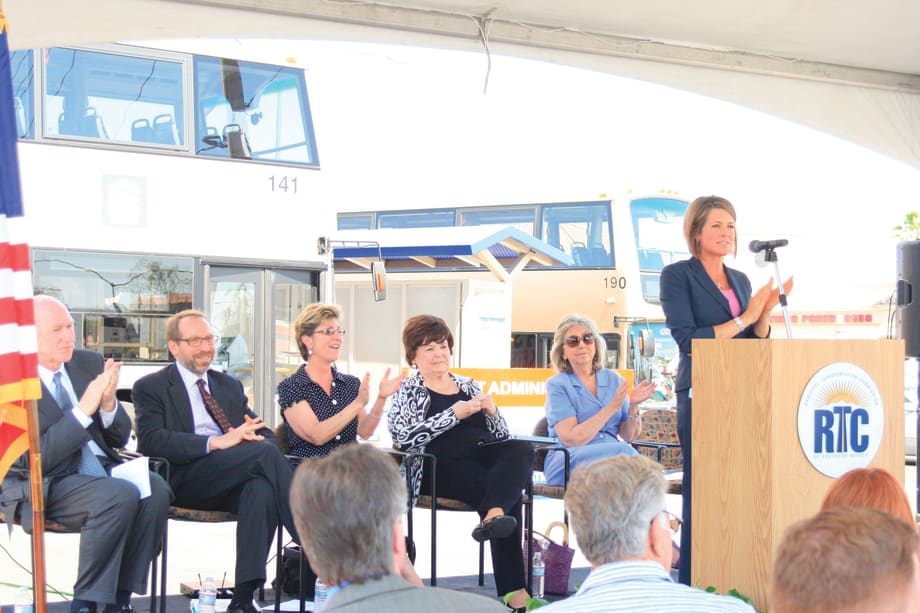
Growing up in Petaluma, Calif., Tina Quigley always dreamed of becoming a pilot. She took flying lessons in high school and upon graduation enrolled at Embry-Riddle Aeronautical University in Prescott, Ariz.
However, bad eyesight and the expense of student loans led her in a different direction. Halfway through college, she shifted gears and began pursuing an airport planning degree. Soon after completing an internship at McCarran International Airport in Las Vegas, she was offered a job.
“I thought I was only staying there for two years, but I got addicted to this place,” says Quigley. “It was growing really quickly, so I was getting exposed to projects that people would spend their whole careers looking for.”
She helped plan and acquire grant money for the building of the airport’s newest D gates. They are a collection of 25 gates connected to the main terminal through an underground transportation system, altogether amassing about one million square feet of facility.
In 2005, after 15 years at McCarran Airport, an unexpected job opportunity came Quigley’s way. Her former boss, Jacob Snow, who was recently recruited to be GM of the Regional Transportation Commission of Southern Nevada (RTC), wanted her as deputy GM.
“Although I loved the airport, I just really enjoyed Jacob Snow’s leadership style,” said Quigley. “He has a strong sense of vision but lets you do your job.”
Quigley said yes, and in this position helped launch two bus rapid transit projects and four express routes. She also assisted with the building of three park-and-ride facilities, a state-of-the-art transit facility, a traffic management facility and a bus maintenance facility.
The RTC of Southern Nevada, a designated metropolitan planning organization (MPO), is one of the few agencies in the country that’s responsible for street and highway planning and funding, freeway and arterial traffic management, and public transportation. But, the initial job transition was made simple for Quigley by the foundational crossovers of her duties at the RTC and her previous line of work.
“Like the airport, RTC is also transportation so a lot of the processes, studies and data, and the way you manage you system is very similar,” Quigley says. “We’re talking about passengers, federal processes and grants.”
In April of this year, Quigley was promoted to GM. Facing a tough economic climate, her largest goal is to focus on building a strong foundation for Las Vegas. She’s currently overseeing the ongoing Complete Street program, which promotes streets and sidewalks cohesively designed for alternative modes of transportation in addition to pedestrians and public transit. They feature wider sidewalks, bike lanes, fewer automobile lanes and more landscaping.
Quigley’s also working toward solutions for better workforce mobility. RTC plans to reach out to major employers in the district to learn about the commuting characteristics of their employees. “Our next priority is going to be growing our express system of transportation, and there are specific major corridors we’re studying right now,” says Quigley.
She’s also proud of the agency’s electric bike program. A grant funded 25 electric bikes that RTC shares with other local governments in the area. Instead of driving to meetings, employees ride these electric bikes.
Under Quigley’s leadership, the National Transit Database named the RTC one of the most efficient transit providers in the nation, according to Angela Torres of RTC’s government affairs and media relations.
When she’s not at the RTC, Quigley is utilizing her private pilot license, spending time with her family, and attending meetings for the United Way Women’s Leadership Council and the Clark County Credit Union Audit Committee.
More Bus

New York MTA Plans Largest Bus Fleet Upgrade in More Than a Decade
The agency is seeking manufacturers for 650 new CNG buses to replace aging vehicles, improve reliability, and advance its broader fleet modernization strategy.
Read More →
Building a Flexible Path to Transit Electrification
John Hroncich discusses BAE Systems’ modular and scalable approach, lessons learned from decades of real-world operations, and how agencies can identify electrification strategies that fit their fleets.
Read More →
Bus Tech Talk: Keeping Transit Technicians Ahead of the Technology Curve
LA Metro’s Obed Mejia discusses technician training, evolving maintenance technology, fleet replacement, and strategies for getting the most out of today’s transit fleets.
Read More →
Biz Briefs: RIPTA Unveils New Frontrunners, Clevland RTA Adds New Siemens, and More
In METRO's latest installment, we take a look at recent news from Siemens, Prevost, Dodge, and more partnerships making headlines across the transportation sector.
Read More →
People Movement: Holly Arnold Joins Transdev and More
In this edition, we also cover recent appointments and announcements at Pace, CamTran, MCI, and more, showcasing the individuals helping to shape the future of transportation.
Read More →
The High Cost of Transit Buses: Industry Leaders Look to Procurement Reform
Transit leaders and policymakers examine how standardized bus designs, streamlined procurement, and predictable funding could help agencies stretch budgets and deliver better service.
Read More →
The Business Voice Behind Public Transportation
As chair of APTA’s Business Members Board of Governors, Ray Melleady explains how more than 850 business members are partnering with transit agencies to advance funding, innovation, and industry-wide collaboration.
Read More →
From Surviving to Thriving: Building Stronger Transportation Organizations
Bus Business Consultants founder Brian Dickson shares lessons on leadership, organizational health, and creating options for long-term success in a changing transportation industry.
Read More →
Finding the ‘Happy Medium’: Optimizing Maintenance Without Sacrificing Reliability
The key to maintenance optimization isn’t doing less work—it’s doing the right work at the right time on the right assets.
Read More →
LA Metro, City of West Hollywood, and Partners Advance Smarter Bus Lane Enforcement
The award-winning partnership combines AI-powered detection with human oversight to improve bus reliability, accessibility, and enforcement efficiency.
Read More →