



Transit agencies: Big Brother is not watching
Each of the Central Ohio Transit Authority’s 305 buses is equipped with video and audio surveillance, which can be used clarify incidents reported by drivers or customers.
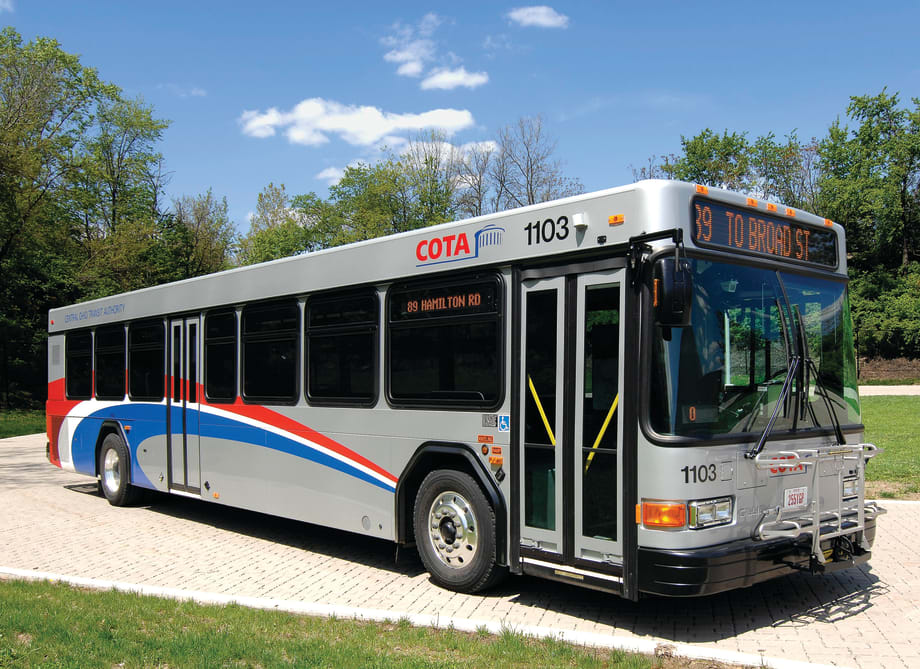
It’s true that all of the 305 fixed-route transit coaches operated by the Central Ohio Transit Authority (COTA) in Columbus, Ohio, are equipped with audio and video equipment. But when the agency showed up on a list of transit agencies accused of using surveillance equipment for the purpose of eavesdropping on passengers, VP, Communications, Marketing and Customer Service, for COTA, Marty Stutz, was more than a little surprised.
“I think you can get people’s attention when you frighten them into thinking that transit authorities have some kind of interest in recording their private conversations,” Stutz explained. “When you explain what the cameras and microphones are for on a coach, — safety and security — I think it takes away some of the fear.”
According to The Daily, a tablet publication that ceased operations on December 15, government officials were quietly installing audio-enabled surveillance systems on public buses across the country, allowing transit agencies to “effectively send an invisible police officer to transcribe the individual conversations of every passenger riding on a public bus.”
The story claimed the agencies, including COTA, the San Francisco Municipal Transportation Agency, Lane Transit District (LTD) in Eugene, Ore.; the Bay Area Transportation Authority in Traverse City, Mich.; CTTransit in Hartford; and Athens Transit in Athens, Ga., were actively seeking to install surveillance equipment for the purpose of monitoring conversations.
However, COTA’s buses have been equipped with audio and video surveillance equipment for more than three years. And, this should come as no surprise to its customers: each coach has a plaque onboard explaining monitoring is taking place.
Similarly, LTD has had audio surveillance-equipped buses for more than a decade, according to Andy Vobora, director, customer services and planning.
“I think the article [in The Daily] kind of got the discussion going,” he said. “But, we’ve been doing this for over 10 years. The only reason we were mentioned was because we were looking to upgrade the audio quality.”
LTD’s buses have five cameras and two microphones each. Vobora said it is important to note that “our program has always been incident-based. So, the video gets recorded over after a period of time; if nothing’s pulled, it’s lost forever.” The two microphones are located at the front of the bus near the driver — “we feel those conversations are important to hear” in case of an incident, he explained — and in the main body of the bus.
Each one of COTA’s coaches has multiple security cameras inside the bus, and most have two outside cameras. As for audio capabilities, those are restricted to the front of the bus.
“We have audio capabilities installed near the coach operator’s seat,” Stutz said. “And, that’s the only place on the bus where there’s any audio at all. The audio…is there so that we can investigate incidents that could occur if the coach operator is confronted with a threatening or dangerous situation while he or she is driving or while he or she has the bus stopped and customers are boarding the coach.”
Stutz emphasized that the equipment is in place for the “the safety and security of our employees and our customers.” COTA coach operators are instructed to radio for assistance if they feel threatened.
“[The surveillance] is all about customer safety and making the experience on our coaches as pleasant as possible for all our customers and our employees as well,” Stutz explained. “Instead of being hesitant to talk about our commitment to safety and security, we want our customers to know that we take it very seriously.”
More Bus

New York MTA Plans Largest Bus Fleet Upgrade in More Than a Decade
The agency is seeking manufacturers for 650 new CNG buses to replace aging vehicles, improve reliability, and advance its broader fleet modernization strategy.
Read More →
Building a Flexible Path to Transit Electrification
John Hroncich discusses BAE Systems’ modular and scalable approach, lessons learned from decades of real-world operations, and how agencies can identify electrification strategies that fit their fleets.
Read More →
Bus Tech Talk: Keeping Transit Technicians Ahead of the Technology Curve
LA Metro’s Obed Mejia discusses technician training, evolving maintenance technology, fleet replacement, and strategies for getting the most out of today’s transit fleets.
Read More →
Biz Briefs: RIPTA Unveils New Frontrunners, Clevland RTA Adds New Siemens, and More
In METRO's latest installment, we take a look at recent news from Siemens, Prevost, Dodge, and more partnerships making headlines across the transportation sector.
Read More →
People Movement: Holly Arnold Joins Transdev and More
In this edition, we also cover recent appointments and announcements at Pace, CamTran, MCI, and more, showcasing the individuals helping to shape the future of transportation.
Read More →
The High Cost of Transit Buses: Industry Leaders Look to Procurement Reform
Transit leaders and policymakers examine how standardized bus designs, streamlined procurement, and predictable funding could help agencies stretch budgets and deliver better service.
Read More →
The Business Voice Behind Public Transportation
As chair of APTA’s Business Members Board of Governors, Ray Melleady explains how more than 850 business members are partnering with transit agencies to advance funding, innovation, and industry-wide collaboration.
Read More →
From Surviving to Thriving: Building Stronger Transportation Organizations
Bus Business Consultants founder Brian Dickson shares lessons on leadership, organizational health, and creating options for long-term success in a changing transportation industry.
Read More →
Finding the ‘Happy Medium’: Optimizing Maintenance Without Sacrificing Reliability
The key to maintenance optimization isn’t doing less work—it’s doing the right work at the right time on the right assets.
Read More →
LA Metro, City of West Hollywood, and Partners Advance Smarter Bus Lane Enforcement
The award-winning partnership combines AI-powered detection with human oversight to improve bus reliability, accessibility, and enforcement efficiency.
Read More →