



2014 BRT Survey: Projects Abound, Bring Economic Benefits
Connecting to jobs and other transit modes as well as supporting economic development were big boons cited. Last year’s sequestration hurt some projects, but not enough to keep this from being a strong year for the mode, with 10 new lines opening.

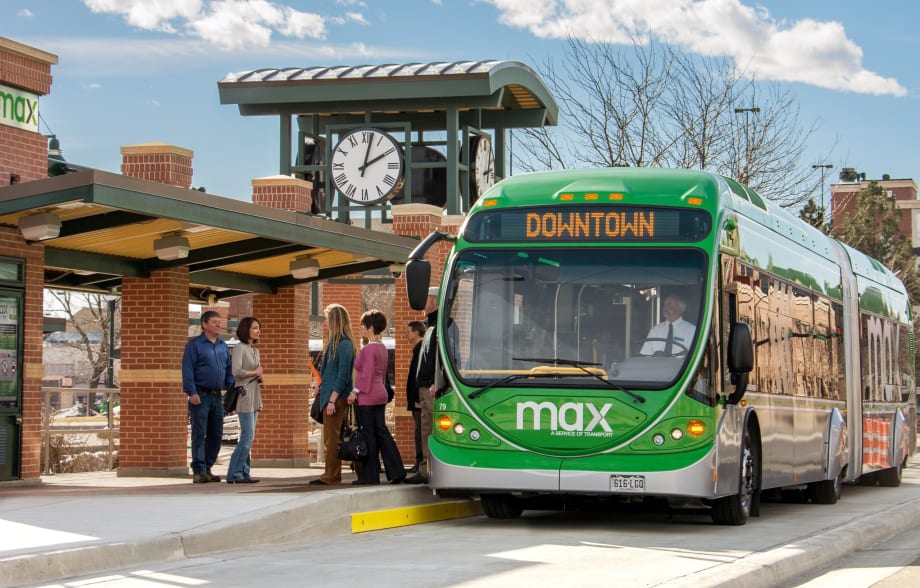
METRO’s bus rapid transit (BRT) survey results for 2014 include 41 projects, 40 of which are located in the U.S., with one in Canada.
This year, we updated our survey to include questions about the number of doors per vehicle, more specific passenger amenity information and boarding characteristics, offering options such as curb level boarding, floor level platforms or bridge plates at doors.
The upcoming year will be a big one for BRT. Launching new routes are Austin, Texas; Los Angeles; Orlando, Fla., El Paso, Texas; San Bernardino, Calif.; Seattle; Fort Collins, Colo.; and San Diego, totaling 10 new lines, nearly double the number slated for last year. The projects planned for the farthest in the future are the San Francisco Municipal Transportation Agency’s Geneva (2020) and Minneapolis-based Metro Transit’s Orange Line (2019.)
RELATED: "BRT 2014 Photo Gallery"
Two of Florida’s projects were in the spotlight recently: U.S. Transportation Secretary Anthony Foxx toured the nearly completed East-West Circulator in downtown Orlando, Fla. The new line, scheduled to open this spring, will connect area residents with several employers and attractions.
The Federal Transit Administration (FTA) is providing approximately $8 million in funds toward the $10 million project.
In addition, the U.S. Department of Transportation committed $13 million in Transportation Investment Generating Economic Recovery (TIGER) funding for construction of another BRT line to link the Parramore neighborhood — one of Orlando’s lowest-income neighborhoods — to other rapid bus and commuter rail service.
Construction of the Parramore BRT line is expected to begin this spring.
Meanwhile, in October 2013, the Minnesota Public Transit Association (MPTA) awarded its annual Management Innovation Award to the Minneapolis/St. Paul Metro Red Line BRT project as an example of a creative partnership designed to address the needs of transit users.
Cities such as St. Louis and Albuquerque, N.M., are currently taking a new look at possible BRT routes to shorten commutes and provide more transportation access to students.
The U.S. region reporting the highest number of BRT projects in our survey was, once again, the West Coast, with 25. Most of the projects respondents discussed are located in California — 60% of West Coast projects and one-third of all projects. Projects in this region combined totaled $924.3 million, slightly less than last year’s $1.8 billion total.
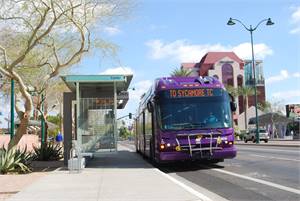
Valley Metro’s Mesa Main Street LINK BRT service began operating in 2008. It has since provided more connectivity to the light rail, schools, shopping and other attractions.
Meanwhile, the total capital cost of all projects reported was $1.8 billion.
The project reporting the highest number of vehicles is Ontario, Canada-based Brampton Transit’s Zum line, with 70 buses.
Slightly more than three-quarters of respondents are using or plan to use low-floor style vehicles, which is down from last year’s 91%. Three-quarters of respondents selected articulated vehicles and nearly two-thirds chose enhanced aesthetics, which is the same as last year.
Most operators reported the number of doors on their vehicles is three, at one-third, with two doors coming in a distant second option, at 20%. Twelve percent of operators said their vehicles have five doors.
Nearly one-half of operators surveyed plan to use hybrid-electric propulsion for their vehicles, just slightly less than last year. Nearly one-third use or plan to use CNG, which is on par with last year, with clean diesel use up by a hair, at 22%. Only one operator plans to use trolleys.
The most popular vehicle amenities chosen by operators were conventional transit seats and bicycle racks on the front bumper at about one-half for each. Coming in a distant third and fourth place were inside bicycle racks (14.6%) and added comfort non-reclining seats (12%).
Nearly one-half of operators selected curb-level boarding, slightly more than one-quarter chose floor-level platforms, and nearly 20% use or plan to use bridge plates at doors.
For fare collection, more than two-thirds of projects will use cash/coin, nearly two-thirds of operators selected off-board payment, about one-half are using smart cards and/or on-board payment, and slightly more than one-third selected magnetic strip. Two systems selected mobile payment as a fare option.
Federal funding, including FTA’s Very Small Starts, Small Starts, ARRA, TIGER and Congestion Mitigation and Air Quality, made up about two-thirds of the funding for projects. Local support is helping more than one-half of all projects, at 56%, and state money was awarded to one-third of all BRT lines represented.
This year’s survey showed less federal funding and local support — down by 16.5% and 10%, respectively — but that could be because fewer projects were submitted this year.
However, those results do fall in line with the biggest oft-cited challenge of funding. One operator of four different projects pointed to last year’s sequestration as a particular difficulty, since it delayed federal money.
Closely following that was the hurdle of coordination with multiple cities, counties and other jurisdictions. Construction and limited right-of-way are less-reported but still common concerns.
The project benefits touted most frequently were cutting travel time; connecting to job centers, rail and other transit modes; supporting economic development and growing ridership.
Regarding running way features, respondents once again this year overwhelmingly chose mixed-flow arterials, at 80%, with dedicated arterials selected by one-quarter of respondents.
When asked about ITS features, more than 80% selected passenger information and signal manipulation, similar to last year. More than three-quarters chose voice annunciation, while vehicle tracking came in at 70%. Nearly two-thirds are using ITS for security. Other uses included railway detection, gate control of guideway access and real-time bus arrival information.
To view the article as it appeared in print, click here.
More Bus

People Movement: Dan Dipert Coaches Adds Third-Generation Leader, Keolis Names New Valley Metro VP/GM, and More
In this edition, we also cover recent appointments and announcements at the Wabtec, SilverRide, HNTB, and more, showcasing the individuals helping to shape the future of transportation.
Read More →
New York MTA Plans Largest Bus Fleet Upgrade in More Than a Decade
The agency is seeking manufacturers for 650 new CNG buses to replace aging vehicles, improve reliability, and advance its broader fleet modernization strategy.
Read More →
Building a Flexible Path to Transit Electrification
John Hroncich discusses BAE Systems’ modular and scalable approach, lessons learned from decades of real-world operations, and how agencies can identify electrification strategies that fit their fleets.
Read More →
Bus Tech Talk: Keeping Transit Technicians Ahead of the Technology Curve
LA Metro’s Obed Mejia discusses technician training, evolving maintenance technology, fleet replacement, and strategies for getting the most out of today’s transit fleets.
Read More →
Biz Briefs: RIPTA Unveils New Frontrunners, Clevland RTA Adds New Siemens, and More
In METRO's latest installment, we take a look at recent news from Siemens, Prevost, Dodge, and more partnerships making headlines across the transportation sector.
Read More →
People Movement: Holly Arnold Joins Transdev and More
In this edition, we also cover recent appointments and announcements at Pace, CamTran, MCI, and more, showcasing the individuals helping to shape the future of transportation.
Read More →
The High Cost of Transit Buses: Industry Leaders Look to Procurement Reform
Transit leaders and policymakers examine how standardized bus designs, streamlined procurement, and predictable funding could help agencies stretch budgets and deliver better service.
Read More →
The Business Voice Behind Public Transportation
As chair of APTA’s Business Members Board of Governors, Ray Melleady explains how more than 850 business members are partnering with transit agencies to advance funding, innovation, and industry-wide collaboration.
Read More →
From Surviving to Thriving: Building Stronger Transportation Organizations
Bus Business Consultants founder Brian Dickson shares lessons on leadership, organizational health, and creating options for long-term success in a changing transportation industry.
Read More →
Finding the ‘Happy Medium’: Optimizing Maintenance Without Sacrificing Reliability
The key to maintenance optimization isn’t doing less work—it’s doing the right work at the right time on the right assets.
Read More →