



BYD Passes Altoona Testing, Set to Make Big Leap Into the Market
As transit agencies continue to look at ways to both improve their environmental footprint and save money, the interest in all-electric buses has steadily increased.

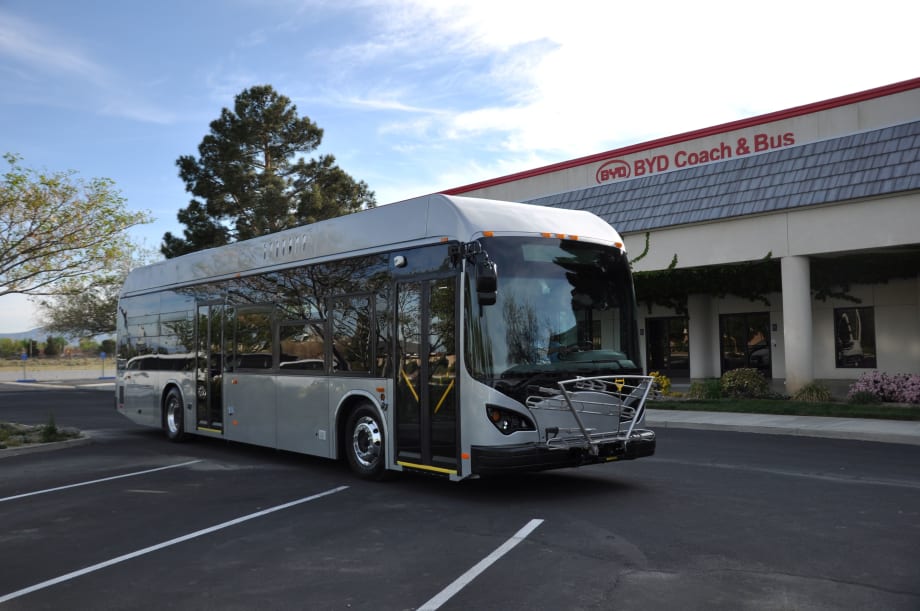
BYD plans to introduce several new models over the next couple of years ranging from 26 feet to 45 feet, as well as an articulated model.
As transit agencies continue to look at ways to both improve their environmental footprint and save money, the interest in all-electric buses has steadily increased.
Capitalizing on that growth, BYD introduced its all-electric vehicle to the market a few years ago, garnering interest in several cities, including Los Angeles, where the Los Angeles County Metropolitan Transportation Authority (Metro) is set to take delivery of 25 BYD 40-foot buses
In late May, BYD’s all-electric 40-foot bus completed the Federal Transit Administration’s “new model bus testing program” at the Altoona Bus Research and Testing Center in a fast 116 track days.
Additionally, the company opened an electric bus factory in Lancaster, Calif., in April, at which time it rolled out the first 40-foot bus built at that facility. The event featured several dignitaries, including Gov. Jerry Brown, who called the opening “a harbinger of great things to come.”
METRO Magazine recently spoke to BYD’s President Stella Li about the vehicle’s technology and the company’s future.
METRO: What sets BYD’s buses apart from others on the market?
Li: There are several differentiators in our buses, which set us apart from our competition and make it less expensive for customers, reducing infrastructure investments.
One is that the battery can last over 12 years, and with one charge, can propel the bus up to 24 hours and go for over 150 miles. The second is that our in-wheel motors replace the clutches, drive-train and transmission that our competitors all use, so you save a lot on maintenance costs, reducing the components that can fail while increasing efficiencies, all in a zero-emissions bus.
Finally, we embedded the charging technology into the bus — multi-using the regenerative braking inverters. Our concept is we want to make our green bus of the future as easy to use as your cell phone.
Explain that concept.
Sure. If you think about the way we use electricity, an Alternating-Current (AC) charging infrastructure for our buses is everywhere; all you need is a plug. For our charger, you just need to plug 480-volt, 3-phase, AC directly into the bus with a small power interface, which makes it very cheap to implement the charging infrastructure; it only costs about $8,000 and that is mainly for the mechanical warranty costs.
Because of all this, and the fact that our bus is the only one on the market that has such a long range per charge, I believe our bus is the wave of the future.
There have been plenty of agencies that have tested your buses, what are the results and what has their feedback been?
So far, every agency that has tested our bus has had a positive experience — they have been quite pleased.
I believe that allowing agencies to test our buses has improved their confidence, especially because this is a very conservative industry. Agencies have pressure to guarantee daily service, and if they experience issues in doing that, it’s a real problem. So, reliability is incredibly important. We understand the pressure transit agencies are facing, so as a company our mission is to develop robust technology that is as simple and reliable as possible.
Have you made changes to your buses at all after receiving feedback from the agencies that have tested them?
We have made configuration changes and improved durability based on feedback, but from a technology standpoint, our research and development has been strong from the beginning.
Has the battery technology improved since you’ve introduced the bus?
Not the BYD Iron-Phosphate technology so much, but we have continued to increase capacity. We believe that by the second half of next year, we can increase capacity another 10% to 15%, which will be great for agencies because they will get a bus with even more range for exactly the same price.
You received an order from L.A. Metro for 25 of your buses, now that you’ve completed Altoona testing what is the status of that delivery?
We are moving very deliberately on that order to make sure that every one of the 25 buses we are building are up to Metro’s specifications and meet their local configuration. We expect to deliver the buses by November.
Will those buses be built at your newly opened plant in Lancaster?
Yes. We actually have two factories in Lancaster: one for the manufacturer of the batteries and the other builds the buses.
We now also have an engineering team at the Lancaster facility, which will be working on designing a 60-foot articulated bus that we will prototype very soon. We also plan on growing our workforce at this facility from 50-plus employees that we have now to somewhere between 100 and 150, by the end of the year.
Are there plans to introduce other new models besides the articulated version?
Yes, as I mentioned we hope the articulated bus will be ready this fall. We also have a 26-foot shuttle bus that was recently demoed by the Los Angeles Department of Transportation. That bus was a high-floor and we plan to introduce a 30-foot low-floor version by the second half of next year. We are also planning on introducing a 45-foot commuter coach bus next year as well.
So, the plan is to introduce maybe three models or so each year to our market, because we also target the private industry in addition to the public transit industry.
Aside from that, what are BYD’s short- and long-term goals?
For the short term, it is to ramp up our Lancaster facility successfully. The more demos we have, the more the customer confidence is built in the technology.
BYD as a company has also grown up: we have more people, more experience and are in a position now to recruit from within the industry. Now, our plan is to really focus on the expansion of the business into the entire U.S., not just California. We want to continue to provide demos all across the states and various regions, and hopefully if they continue to be pleased with what they see, maybe next year we can double or even triple our business.
More Bus

Report: Transit Bus Manufacturing Supports 34,100 Jobs, $5.1B in GDP
The “Buses Mean Business” report examines the transit bus manufacturing industry’s economic footprint, supply chain, and rising demand for vehicle replacements.
Read More →
Biz Briefs: New Flyer Delivers in Columbus, Houston, Beep and Freebee Merge, and More
In this edition of Biz Briefs, we spotlight the latest developments shaping the future of mobility.
Read More →
People Movement: Dan Dipert Coaches Adds Third-Generation Leader, Keolis Names New Valley Metro VP/GM, and More
In this edition, we also cover recent appointments and announcements at the Wabtec, SilverRide, HNTB, and more, showcasing the individuals helping to shape the future of transportation.
Read More →
New York MTA Plans Largest Bus Fleet Upgrade in More Than a Decade
The agency is seeking manufacturers for 650 new CNG buses to replace aging vehicles, improve reliability, and advance its broader fleet modernization strategy.
Read More →
Building a Flexible Path to Transit Electrification
John Hroncich discusses BAE Systems’ modular and scalable approach, lessons learned from decades of real-world operations, and how agencies can identify electrification strategies that fit their fleets.
Read More →
Bus Tech Talk: Keeping Transit Technicians Ahead of the Technology Curve
LA Metro’s Obed Mejia discusses technician training, evolving maintenance technology, fleet replacement, and strategies for getting the most out of today’s transit fleets.
Read More →
Biz Briefs: RIPTA Unveils New Frontrunners, Clevland RTA Adds New Siemens, and More
In METRO's latest installment, we take a look at recent news from Siemens, Prevost, Dodge, and more partnerships making headlines across the transportation sector.
Read More →
People Movement: Holly Arnold Joins Transdev and More
In this edition, we also cover recent appointments and announcements at Pace, CamTran, MCI, and more, showcasing the individuals helping to shape the future of transportation.
Read More →
The High Cost of Transit Buses: Industry Leaders Look to Procurement Reform
Transit leaders and policymakers examine how standardized bus designs, streamlined procurement, and predictable funding could help agencies stretch budgets and deliver better service.
Read More →
The Business Voice Behind Public Transportation
As chair of APTA’s Business Members Board of Governors, Ray Melleady explains how more than 850 business members are partnering with transit agencies to advance funding, innovation, and industry-wide collaboration.
Read More →