



2014 Women In Transportation: Mary Shaffer
Public Relations Broward County Transit Fort Lauderdale, Fla.
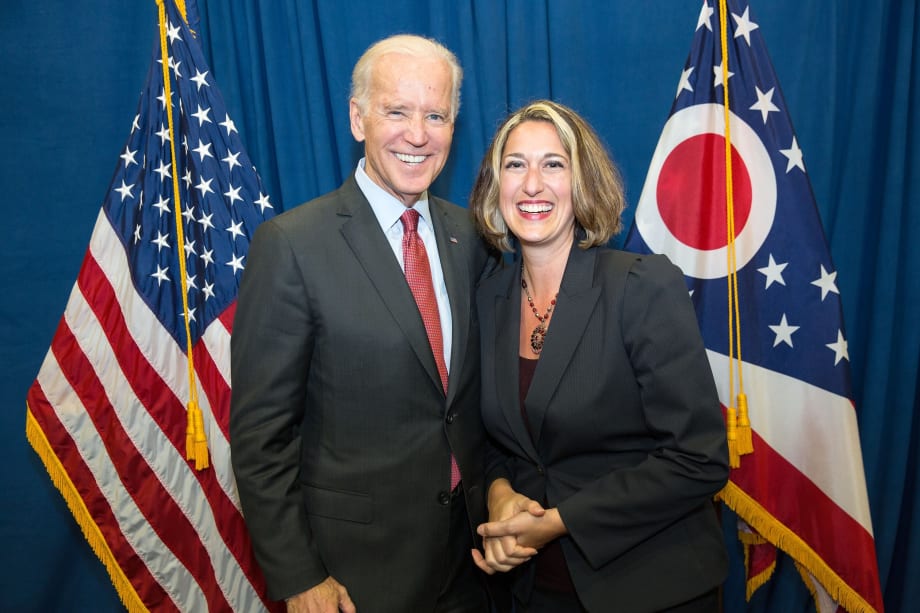
Last year, Shaffer and the Cleveland RTA team hosted Vice President Joe Biden at their rail facility. Recently, Shaffer left RTA to join the Broward County Transit team.
Last year, Shaffer and the Cleveland RTA team hosted Vice President Joe Biden at their rail facility. Recently, Shaffer left RTA to join the Broward County Transit team.
The best part of Mary Shaffer’s previous role as the public relations representative for the Greater Cleveland Regional Transit Authority (RTA) was when it worked.
“I know our campaigns had a lot of impact when people come up to me and tell me they don’t know what they’d do without RTA,” she explains. “That was the most rewarding.”
Last year, Shaffer and her team had the opportunity to host Vice President Joe Biden at RTA’s rail facility. She says the fact that Biden thought their projects and programs were important enough to single out over everywhere else in the country was a huge accomplishment.
Shaffer spent about eight years pursuing a broadcast journalism career before switching over to public relations. In fact, it wasn’t until she received an opportunity to work for Delphi Automotive in Mexico doing media relations that she considered the transit world at all, she explains. According to Shaffer, she spent several years doing PR for Delphi, the private firm Dix & Eaton, and eventually, her own firm until she moved into the public transit market.
After she relocated back to Cleveland, she explains she had a respect and love for public transportation. Shaffer consciously moved to an area with easy access to the train she could ride downtown to work to avoid the expense of parking. While running her own firm, she says she would occasionally check in to see if there were any openings for public relations.
When a position for the media relations manager for RTA came available four years ago, she applied, building it into a full public relations segment.
“Now, we’re not just fighting and being on the defensive,” Shaffer explains. “We’re actively promoting all the good things we have and putting them out in front of people and personalizing the things that are wonderful.”
An example she gives is highlighting an individual in a wheelchair, who wouldn’t be able to get to work every day if it weren’t for paratransit.
According to Shaffer, the different hats she wore at RTA ran the gammit from media and community relations, public speaking, speech writing, community fundraising events, coordinating board members and special projects management, such as facilitating the transportation of the athletes and attendees of the Senior Games and the Gay Games. Though employee communications program are not necessarily in her personal arsenal, she helps when she can, because she feels that good employee relations is extremely important.
“To have a good external image you have to have a good relationship with your internal co-workers,” Shaffer says.
Since she began her work with RTA, one of Shaffer’s proudest accomplishments has been to help establish a speaker’s bureau. She explains that she has about 45 RTA employees she trained in presentation skills, teaching them what kinds of things to focus on if they are asked to speak in public. She feels this is valuable, because there were often staff members who have a great working knowledge of a particular area, but may not have felt the most comfortable speaking in front of the public.
As she navigated her role, Shaffer says she found media relations is often the most difficult aspect, but one of the most important. With the addition of social media-type news outlets, there are more individuals looking to get in touch with her.
“While there are actually more [reporters], there is still only one of me,” she says. “Some days there are 12 or 14 phones calls about 12 or 14 different events.”
But since she had many years of experience as a journalist, she knows what it entails to reach a deadline and is responsive as she can be, especially with the rise of multimedia journalism.
Shaffer recently took her talents to the Fort Lauderdale, Fla. area, in a great opportunity to lead the marketing, communications and customer service areas at Broward County Transit. She is excited for the new challenges and mostly, for the lack of snow.
More Bus

New York MTA Plans Largest Bus Fleet Upgrade in More Than a Decade
The agency is seeking manufacturers for 650 new CNG buses to replace aging vehicles, improve reliability, and advance its broader fleet modernization strategy.
Read More →
Building a Flexible Path to Transit Electrification
John Hroncich discusses BAE Systems’ modular and scalable approach, lessons learned from decades of real-world operations, and how agencies can identify electrification strategies that fit their fleets.
Read More →
Bus Tech Talk: Keeping Transit Technicians Ahead of the Technology Curve
LA Metro’s Obed Mejia discusses technician training, evolving maintenance technology, fleet replacement, and strategies for getting the most out of today’s transit fleets.
Read More →
Biz Briefs: RIPTA Unveils New Frontrunners, Clevland RTA Adds New Siemens, and More
In METRO's latest installment, we take a look at recent news from Siemens, Prevost, Dodge, and more partnerships making headlines across the transportation sector.
Read More →
People Movement: Holly Arnold Joins Transdev and More
In this edition, we also cover recent appointments and announcements at Pace, CamTran, MCI, and more, showcasing the individuals helping to shape the future of transportation.
Read More →
The High Cost of Transit Buses: Industry Leaders Look to Procurement Reform
Transit leaders and policymakers examine how standardized bus designs, streamlined procurement, and predictable funding could help agencies stretch budgets and deliver better service.
Read More →
The Business Voice Behind Public Transportation
As chair of APTA’s Business Members Board of Governors, Ray Melleady explains how more than 850 business members are partnering with transit agencies to advance funding, innovation, and industry-wide collaboration.
Read More →
From Surviving to Thriving: Building Stronger Transportation Organizations
Bus Business Consultants founder Brian Dickson shares lessons on leadership, organizational health, and creating options for long-term success in a changing transportation industry.
Read More →
Finding the ‘Happy Medium’: Optimizing Maintenance Without Sacrificing Reliability
The key to maintenance optimization isn’t doing less work—it’s doing the right work at the right time on the right assets.
Read More →
LA Metro, City of West Hollywood, and Partners Advance Smarter Bus Lane Enforcement
The award-winning partnership combines AI-powered detection with human oversight to improve bus reliability, accessibility, and enforcement efficiency.
Read More →