



Omnitrans' sbX Green Line Service
The 16-mile BRT line, which began passenger service in April 2014, includes over five miles of dedicated lanes, 16 station locations, and four park-and-ride lots. It serves major activity centers, including two hospitals, two universities, numerous trade schools, city and county government centers, and employment centers, along with major shopping, hospitality and entertainment venues.
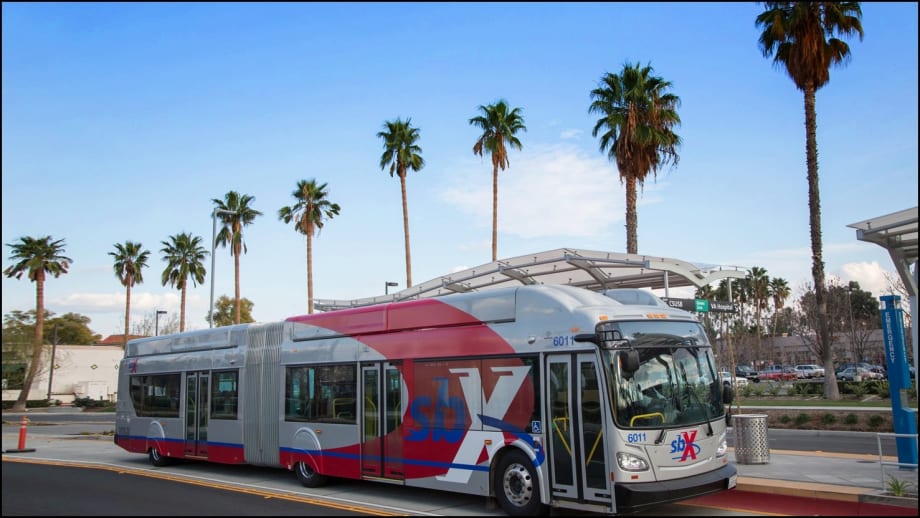
San Bernardino, Calif.-based Omnitrans is nearing the one-year anniversary of the launch of its sbX BRT service. The 16-mile BRT line, which began passenger service in April 2014, includes over five miles of dedicated lanes, 16 station locations, and four park-and-ride lots. It serves major activity centers, including two hospitals, two universities, numerous trade schools, city and county government centers, and employment centers, along with major shopping, hospitality and entertainment venues.
“Our customers reflect these varied destinations,” says Omnitrans Director, Marketing and Planning, Wendy Williams. “It does appear from observation that the sbX ridership trends a little younger because of the university and high school connections.”
The 14 articulated vehicles manufactured by New Flyer for the sbX line are the first five-door, CNG-powered 60-foot buses ever built. Vehicle features include rear-facing, self-securement wheelchair positions, interior bike racks, and on-board Wi-Fi and power outlets.
sbX utilizes traffic signal prioritization and dedicated station platforms with real-time arrival displays, ticket vending machines, emergency telephones, customer call boxes and public art. To enhance security, multiple video cameras at each station are monitored 24/7.
The total budget for the project was $191.7 million, which includes design, corridor construction, 14 vehicles, and upgrades at Omnitrans’ vehicle maintenance facility (design and construction) to accommodate the articulated buses. The capital project utilized FTA Small Starts funding ($75 million), other FTA funding ($67.3 million), and local/state funding ($49.5 million).
“We are proud to say that Omnitrans delivered the sbX green line project on time, under budget and with zero lost time accidents during construction,” Williams says.
The sbX’s branding was developed during the design phase, she explains. “The intent was to differentiate the BRT service from local service by creating a distinct brand image with an eye toward attracting the non-traditional rider. The letters are intended to signify San Bernardino (Valley) Express.”
When asked how development in the areas surrounding the line changed since its launch, Williams says that although the line has been operational less than a year, the agency is beginning to see signs of development that will benefit from the BRT service and the fall 2015 completion of an adjacent new transit center in downtown San Bernardino (SBTC). “There is a mixed use project under construction near the California State University, San Bernardino station. Proximity to the sbX line and SBTC was cited as a key factor in the City’s efforts to get developer proposals to redevelop an aged mall in downtown,” she adds.
“We are still working on optimization of the transit signal priority system and traffic signal synchronization; when complete we expect to trim end-to-end travel time by another 10 to 15%,” Williams says.
From the first week of paid service, ridership on sbX has doubled. However, Omnitrans is below original projections, due in large part to the SBTC project not being completed prior to the sbX launch as originally planned (a decade ago), Williams explains. With the transit center opening in September 2015, Omnitrans expects a significant boost to ridership on sbX as there will be a direct connection with 13 local routes. Currently, there is a 4/10 mile walk between sbX and Omnitrans’ temporary downtown transfer facility.
Omnitrans has begun work on its next proposed BRT line, Williams says. “The alternative analysis of the “West Valley Connector Corridor” is complete, and we expect to begin design later this year.”
More Bus

New York MTA Plans Largest Bus Fleet Upgrade in More Than a Decade
The agency is seeking manufacturers for 650 new CNG buses to replace aging vehicles, improve reliability, and advance its broader fleet modernization strategy.
Read More →
Building a Flexible Path to Transit Electrification
John Hroncich discusses BAE Systems’ modular and scalable approach, lessons learned from decades of real-world operations, and how agencies can identify electrification strategies that fit their fleets.
Read More →
Bus Tech Talk: Keeping Transit Technicians Ahead of the Technology Curve
LA Metro’s Obed Mejia discusses technician training, evolving maintenance technology, fleet replacement, and strategies for getting the most out of today’s transit fleets.
Read More →
Biz Briefs: RIPTA Unveils New Frontrunners, Clevland RTA Adds New Siemens, and More
In METRO's latest installment, we take a look at recent news from Siemens, Prevost, Dodge, and more partnerships making headlines across the transportation sector.
Read More →
People Movement: Holly Arnold Joins Transdev and More
In this edition, we also cover recent appointments and announcements at Pace, CamTran, MCI, and more, showcasing the individuals helping to shape the future of transportation.
Read More →
The High Cost of Transit Buses: Industry Leaders Look to Procurement Reform
Transit leaders and policymakers examine how standardized bus designs, streamlined procurement, and predictable funding could help agencies stretch budgets and deliver better service.
Read More →
The Business Voice Behind Public Transportation
As chair of APTA’s Business Members Board of Governors, Ray Melleady explains how more than 850 business members are partnering with transit agencies to advance funding, innovation, and industry-wide collaboration.
Read More →
From Surviving to Thriving: Building Stronger Transportation Organizations
Bus Business Consultants founder Brian Dickson shares lessons on leadership, organizational health, and creating options for long-term success in a changing transportation industry.
Read More →
Finding the ‘Happy Medium’: Optimizing Maintenance Without Sacrificing Reliability
The key to maintenance optimization isn’t doing less work—it’s doing the right work at the right time on the right assets.
Read More →
LA Metro, City of West Hollywood, and Partners Advance Smarter Bus Lane Enforcement
The award-winning partnership combines AI-powered detection with human oversight to improve bus reliability, accessibility, and enforcement efficiency.
Read More →