



Fleet, Route Updates Help San Diego MTS' Adapt to Service Demands
The agency is continuing to balance paratransit and ridership challenges with a growing fleet of clean-fuel vehicles.
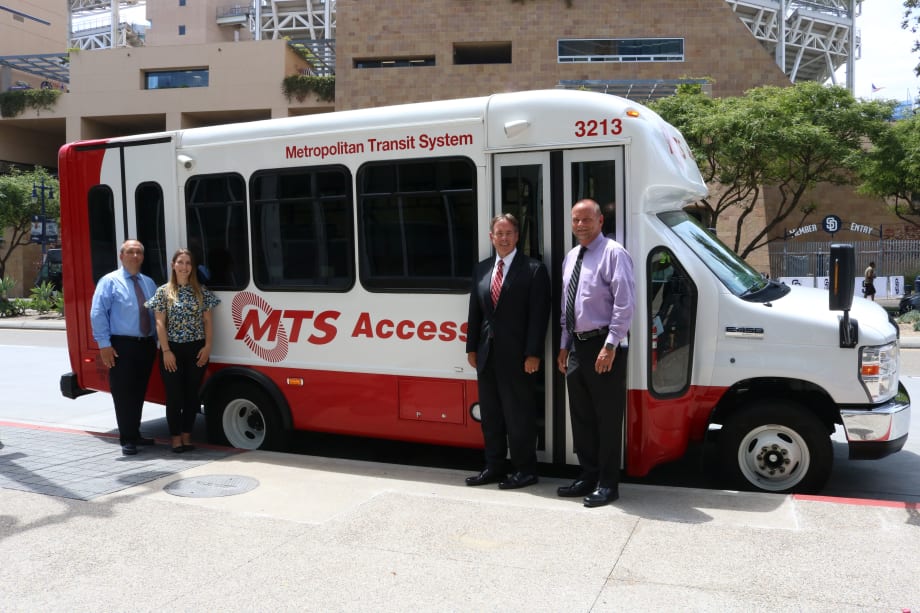
MTS began using the StarCraft product for its paratransit services in 2008. Pictured (from L to R) Jay Washburn, MTS manager of paratransit and minibus; Vassilena Lerinska, MTS transit operations specialist; Paul Jablonski, MTS CEO; and Bill Spraul, MTS Bus COO.
Photos courtesy MTS

Long a proponent of clean fuels, San Diego’s Metropolitan Transit System (MTS) boasts an all-natural gas fixed-route fleet, moving recently from compressed natural gas (CNG) to renewable natural gas. It’s just one of many steps the agency has taken to reduce emissions while still maintaining a high-level of performance demanded by the 570- square-mile territory it serves.
“When we made the decision to go 100% CNG in the early 2000s, we may have been the first system in California, and among the first in the nation,” explains Bill Spraul, COO, transit services division, at MTS. “We are also switching over to the Cummins low NOx engines, so with the combination of those engines and the renewable natural gas, we expect to really continue to drive down our emissions profile.”
In its quest to lower emissions, the agency also decided a couple years ago to switch its minibus and paratransit fleet — approximately 210 vehicles in all — to propane autogas.
“We are about 50 percent of the way through that conversion right now, and expect to be 100 percent propane autogas with our minibus and paratransit fleet within three years.”
Continuing down its greener path, the MTS board also approved the purchase of six 40-foot electric buses, along with options to purchase nine depot chargers. The total cost of the purchase is estimated at $6 million, and the buses are expected to arrive mid-summer 2019.
Paratransit services
The 20-year transition to clean fuels has been successful, but new passenger counts have presented a challenge. Like most transit agencies around the nation, MTS has been seeing an uptick in demand for its paratransit system and is challenged to manage that demand with the high cost of providing the service.
“The cost for a paratransit trip is significantly higher than fixed-route transit trips because of the way the service is operated — the duty cycles are heavy and the vehicles that go out can put on 300 to 350 miles a day — so really it’s all about balancing cost and demand,” says Spraul.
He adds that the success of the agency’s paratransit system can be contributed to both choosing a good contractor — First Transit operates the service but MTS owns the fleet — and having a dependable fleet. To that end, MTS has been purchasing Forest River’s Starcraft All-Star bus, built on the Ford E450 chassis, since 2008 from its dealer Creative Bus Sales.
“In this service, where we provide transit service to people with disabilities, the vehicles we operate have to be dependable and reliable and the Starcraft product has been both of those things for us,” Spraul says.
With a seating capacity of 16 ambulatory and four wheelchair positions, the entire 170-vehicle MTS paratransit fleet now consists exclusively of Starcraft buses. All told, Spraul says that the agency’s Starcraft fleet has traveled 42 million miles and carried 4.5 million passengers since making their debut in 2008.
He adds that MTS originally started purchasing Starcraft buses as part of a competitive procurement process, but now purchases the buses off of a CalACT state contract, because MTS has been satisfied with the performance and cost-effectiveness of the bus, as well as the partnership with Creative Bus Sales and Forest River, Starcraft’s parent company.

Spraul says that having one vehicle type in use across its entire paratransit fleet has also brought continuity for its maintenance and bus operators.
Another reason MTS has remained faithful to the Starcraft brand is the vehicles adaptability.
“We’ve installed fire suppression systems, onboard mobile display terminals so we can do real-time CAD/AVL, Apollo Video Technology camera and audio systems, and back-up cameras,” explains Spraul. “Of course, the fleet is also being converted to propane autogas as well, and through it all we have never had an issue doing any of those things to the Starcraft bus. It really remains to be a workhorse for our system.”
Boosting Ridership
With 53 miles of rail track and 125 railcars, 95 bus routes serviced by 630 fixed-route buses, and 170 paratransit vehicles, MTS moves more than 300,000 passenger trips in 10 cities and the county every day. In fact, in FY 2017, the agency served more than 88 million riders.
Even with those impressive numbers, though, MTS like many agencies around the nation is seeing a dip in ridership and fare revenue. To that end, the agency’s board unanimously approved changes to the bus network last September, adding $2 million in new service.
The Transit Optimization Plan (TOP), which includes significant additions to the agency’s network of high-frequency services and shorter wait times, is being implemented in three phases, with the first two phases occurring in January and June, and the final phase launching this September.
“Our Transit Optimization Plan is sort of like the old comprehensive analysis and is a combination of changes in frequency of service, as well adding in some new service and shortening some routes that weren’t performing well,” Spraul explains. “All told, we are making adjustments to over 60 percent of our routes and making adjustments to our light rail system, as well, to better meet market demands and ridership patterns.”
The TOP process included nearly 6,000 surveys, more than 50 outreach events across the region, and a public hearing. It also incorporated data that MTS has been accumulating over the years.
“When our CEO Paul Jablonski arrived in San Diego, part of the redesign of MTS as a transit system was to implement what we call a market-based approach,” says Spraul. “So, we put in key performance standards that every bus route in the system has to meet, and about every two years or so, we go through and look at those standards to see which routes are continuing to perform. Using that information, as well as the feedback we received, we developed the TOP plan.”
Spraul explains that MTS serves a diverse area that not only includes the traditional Central Business District, but also several “edge” cities that have developed successful employment centers. He adds that the TOP plan also focused on the unique ridership growth the agency sees to and from the city’s downtown area south to the border with Mexico — a 15-mile distance.
“We continue to see that ridership from our southern area up into San Diego is increasing, and with TOP we attempted to reshift and continue to meet ridership demands where our employment, education, and medical centers are, so we reallocated resources for that,” Spraul says.
More Bus
Biz Briefs: OCTA Taps Clean Energy for Hydrogen Station, Stadler to Supply Via Rail Vehicles, and More
From manufacturers and suppliers to transit agencies and motorcoach operators, these updates offer a snapshot of the projects, partnerships and business moves driving the industry forward.
Read More →
METRO Magazine Announces 2026 Innovative Solutions Awards Winners
Projects Recognized for Advancing Mobility Through Technology, Accessibility, Workforce Innovation, and Operational Excellence
Read More →
Biz Briefs: STV teams with Amtrak, Motorcoach Operators Boost Fleet and Land Contracts, and More
From manufacturers and suppliers to transit agencies and motorcoach operators, these updates offer a snapshot of the projects, partnerships and business moves driving the industry forward.
Read More →
LA Metro Marks Banner Year, Sets Ambitious Goals for New Fiscal Year
Incoming LA Metro Board Chair and Los Angeles Mayor Karen Bass joined outgoing Board Chair Fernando Dutra and LA Metro CEO Stephanie Wiggins to review accomplishments from fiscal year 2026, which included the opening of new rail extensions, advancement of major transit projects, expanded safety programs, and new rider amenities.
Read More →
DART Taps Nathaniel P. Ford Sr. as Next President/CEO
Since 2012, Ford has served as the CEO of the Jacksonville Transportation Authority
Read More →
AC Transit’s Cecil Blandon on Building the Next Generation of Transit Maintenance Leaders
The agency’s maintenance chief discusses leadership, workforce development, zero-emission technology, and preparing technicians for the future of public transportation.
Read More →
Building the Next Generation of Transit Technology
In this edition of METROspectives, Luminator CEO Magnus Friberg discusses the company's transformation, the growing role of AI and software, and what's next for transit technology.
Read More →
June LA Metro Ridership Surges 2 Million Year Over Year
Total June ridership increased for both weekdays and weekends. Weekday ridership was 953,820, which grew 8.4% from June 2025; Saturdays increased nearly 13% year-over-year to 708,826; and Sundays increased 7.7% to 611,534 from June 2025, according to LA Metro.
Read More →
Washington's Pierce Transit Board Sends Transit Funding Measure to November Ballot
With the adoption of Resolution 2026-006, the measure moves to the Pierce County Auditor, giving voters in the Pierce Transit service area the decision on whether to fund an expansion of local transit service within the agency’s service area.
Read More →
New York Unveils Sweeping Plan to Modernize City Bus Service
Next Stop: Fast Buses, Better Service identifies 50 priority bus corridors for improvements across the five boroughs and launches the City’s next generation of rapid bus service along five key routes.
Read More →