



German bus system to test Bombardier electric charging tech
PRIMOVE technology is based on inductive energy transfer. It is installed entirely under the road surface and under the floor of the vehicles. The charging process begins as soon as the vehicle completely covers the charging segment.

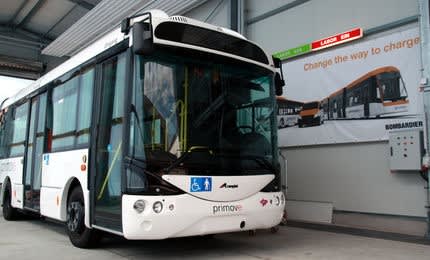
Mannheim, Germany-based regional operator Rhein-Neckar-Verkehr GmbH (RNV) is introducing electric buses equipped with Bombardier's PRIMOVE technology as part of a pilot project.
During the “PRIMOVE Mannheim” research project, electric buses will recharge wirelessly while passengers get on and off the vehicles at bus stops along a selected inner city route. The project aims to prove that electric buses can operate daily passenger services, even on demanding routes.
During an initial period of 12 months, two completely electrically powered and inductively charged electric buses will be trialled in daily passenger operation on the existing RNV bus route. Both e-buses, built by the Swiss manufacturer Carrosserie HESS AG, are also equipped with the new Bombardier MITRAC e-bus powertrain for city buses. In addition, an electric van equipped with wireless PRIMOVE technology will be tested as a RNV service vehicle.
The project will help to determine a framework for infrastructure, batteries, inductive energy transfer and daily operation by testing the new technology on a real-life route. The project partners aim to prove that a technology transfer towards e-mobility is viable. They will also gain insights into further improving low-emission public transport systems by focusing on the operating efficiency of daily transport services.
RNV GmbH was the first transport operator to use energy storage systems on its rail network; since 2009, light rail vehicles equipped with the MITRAC Energy Saver are operating successfully in the region. The use of PRIMOVE technology widens RNV’s commitment to efficient e-mobility to roads as well.
Bombardier’s invisible PRIMOVE charging technology is based on inductive energy transfer. It is installed entirely under the road surface and under the floor of the vehicles. The charging process begins as soon as the vehicle completely covers the charging segment.
The project partners will initially test the PRIMOVE technology during a testing and approval phase to collect information for the subsequent scheduled passenger operations, as well as for RNV’s internal operations and its training of personnel. Innovative features of the project include the planned optimization of the charging process by evaluating real-time data on the vehicle’s position on the route and its battery’s level of charging. Public relations and civic participation initiatives will involve passengers and residents of the city of Mannheim in the PRIMOVE trial.
More Bus

New York MTA Plans Largest Bus Fleet Upgrade in More Than a Decade
The agency is seeking manufacturers for 650 new CNG buses to replace aging vehicles, improve reliability, and advance its broader fleet modernization strategy.
Read More →
Building a Flexible Path to Transit Electrification
John Hroncich discusses BAE Systems’ modular and scalable approach, lessons learned from decades of real-world operations, and how agencies can identify electrification strategies that fit their fleets.
Read More →
Bus Tech Talk: Keeping Transit Technicians Ahead of the Technology Curve
LA Metro’s Obed Mejia discusses technician training, evolving maintenance technology, fleet replacement, and strategies for getting the most out of today’s transit fleets.
Read More →
Biz Briefs: RIPTA Unveils New Frontrunners, Clevland RTA Adds New Siemens, and More
In METRO's latest installment, we take a look at recent news from Siemens, Prevost, Dodge, and more partnerships making headlines across the transportation sector.
Read More →
People Movement: Holly Arnold Joins Transdev and More
In this edition, we also cover recent appointments and announcements at Pace, CamTran, MCI, and more, showcasing the individuals helping to shape the future of transportation.
Read More →
The High Cost of Transit Buses: Industry Leaders Look to Procurement Reform
Transit leaders and policymakers examine how standardized bus designs, streamlined procurement, and predictable funding could help agencies stretch budgets and deliver better service.
Read More →
The Business Voice Behind Public Transportation
As chair of APTA’s Business Members Board of Governors, Ray Melleady explains how more than 850 business members are partnering with transit agencies to advance funding, innovation, and industry-wide collaboration.
Read More →
From Surviving to Thriving: Building Stronger Transportation Organizations
Bus Business Consultants founder Brian Dickson shares lessons on leadership, organizational health, and creating options for long-term success in a changing transportation industry.
Read More →
Finding the ‘Happy Medium’: Optimizing Maintenance Without Sacrificing Reliability
The key to maintenance optimization isn’t doing less work—it’s doing the right work at the right time on the right assets.
Read More →
LA Metro, City of West Hollywood, and Partners Advance Smarter Bus Lane Enforcement
The award-winning partnership combines AI-powered detection with human oversight to improve bus reliability, accessibility, and enforcement efficiency.
Read More →