




Related: CHK America launches digital division for interactive info kiosks
CHK America and E Ink debut digital bus stops
The lightweight displays will be readable under all lighting conditions and easy to deploy within existing infrastructure.
March 17, 2016
CHK America
2 min to read
CHK America
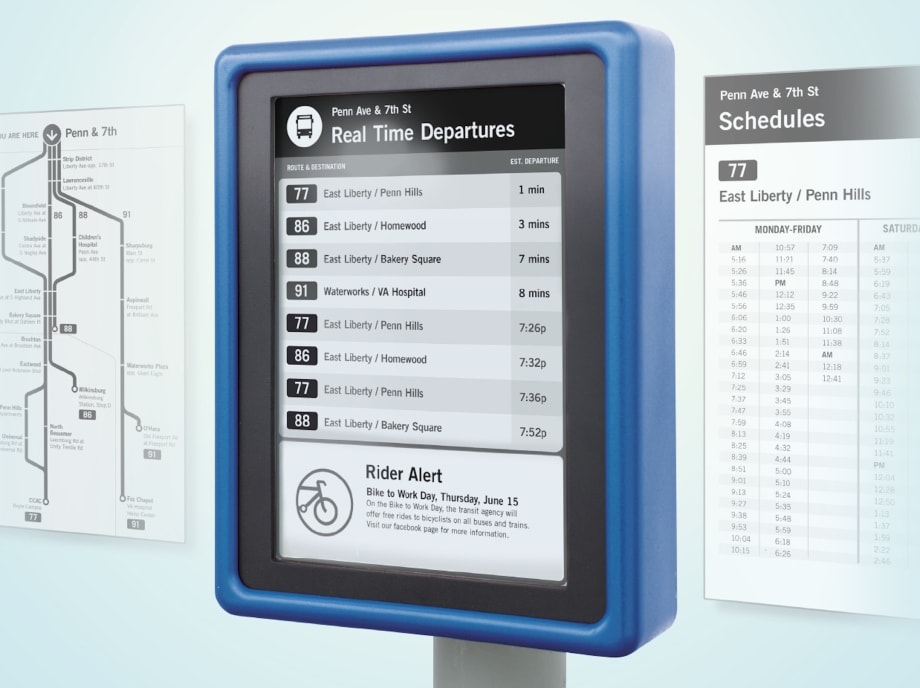
CHK America, a designer of customer information solutions for the U.S. public transportation industry and E Ink Holdings (E Ink), an innovator of electronic ink technology, announced a plan to provide more flexibility to transit agencies and better information to customers. Their first product through this partnership is Digital Bus Stops, which were on display at the Digital Signage Expo in Las Vegas March 16 to 17.
The Digital Bus Stops will provide transit riders with easily-readable, up-to-date information at bus stops under all lighting conditions.They can be easily deployed almost anywhere without requiring electrical infrastructure at bus stops.
"Traditionally, at-stop information has been static, making update costs prohibitive, and the lack of electrical power at the vast majority of bus stops has made digital options impossible, until now," said Rick Wood, CEO of CHK America. "Together with E Ink, we are replacing traditional static signs with high-contrast, sunlight-readable displays operated via battery or solar. The solution enables transit agencies to deliver service change updates to bus stops everywhere effectively and efficiently from one central location without expensive electrical infrastructure improvements, and at the same time provide improved service to riders with real-time departure information."
"The large area signage displays are ultra-low power and provide exceptional outdoor readability making them the ideal solution where power availability is a premium," said Harit Doshi, head of the Signage Business Unit for E Ink.
Digital Bus Stops are an important development for transit agencies whose customers do not want to, or are not able to, rely on mobile technology to receive updates. A November 2015 HNTB Corp. study revealed that 38% of Americans would be motivated to take public transit more often if real-time schedules were displayed on location. An October 2015 study by Pew Research Center revealed that only 52% of adults with a household income of less than $30K own a smart phone. Other barriers to using a smart phone for this use can result in expensive data and text charges; correctly inputting locations; small screens to decipher text, among other things.
CHK America clients, LYNX-Orlando and Pittsburgh's Port Authority of Alleghany County are set to test prototypes of the Digital Bus Stops.
CHK America is in development on additional products utilizing E Ink technology across various industry sectors including transit agencies and smart city developers.
More Bus

New York MTA Plans Largest Bus Fleet Upgrade in More Than a Decade
The agency is seeking manufacturers for 650 new CNG buses to replace aging vehicles, improve reliability, and advance its broader fleet modernization strategy.
Read More →
Building a Flexible Path to Transit Electrification
John Hroncich discusses BAE Systems’ modular and scalable approach, lessons learned from decades of real-world operations, and how agencies can identify electrification strategies that fit their fleets.
Read More →
Bus Tech Talk: Keeping Transit Technicians Ahead of the Technology Curve
LA Metro’s Obed Mejia discusses technician training, evolving maintenance technology, fleet replacement, and strategies for getting the most out of today’s transit fleets.
Read More →
Biz Briefs: RIPTA Unveils New Frontrunners, Clevland RTA Adds New Siemens, and More
In METRO's latest installment, we take a look at recent news from Siemens, Prevost, Dodge, and more partnerships making headlines across the transportation sector.
Read More →
People Movement: Holly Arnold Joins Transdev and More
In this edition, we also cover recent appointments and announcements at Pace, CamTran, MCI, and more, showcasing the individuals helping to shape the future of transportation.
Read More →
The High Cost of Transit Buses: Industry Leaders Look to Procurement Reform
Transit leaders and policymakers examine how standardized bus designs, streamlined procurement, and predictable funding could help agencies stretch budgets and deliver better service.
Read More →
The Business Voice Behind Public Transportation
As chair of APTA’s Business Members Board of Governors, Ray Melleady explains how more than 850 business members are partnering with transit agencies to advance funding, innovation, and industry-wide collaboration.
Read More →
From Surviving to Thriving: Building Stronger Transportation Organizations
Bus Business Consultants founder Brian Dickson shares lessons on leadership, organizational health, and creating options for long-term success in a changing transportation industry.
Read More →
Finding the ‘Happy Medium’: Optimizing Maintenance Without Sacrificing Reliability
The key to maintenance optimization isn’t doing less work—it’s doing the right work at the right time on the right assets.
Read More →
LA Metro, City of West Hollywood, and Partners Advance Smarter Bus Lane Enforcement
The award-winning partnership combines AI-powered detection with human oversight to improve bus reliability, accessibility, and enforcement efficiency.
Read More →