



AC Transit awards $108M contract for first BRT line
Construction of the 9.5-mile service, linking Oakland and San Leandro, is slated to begin in May 2016 with service expected to begin in November 2017.

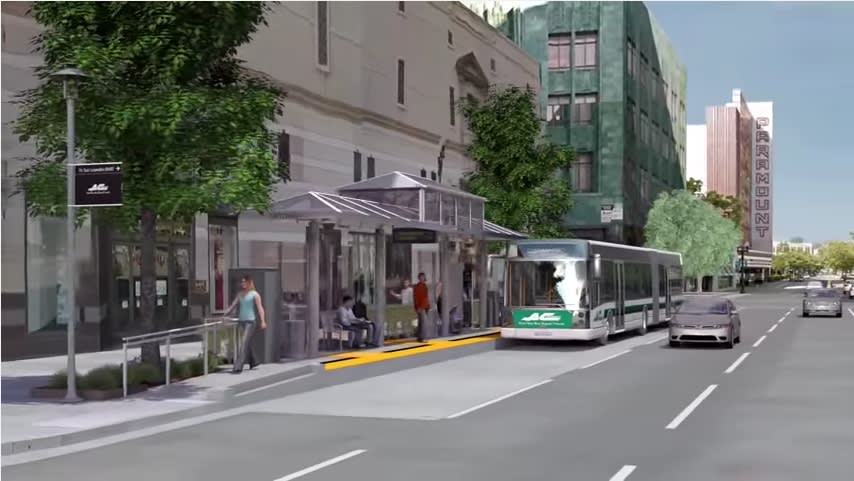
AC Transit
AC Transit
The Alameda-Contra Costa Transit District’s (AC Transit) awarded an $108 million contract for the agency's first bus rapid transit line.
The contract, which includes construction of the infrastructure and station platforms, was awarded to O.C. Jones & Sons, an East Bay-based heavy civil construction and general engineering firm.
AC Transit’s BRT will operate between downtown Oakland and San Leandro – primarily utilizing historic International Boulevard and East 14th Street. Construction of the 150-block transit service (that spans 9.5 miles) is slated to begin in May 2016 with service expected to begin in November 2017.
The new corridor will replace the portion of existing Line 1 Between 20th Street and Broadway in Uptown Oakland and the San Leandro BART station. The BRT service, operating inside a transit-only lane for most of the 9.5-mile route with stops at raised station platforms, will use new, environmentally friendly, diesel-electric hybrid buses. These low- CO² emission 60-foot articulated buses are manufactured in the U.S. by New Flyer. Each bus is specially designed with five-doors to quicken the boarding process.
Service features:
The service will make stops every five minutes during peak hours and every 10 minutes during off-peak hours;
Stops are spaced an average of one-third of a mile;
Transit signal priority extends green lights allowing the BRT to maintain its enhanced frequency;
Interior bike racks will quicken the boarding of cyclist;
Innovative wheelchair tie-down systems will reduce dwell time to secure passengers.
“Bus Rapid Transits have reduced travel anywhere from 15 to 50 percent while improving transit reliability by up to 50 percent in several North American cities,” said H. E. Christian Peeples, AC Transit Board President. “However, AC Transit’s BRT goes further by encouraging bicycle travel thorough designated bike lanes and more foot-traffic by utilizing well-designed medians, shorter crossing distances, and pedestrian count-down signals. Ultimately the BRT’s design makes the streets more pleasant to ride, stroll and shop.”
The construction of the BRT was planned in three distinct projects. The first project, which has been completed, was a prep work project to relocate sewer and water lines typically adjacent to future station locations. The second project, which is about 50% complete, is a two-part effort to mitigate parking and traffic impacts identified during the environmental phase. Phase two involved the construction of two off-street parking lots, now completed, along International Boulevard near 35th and Auseon Avenues to address parking displacement resulting from new alignment. Phase two also included a street improvement project in the vicinity of Derby Avenue, East 10th and San Leandro Streets to accommodate anticipated increased traffic through this area once the BRT begins operation. The third project, major roadway and station construction, is the award to O.C. Jones & Sons.
The BRT will make direct connections to 46 bus lines, five BART stations, and the Oakland Airport (via transfers with Line 73 – Eastmont Transit Center/Oakland Airport).
The East Bay BRT project is substantially funded by these grant programs: Federal Transit Administration Small Starts; Federal Highway Administration CMAQ; Alameda County Transportation Commission Measure B and Measure BB; Metropolitan Transportation Commission/Bay Area Toll Authority Regional Measure 2 Bridge Tolls; State of California STIP, Prop 1B Infrastructure Bonds, and Low Carbon Transit Operations Program; and Bay Area Air Quality Management District Transportation Fund for Clean Air.
More Bus

New York MTA Plans Largest Bus Fleet Upgrade in More Than a Decade
The agency is seeking manufacturers for 650 new CNG buses to replace aging vehicles, improve reliability, and advance its broader fleet modernization strategy.
Read More →
Building a Flexible Path to Transit Electrification
John Hroncich discusses BAE Systems’ modular and scalable approach, lessons learned from decades of real-world operations, and how agencies can identify electrification strategies that fit their fleets.
Read More →
Bus Tech Talk: Keeping Transit Technicians Ahead of the Technology Curve
LA Metro’s Obed Mejia discusses technician training, evolving maintenance technology, fleet replacement, and strategies for getting the most out of today’s transit fleets.
Read More →
Biz Briefs: RIPTA Unveils New Frontrunners, Clevland RTA Adds New Siemens, and More
In METRO's latest installment, we take a look at recent news from Siemens, Prevost, Dodge, and more partnerships making headlines across the transportation sector.
Read More →
People Movement: Holly Arnold Joins Transdev and More
In this edition, we also cover recent appointments and announcements at Pace, CamTran, MCI, and more, showcasing the individuals helping to shape the future of transportation.
Read More →
The High Cost of Transit Buses: Industry Leaders Look to Procurement Reform
Transit leaders and policymakers examine how standardized bus designs, streamlined procurement, and predictable funding could help agencies stretch budgets and deliver better service.
Read More →
The Business Voice Behind Public Transportation
As chair of APTA’s Business Members Board of Governors, Ray Melleady explains how more than 850 business members are partnering with transit agencies to advance funding, innovation, and industry-wide collaboration.
Read More →
From Surviving to Thriving: Building Stronger Transportation Organizations
Bus Business Consultants founder Brian Dickson shares lessons on leadership, organizational health, and creating options for long-term success in a changing transportation industry.
Read More →
Finding the ‘Happy Medium’: Optimizing Maintenance Without Sacrificing Reliability
The key to maintenance optimization isn’t doing less work—it’s doing the right work at the right time on the right assets.
Read More →
LA Metro, City of West Hollywood, and Partners Advance Smarter Bus Lane Enforcement
The award-winning partnership combines AI-powered detection with human oversight to improve bus reliability, accessibility, and enforcement efficiency.
Read More →