




RELATED: As Tech Matures, Transit's Usage of E-Buses Evolves
Electric bus sales to surge even faster than EVs, new study says
Sales of electric cars racing to 28%, and those of electric buses to 84%, of their respective global markets by 2030.
May 22, 2018
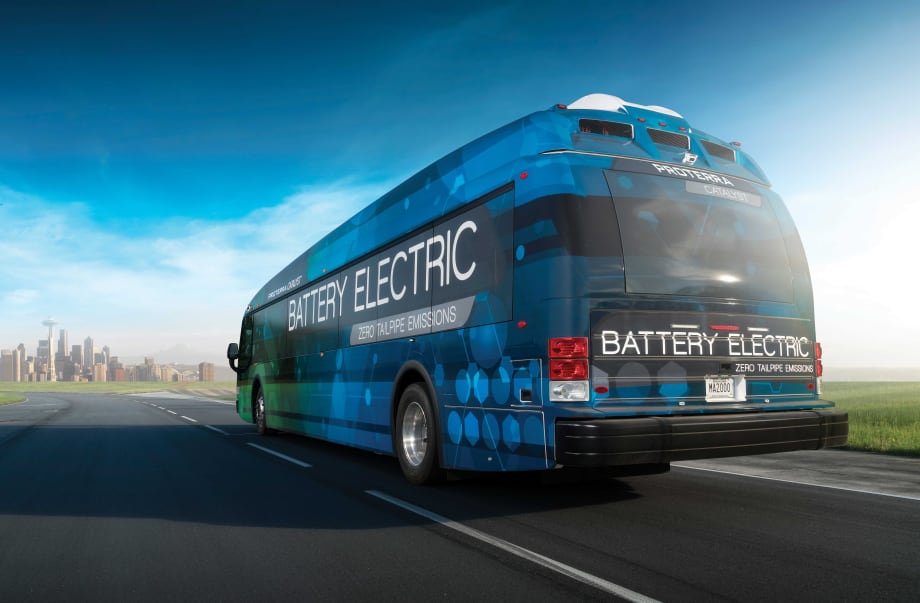
The pace of electrification in transport will vary by country, particularly over the next 12 years as some markets jump ahead of others, according to the report.
photo courtesy Proterra
4 min to read
The pace of electrification in transport will vary by country, particularly over the next 12 years as some markets jump ahead of others, according to the report.
photo courtesy Proterra
The electrification of road transport will move into top gear in the second half of the 2020s, thanks to tumbling battery costs and larger-scale manufacturing, with sales of electric cars racing to 28%, and those of electric buses to 84%, of their respective global markets by 2030.
The latest long-term forecast from Bloomberg New Energy Finance (BNEF) shows sales of electric vehicles (EVs), increasing from a record 1.1 million worldwide last year to 11 million in 2025, and then surging to 30 million in 2030 as they establish cost advantage over internal combustion engine (ICE) cars. China will lead this transition, with sales there accounting for almost 50% of the global EV market in 2025 and 39% in 2030.
The number of ICE vehicles sold per year (gasoline or diesel) is expected to start declining in the mid-2020s, as EVs bite hard into their market. In 2040, some 60 million EVs are projected to be sold, equivalent to 55% of the global light-duty vehicle market. ‘Shared mobility’ cars will be a small but growing element (see below).
The advance of e-buses will be even more rapid than for electric cars, according to BNEF’s analysis. It shows electric buses in almost all charging configurations having a lower total cost of ownership than conventional municipal buses by 2019. There are already over 300,000 e-buses on the road in China, and electric models are on track to dominate the global market by the late 2020s.
Colin McKerracher, lead analyst on advanced transportation for BNEF, commented: “Developments over the last 12 months, such as manufacturers’ plans for model roll-outs and new regulations on urban pollution, have bolstered our bullish view of the prospects for EVs. The changes to our forecast this time compared to the previous one a year ago are modest, at least as far as cars are concerned. We now think EVs will be 55% of light-duty vehicle sales in 2040, rather than 54%, and represent 33% of the total car fleet worldwide.
“But the big new feature of this forecast is electric buses. China has led this market in spectacular style, accounting for 99% of the world total last year. The rest of the world will follow, and by 2040 we expect 80% of the global municipal bus fleet to be electric.”
BNEF expects the transition in transport to have major implications for electricity demand, and for the oil market. EVs and e-buses will use 2,000TWh in 2040, adding 6% to global electricity demand. Meanwhile, the switch from ICE to electric vehicles is forecast to displace 7.3 million barrels a day of transport fuel.
The BNEF team has taken a detailed look at whether the increased appetite for metals such as lithium and cobalt resulting from the rise of electrified transport could lead to supply shortages for these key metals.
Salim Morsy, senior transportation analyst, said: “While we’re optimistic on EV demand over the coming years, we see two important hurdles emerging. In the short term, we see a risk of cobalt shortages in the early 2020s that could slow down some of the rapid battery cost declines we have seen recently. Looking further out, charging infrastructure is still a challenge.”
Ali Izadi-Najafabadi, lead analyst for intelligent mobility at BNEF, said: “We predict that the global shared mobility fleet will swell from just under 5 million vehicles today to more than 20 million by 2040. By then over 90% of these cars will be electric, due to lower operating costs. Highly autonomous vehicles will account for 40% of the shared mobility fleet.”
The pace of electrification in transport will vary by country, particularly over the next 12 years as some markets jump ahead of others. BNEF forecasts that in 2030, EVs will make up 44% of European light-duty vehicle sales, 41% of those in China, 34% in the U.S., and 17% in Japan. However, a shortage of charging infrastructure and a lack of affordable models will hold back the market in India, so that EVs will make up just 7% of new car sales in 2030 there.
BNEF’s projections imply big opportunities for lithium-ion battery manufacturers. China is already dominant in this market, with a 59% global share of production capacity in 2018, and this is forecast to rise to 73% by 2021.
More information on BNEF’s 2018 Electric Vehicle Outlook can be found at https://about.bnef.com/electric-vehicle-outlook/ including a free public report with high-level findings.
More Bus
Biz Briefs: New Flyer Delivers in Columbus, Houston, Beep and Freebee Merge, and More
In this edition of Biz Briefs, we spotlight the latest developments shaping the future of mobility.
Read More →
People Movement: Dan Dipert Coaches Adds Third-Generation Leader, Keolis Names New Valley Metro VP/GM, and More
In this edition, we also cover recent appointments and announcements at the Wabtec, SilverRide, HNTB, and more, showcasing the individuals helping to shape the future of transportation.
Read More →
New York MTA Plans Largest Bus Fleet Upgrade in More Than a Decade
The agency is seeking manufacturers for 650 new CNG buses to replace aging vehicles, improve reliability, and advance its broader fleet modernization strategy.
Read More →
Building a Flexible Path to Transit Electrification
John Hroncich discusses BAE Systems’ modular and scalable approach, lessons learned from decades of real-world operations, and how agencies can identify electrification strategies that fit their fleets.
Read More →
Bus Tech Talk: Keeping Transit Technicians Ahead of the Technology Curve
LA Metro’s Obed Mejia discusses technician training, evolving maintenance technology, fleet replacement, and strategies for getting the most out of today’s transit fleets.
Read More →
Biz Briefs: RIPTA Unveils New Frontrunners, Clevland RTA Adds New Siemens, and More
In METRO's latest installment, we take a look at recent news from Siemens, Prevost, Dodge, and more partnerships making headlines across the transportation sector.
Read More →
People Movement: Holly Arnold Joins Transdev and More
In this edition, we also cover recent appointments and announcements at Pace, CamTran, MCI, and more, showcasing the individuals helping to shape the future of transportation.
Read More →
The High Cost of Transit Buses: Industry Leaders Look to Procurement Reform
Transit leaders and policymakers examine how standardized bus designs, streamlined procurement, and predictable funding could help agencies stretch budgets and deliver better service.
Read More →
The Business Voice Behind Public Transportation
As chair of APTA’s Business Members Board of Governors, Ray Melleady explains how more than 850 business members are partnering with transit agencies to advance funding, innovation, and industry-wide collaboration.
Read More →
From Surviving to Thriving: Building Stronger Transportation Organizations
Bus Business Consultants founder Brian Dickson shares lessons on leadership, organizational health, and creating options for long-term success in a changing transportation industry.
Read More →