




RELATED: All New Flyer facilities now capable of building battery-electric buses
New Flyer, King County Metro celebrate 10,000th Xcelsior bus
The artic is propelled by low-emission, hybrid technologies that reduce air pollution and help evolve KCM’s transit bus fleet with lower emission solutions.
May 23, 2018
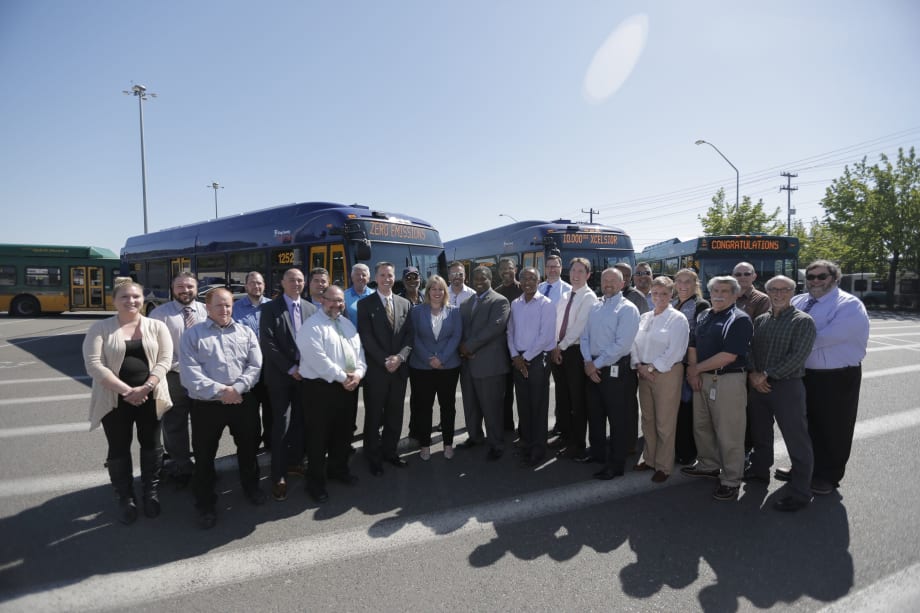
Representatives from New Flyer and King County Metro mark the milestone Xcelsior bus.
King County Metro
2 min to read
Representatives from New Flyer and King County Metro mark the milestone Xcelsior bus.
King County Metro
New Flyer of America Inc., the U.S. subsidiary of NFI Group Inc., celebrated the build and delivery of its 10,000 Xcelsior® heavy-duty transit bus.
New Flyer marked the 10,000th bus with delivery of a 60-foot, hybrid diesel-electric Xcelsior bus to King County Metro (KCM) in Seattle. The articulated bus is propelled by low-emission, hybrid technologies that reduce air pollution and help evolve KCM’s transit bus fleet with lower emission solutions to help achieve its goal of an all-electric bus fleet by 2040. The Xcelsior platform, which was launched in North America in 2010, offers a wide variety of low and zero-emission technologies, of which KCM operates clean diesel, diesel hybrid, and electric trolley buses.
New Flyer has continued to stretch the boundaries of innovation with advancements in onboard communication systems, developments in battery-electric propulsion, and autonomous partnerships displayed through the Vehicle Innovation Center located in Anniston, Ala. New Flyer is also the only North American manufacturer to offer all four types of electric drivetrains on heavy-duty transit vehicles: zero-emission battery-electric, fuel cell-electric, or trolley-electric platforms in addition to low-emission diesel-electric hybrids.
“New Flyer is proud to reach this manufacturing milestone as we continue to drive innovation in low and no-emission transportation,” said Wayne Joseph, president, New Flyer of America. “We are proud of our long-term partnership with Seattle King County Metro, having delivered over 1,500 buses since the late 1970s. Seattle has been a leader and visionary in leading sustainable transportation, and we look forward to advancing public transit in close collaboration with North American leaders like KCM, as it continues to build its zero-emission footprint in the community.”

(From left) Chris Stoddart, sr. VP, engineering and customer service, at New Flyer; Lisa Gehrkee, regional administrator at the FTA; and Terry White, deputy GM at King County Metro.
Seattle King County Metro is one of the nation’s most utilized transit authorities, with 190,000 fewer cars congesting Seattle streets each weekday, saving over 70 million gallons of gasoline and 600,000 metric tons of CO2 from the atmosphere. King County Metro’s strategic use of low and zero-emission vehicles improves quality of life while providing a foundation for further efficiency.
“King County is proud to provide cleaner, quieter transportation for the greater Seattle area and New Flyer has been an essential partner in achieving these goals,” said King County Metro GM Rob Gannon. “We are happy to join New Flyer in celebrating this milestone.”
The NFI Group has over 50 years of experience in manufacturing zero-emission buses and currently has 1,600 of these buses on the road today, the most of any manufacturer in North America.
More Bus

New York MTA Plans Largest Bus Fleet Upgrade in More Than a Decade
The agency is seeking manufacturers for 650 new CNG buses to replace aging vehicles, improve reliability, and advance its broader fleet modernization strategy.
Read More →
Building a Flexible Path to Transit Electrification
John Hroncich discusses BAE Systems’ modular and scalable approach, lessons learned from decades of real-world operations, and how agencies can identify electrification strategies that fit their fleets.
Read More →
Bus Tech Talk: Keeping Transit Technicians Ahead of the Technology Curve
LA Metro’s Obed Mejia discusses technician training, evolving maintenance technology, fleet replacement, and strategies for getting the most out of today’s transit fleets.
Read More →
Biz Briefs: RIPTA Unveils New Frontrunners, Clevland RTA Adds New Siemens, and More
In METRO's latest installment, we take a look at recent news from Siemens, Prevost, Dodge, and more partnerships making headlines across the transportation sector.
Read More →
People Movement: Holly Arnold Joins Transdev and More
In this edition, we also cover recent appointments and announcements at Pace, CamTran, MCI, and more, showcasing the individuals helping to shape the future of transportation.
Read More →
The High Cost of Transit Buses: Industry Leaders Look to Procurement Reform
Transit leaders and policymakers examine how standardized bus designs, streamlined procurement, and predictable funding could help agencies stretch budgets and deliver better service.
Read More →
The Business Voice Behind Public Transportation
As chair of APTA’s Business Members Board of Governors, Ray Melleady explains how more than 850 business members are partnering with transit agencies to advance funding, innovation, and industry-wide collaboration.
Read More →
From Surviving to Thriving: Building Stronger Transportation Organizations
Bus Business Consultants founder Brian Dickson shares lessons on leadership, organizational health, and creating options for long-term success in a changing transportation industry.
Read More →
Finding the ‘Happy Medium’: Optimizing Maintenance Without Sacrificing Reliability
The key to maintenance optimization isn’t doing less work—it’s doing the right work at the right time on the right assets.
Read More →
LA Metro, City of West Hollywood, and Partners Advance Smarter Bus Lane Enforcement
The award-winning partnership combines AI-powered detection with human oversight to improve bus reliability, accessibility, and enforcement efficiency.
Read More →