



MCI brings state-of-the-art features to J4500, set to introduce J3500 at BusCon
Both vehicles share coach systems technologies including electric, HVAC suspension, brakes, axles, frame, and body components.

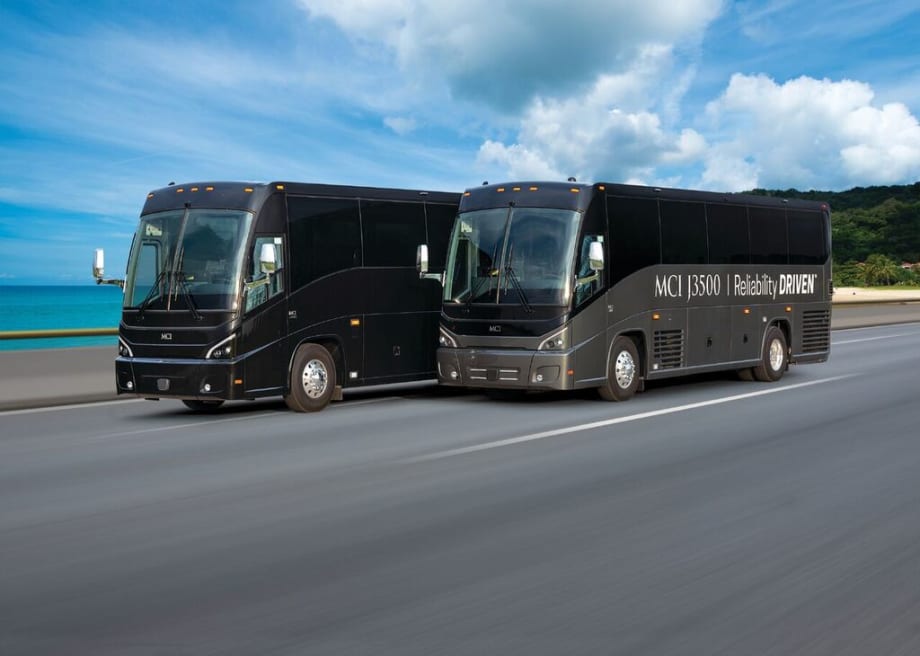
MCI will officially launch the MCI J3500 coach to the industry during BusCon Expo at the Indianapolis Convention Center October 1 to 3.
MCI will officially launch the MCI J3500 coach to the industry during BusCon Expo at the Indianapolis Convention Center October 1 to 3.
Motor Coach Industries (MCI), a U.S. subsidiary of NFI Group Inc., is expanding its 2019 model line up with a new arrival — a compact new MCI J3500 coach to meet increasing demand for right-sized comfort for smaller groups, niche customers, and new markets, and introduces important advances on the 2019 best-selling MCI J4500 with all electric coming in 2020.
MCI will officially launch the MCI J3500 coach to the industry during BusCon Expo at the Indianapolis Convention Center October 1 to 3.
“With the launch of a 35-foot J to all-electric versions of our best-selling models, MCI’s moves are based on feedback from our customers and requirements to meet their marketplace needs,” said Ian Smart, MCI president. “Travel by motorcoach is more relevant than ever. Our goal is to help capture new riders by offering a versatile coach product line with innovative features and long-term reliability.”
Featuring all the styling and performance of the 45-foot MCI J4500, the new 2019 MCI J3500 comfortably seats up to 44 passengers with best in class interior, baggage capacity among all 35-foot vehicles and top maneuverability for congested city streets, airport terminals, and other busy transportation settings.
As for its respected sibling, the 2019 MCI J4500 builds on its striking 2018 interior redesign with mechanical and safety upgrades to match, including Advanced Driver Assistance Systems (ADAS) technology delivered by the optional next-generation Bendix Fusion.
Both J-Series models are built to delight owners and operators watching their maintenance budgets and maximizing uptime. A new e-Fan system boosts fuel efficiency delivering on lowest total cost of operation, with NFI Parts (new name of MCI Service Parts) parts support and near-zero learning curve for busy maintenance teams. Both models also come with the industry’s top limited warranty of 30 months with unlimited miles.
The 2019 J4500:
MCI continues serviceability and reliability improvements, along with further enhancements to the award winning interior and best-in-class interior space that offers industry leading legroom and comfort in a 60-seat passenger configuration launched in model year 2018. For 2019, the J4500 also features:
A new swing-out cooling module e-Fan system improves coach reliability and fuel economy while drastically reducing the time required for service to after treatment sensors and all “hot side” engine components.
The optional next-generation BENDIX WINGMAN FUSION with radar and camera to detect and stop for stationary objects (SVB), including lane departure warning (LDW), following distance alerts (FDA), and traffic sign recognition (TRS), in addition to Adaptive Cruise Control with Braking (ACB) and Collision Mitigation (CMT).
Several other model year 2019 improvements include enhancements to MCI’s optional 360-degree camera system; added condition air supply vents to the driver’s cockpit; a new sliding upper door for the wheelchair lift; and further adjustments to coach’s back cabin interior to increase passenger comfort.
The 2019 J3500:
For MCI, the development of a 35-foot coach answers an important market need.
“The MCI J4500 built its leadership status as a luxury, high-capacity coach that remains the perfect choice for larger ridership in the tour, charter and shuttle industry,” said Brent Maitland, MCI VP, marketing and product planning. “But our operators told us they wanted the same luxury and functionality in a coach for smaller-sized groups that offered great maneuverability, a smooth ride and best-in-class payload capacity. We think the J3500 and J4500 pairing gives operators real market flexibility. The J3500 coach delivers a ride quality you simply can’t find in a smaller, alternative vehicle. Its overall comfort and best-in-class baggage space can enable everything from ski trip excursions to private executive and employee transport.”
A summary of MCI’s newest 35-foot coach advantages include:
Semi-monocoque construction equal to the J4500 means longer vehicle life and also makes for a quieter, smoother ride over the life of the coach.
An interior experience to match the J4500 — best-in-class legroom for up to 44 passengers and the largest baggage bay and enclosed parcel rack space than the nearest competitor.
Interior options equal to the J4500, including an all-new optional rear window, interior RGB programmable lighting, and coordinated interior trim packages in Blues, Lounge, and Tech.
With a turning radius of just under 33 feet the J3500 means top maneuverability — literally opening up new cities, roads and neighborhoods for expanded coach service.
Both the J3500 and J4500 share coach systems technologies including electric, HVAC suspension, brakes, axles, frame, and body components. Equipped with or without wheelchair lift and lavatory, the J3500 has a smaller, yet powerful 2017 EPA Cummins L9, 350 hp, 1150 lb-ft torque w/engine brake and Gen V Allison B500, six-speed automatic with prognostics capability.
“These product enhancements stem from significant support and investment from the NFI Group and continues to build on our industry leadership,” said Smart. “In the last year, we’ve not only taken our J4500 to a new level, but we’ve launched our D45 CRT LE with patent-pending Low Entry vestibule providing a significant improvement to accessibility for all passengers and especially for those with mobility disabilities. Further, we’ve committed to our batter-electric CHARGE range of vehicles with testing well underway and ahead of the production start.”
More Bus

New York MTA Plans Largest Bus Fleet Upgrade in More Than a Decade
The agency is seeking manufacturers for 650 new CNG buses to replace aging vehicles, improve reliability, and advance its broader fleet modernization strategy.
Read More →
Building a Flexible Path to Transit Electrification
John Hroncich discusses BAE Systems’ modular and scalable approach, lessons learned from decades of real-world operations, and how agencies can identify electrification strategies that fit their fleets.
Read More →
Bus Tech Talk: Keeping Transit Technicians Ahead of the Technology Curve
LA Metro’s Obed Mejia discusses technician training, evolving maintenance technology, fleet replacement, and strategies for getting the most out of today’s transit fleets.
Read More →
Biz Briefs: RIPTA Unveils New Frontrunners, Clevland RTA Adds New Siemens, and More
In METRO's latest installment, we take a look at recent news from Siemens, Prevost, Dodge, and more partnerships making headlines across the transportation sector.
Read More →
People Movement: Holly Arnold Joins Transdev and More
In this edition, we also cover recent appointments and announcements at Pace, CamTran, MCI, and more, showcasing the individuals helping to shape the future of transportation.
Read More →
The High Cost of Transit Buses: Industry Leaders Look to Procurement Reform
Transit leaders and policymakers examine how standardized bus designs, streamlined procurement, and predictable funding could help agencies stretch budgets and deliver better service.
Read More →
The Business Voice Behind Public Transportation
As chair of APTA’s Business Members Board of Governors, Ray Melleady explains how more than 850 business members are partnering with transit agencies to advance funding, innovation, and industry-wide collaboration.
Read More →
From Surviving to Thriving: Building Stronger Transportation Organizations
Bus Business Consultants founder Brian Dickson shares lessons on leadership, organizational health, and creating options for long-term success in a changing transportation industry.
Read More →
Finding the ‘Happy Medium’: Optimizing Maintenance Without Sacrificing Reliability
The key to maintenance optimization isn’t doing less work—it’s doing the right work at the right time on the right assets.
Read More →
LA Metro, City of West Hollywood, and Partners Advance Smarter Bus Lane Enforcement
The award-winning partnership combines AI-powered detection with human oversight to improve bus reliability, accessibility, and enforcement efficiency.
Read More →