



WeGo to pilot tech allowing hybrid buses to convert to battery mode
Select buses will feature the exclusive GPS-based technology from BAE Systems.

The data-connectivity from having onboard Wi-Fi will also benefit bus operations along Murfreesboro Pike, where the transit signal priority project construction is wrapping up.
WeGo Public Transit
The data-connectivity from having onboard Wi-Fi will also benefit bus operations along Murfreesboro Pike, where the transit signal priority project construction is wrapping up.
WeGo Public Transit
Nashville’s WeGo Public Transit announced onboard technology coming to its fleet that will help customers move smarter and better throughout the city.
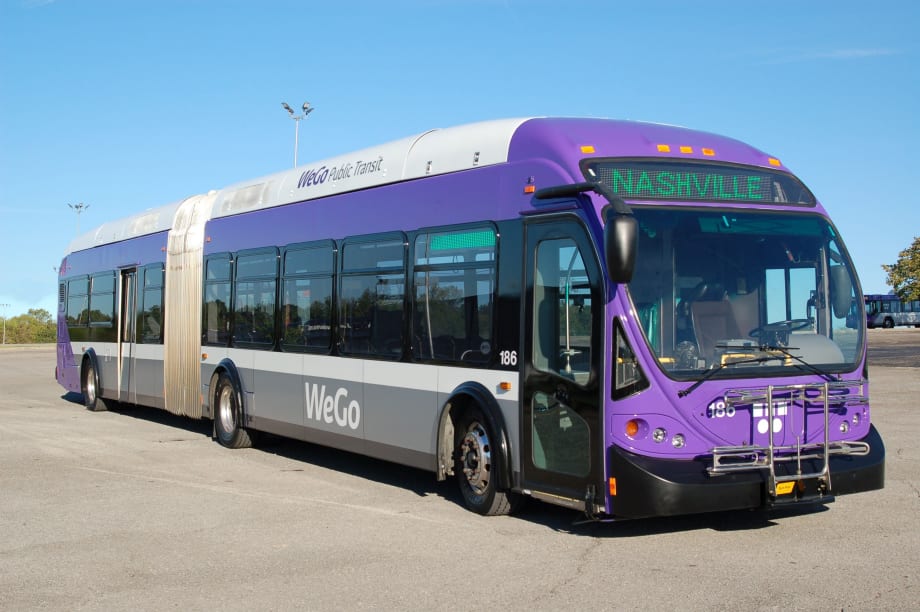
As part of the rebranding process, the agency's articulated bus fleet will gradually be repainted to reflect the WeGo brand. The first rebranded articulated bus can be seen out and about in Nashville starting Friday, October 12. These longer buses, sometimes referred to as bendy buses, operate on the city's major corridors (Charlotte, Gallatin, Murfreesboro, and Nolensville Pikes). While repainting the entire bus fleet is a long-term project, customers will be able to start enjoying the free Wi-Fi onboard the articulated buses first.
"Wi-Fi on our buses is a long-time request of customers and comes on the heels of a WeGo partnership with Metro Nashville ITS last year to make free Wi-Fi available at both Riverfront Station and WeGo Central bus station downtown," WeGo Public Transit CEO Steve Bland said. "Wi-Fi is an amenity which will allow customers to work while commuting, providing another source of convenience and comfort while using transit."
RELATED: Nashville Launches Rebrand, Revised Plan
The data-connectivity from having onboard Wi-Fi will also benefit bus operations along Murfreesboro Pike, where the transit signal priority project construction is wrapping up. It will enable bus operators to begin using green-light extenders, queue jumps, and bus-only lanes to improve on-time performance in 2019.
Customers will also notice WeGo's buses have new fare boxes. Installation of the new fare boxes will wrap up next week and, with the aforementioned Wi-Fi onboard, will bring the agency one step closer to implementing its new fare collection system in 2019.
Select newly-branded buses also feature an exclusive pilot GPS-based technology, allowing WeGo's newest hybrid buses to switch from diesel emissions to a battery-only mode. Spearheaded by BAE Systems, three of the new buses will test out the program, which aims to go into a quiet, electric vehicle mode around certain hospitals, schools, universities, and inside WeGo Central.
"We want to be an innovator in the industry, and we want to be able to offer a cleaner, more efficient ride with fewer emissions for the city," WeGo COO India Birdsong said. "The pilot partnership with BAE Systems will allow us to roll out the technology slowly and to make tweaks and fine-tune where necessary. This will help us provide the best product we can to improve the air quality in the communities we serve when we are ready to roll it out system-wide."
RELATED: Q&A with Stephen Bland
The goal of the pilot program is to expand the GPS-tech throughout the fleet as well as expand the zones so that Davidson County's more populated areas can enjoy reduced carbon-emissions and less noise pollution while public transit can be found.
More Bus

New York MTA Plans Largest Bus Fleet Upgrade in More Than a Decade
The agency is seeking manufacturers for 650 new CNG buses to replace aging vehicles, improve reliability, and advance its broader fleet modernization strategy.
Read More →
Building a Flexible Path to Transit Electrification
John Hroncich discusses BAE Systems’ modular and scalable approach, lessons learned from decades of real-world operations, and how agencies can identify electrification strategies that fit their fleets.
Read More →
Bus Tech Talk: Keeping Transit Technicians Ahead of the Technology Curve
LA Metro’s Obed Mejia discusses technician training, evolving maintenance technology, fleet replacement, and strategies for getting the most out of today’s transit fleets.
Read More →
Biz Briefs: RIPTA Unveils New Frontrunners, Clevland RTA Adds New Siemens, and More
In METRO's latest installment, we take a look at recent news from Siemens, Prevost, Dodge, and more partnerships making headlines across the transportation sector.
Read More →
People Movement: Holly Arnold Joins Transdev and More
In this edition, we also cover recent appointments and announcements at Pace, CamTran, MCI, and more, showcasing the individuals helping to shape the future of transportation.
Read More →
The High Cost of Transit Buses: Industry Leaders Look to Procurement Reform
Transit leaders and policymakers examine how standardized bus designs, streamlined procurement, and predictable funding could help agencies stretch budgets and deliver better service.
Read More →
The Business Voice Behind Public Transportation
As chair of APTA’s Business Members Board of Governors, Ray Melleady explains how more than 850 business members are partnering with transit agencies to advance funding, innovation, and industry-wide collaboration.
Read More →
From Surviving to Thriving: Building Stronger Transportation Organizations
Bus Business Consultants founder Brian Dickson shares lessons on leadership, organizational health, and creating options for long-term success in a changing transportation industry.
Read More →
Finding the ‘Happy Medium’: Optimizing Maintenance Without Sacrificing Reliability
The key to maintenance optimization isn’t doing less work—it’s doing the right work at the right time on the right assets.
Read More →
LA Metro, City of West Hollywood, and Partners Advance Smarter Bus Lane Enforcement
The award-winning partnership combines AI-powered detection with human oversight to improve bus reliability, accessibility, and enforcement efficiency.
Read More →