



Metrolink Leads the Way as PTC Deadline Looms
The California rail system turns from tragedy to triumph as it moves toward completing positive train control installation on its rail lines by 2015. The expedited effort was spurred in part by the 2008 collision that killed 25 passengers. For many systems, though, gaining radio frequency spectrum remains a challenge.

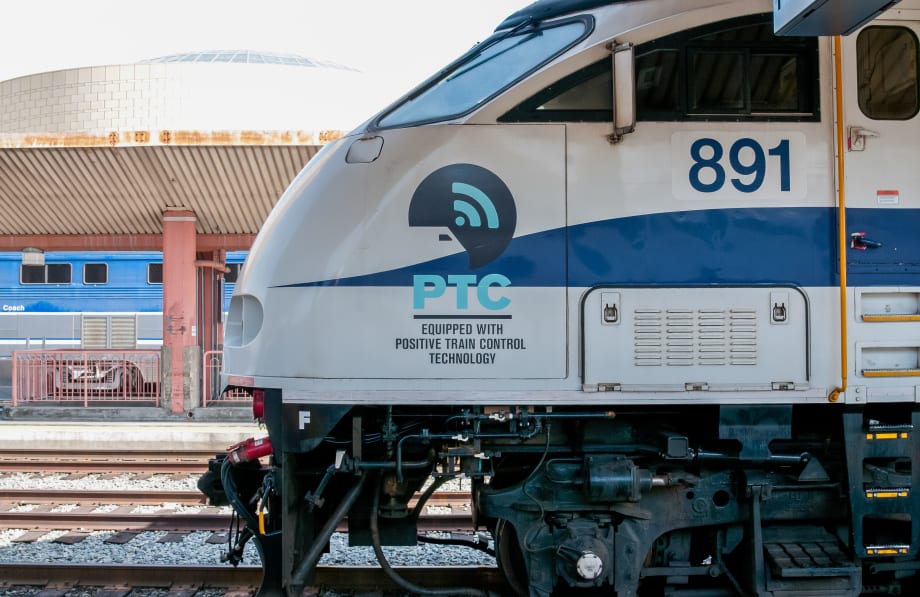
The Dec. 31, 2015 deadline mandated in the Rail Safety Improvement Act is coming up fast for rail systems to install Positive Train Control (PTC), but some of them are well on their way to meeting the challenge.
Calls for PTC, a system designed to prevent train-to-train collisions, derailments caused by excessive speeds, unauthorized train movements in work zones and the movement of trains through switches left in the wrong position, came in 2008 after a Metrolink train and a Union Pacific freight train collided, killing 25 people and injuring 135, in Chatsworth, Calif.
The outcry was revived last December when a Metro-North derailment in New York occurred in a six-degree, 30 minute left hand curve where speed was limited to 30 mph. Event recorder data indicated the train was traveling at 82 mph when it derailed, according to an National Transportation Safety Board (NTSB) report.
However, the expense; need for collaboration with several other entities, such as freights and other transit systems; and getting a radio frequency spectrum assignment are challenges many rail systems are dealing with in implementation.
Rail systems such as Amtrak and Metrolink have recently rolled PTC out on sections of track, while others, including Philadelphia-based Southeastern Pennsylvania Transportation Authority (SEPTA) and Pompano Beach, Fla.-based South Florida Regional Transportation Authority (SFRTA), report being crunched for time but still expect to meet the deadline, despite the challenges.
PTC pioneer
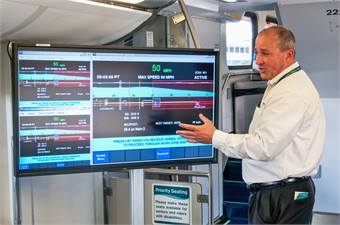
Neil Brown, manager, onboard PTC systems, Metrolink, explains to attendees at the revenue service event in March how positive train control works.
In March, Metrolink became the first commuter rail system in the U.S. to introduce PTC, Jeff Lustgarten, director, public affairs, at Southern California’s Metrolink says. It did so in revenue service demonstration under the authority of BNSF Railway Co. (BNSF).
The Federal Railroad Administration (FRA) authorized Metrolink to operate PTC in revenue service on BNSF territory on its 91 line, which runs between downtown Riverside and Union Station in downtown Los Angeles. The service used Wabtec's Interoperable Electronic Train Management System.
The rest of the rail lines Metrolink operates on will come onboard one at a time over the course of the next year, at which time Metrolink expects to have nearly all its lines up and running and anticipates final federal certification of the entire system as well as certification from the California Public Utilities Commission (PUC).
The debut marks a significant turnaround for the transit system from the tragic accident that occurred when a contractor engineer failed to stop at a red signal just north of the Metrolink Chatsworth Station.
The NTSB eventually determined the engineer of the Metrolink train missed the signal because he was texting.
“Obviously, it was a day that changed the lives of many people and it changed our organization forever,” Lustgarten says.
In the early months following the accident, Metrolink’s board of directors made PTC its number-one priority and committed to installing the safety technology one year ahead of time. It kicked off its implementation process in early 2009, putting a schedule together and bringing a vendor team onboard in 2010, led by engineering services firm Parsons Corp.
The process was elaborate because PTC involves a combination of GPS technology and upgraded dispatching equipment and requires special signal equipment on the trains and along the tracks and communication towers throughout the network.
The system detects the speed and weight of the train, measures whether it is on an uphill or downhill grade, and gives the engineer warnings if it is approaching a signal or a restricted speed zone.
“In the instance of Chatsworth, if PTC had been in place at that time, it would have intervened and stopped the train before it had even gotten to that signal,” Lustgarten explains.
Collaboration crucial
Successful interoperability hinges on a successful PTC system, which improves track sharing and makes it safer. PTC also enables trains to “talk” to each other on the system.
The biggest piece of collaboration for Metrolink involved working with its partners who share or own parts of the rail system, Lustgarten says, such as freight rail systems Union Pacific and BNSF, as well as Amtrak.
Metrolink is collaborating on the technology rollout at various levels of government as well. Locally, the transit system is governed by five different county transportation agencies: Los Angeles County Metropolitan Transportation Authority (MTA); Orange County Transportation Authority; San Bernardino Association of Governments; Riverside County Transportation Commission and Ventura County Transportation Commission.
Several federal entities are also involved, including the FRA, PUC and Federal Communications Commission (FCC), which provides rail systems with radio spectrum assignments.
Coordination efforts, particularly when making decisions on track use, can be difficult. One big sticking point for SEPTA, says Jeff Kneuppel, chief engineer/assistant GM, was equipping one, six-mile section of track it shares with CSX Corp., which owns the track.
“The host basically has the advantage in negotiating how to dictate PTC,” Kneuppel says. “They wanted to run the freight style, i.e., TMS. We wanted to run ACSES [Advanced Civil Speed Enforcement System]. Fortunately, we have a good relationship with CSX.”
That relationship helped SEPTA and the freight rail system decide the best way to go forward was to operate separately on that section of track. The transit agency expects the project to be done in time for the mandate.
Also working with CSX is SFRTA. The agency has begun equipping its locomotive fleet with PTC-ready kits, Brad Barkman, operations department director, SFRTA, says.
Because CSX has a contract with Florida Department of Transportation, giving it exclusive freight rights to operate on the same corridor as SFRTA, the transit agency needs to ensure its PTC equipment will interface with CSX’s so the freight will be able to get its trains initiated from anywhere in its territory to SFRTA’s. The transit system is also working to ensure compatibility with Amtrak trains, Barkman says, since those that travel to Florida originate the day before in New York.
Cost hurdles
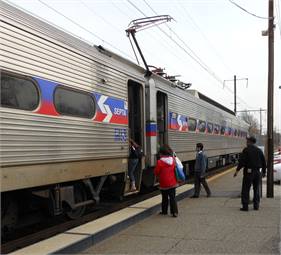
While SEPTA easily obtained radio spectrum for PTC, its other projects were adversely affected due to a combination of having to prioritize the technology above other programs and a decline in capital funding.
Lustgarten acknowledges that the process is, as he put it, “not cheap.” PTC implementation in Southern California will eventually cost approximately $210 million. Then, operation will cost several million dollars a year.
Metrolink has been able to utilize a variety of different federal, state and local grant sources, with the state being the largest funding partner. Slightly more than 70% of the total funding came from various state grants. About 11% came from federal grant funding and 15% from local sources.
The biggest single source of funding at the state level comes from California’s Proposition 1A High Speed Rail Passenger Train bonds at $46 million. Approximately $30 million comes from various sources of Proposition 1B State and Local Partnership Program funds, and Los Angeles MTA Measure R provides about $10 million to support PTC.
In part because PTC has required an extraordinary commitment of time, labor and financial resources, Metrolink’s board of directors approved a modest fare increase last June.
“[PTC] was definitely one of the cost drivers creating an issue for us to complete our budget process last year,” Lustgarten says.
Meanwhile, SEPTA’s financial obstacle to PTC implementation was that other projects were adversely affected due to a combination of prioritizing the technology above other programs and a decline in capital funding. The transit system struggled to keep the rest of its system going with a high backlog of state of good repair, at $5 billion, while advancing PTC work, Kneuppel says.
“We lived on the ragged edge for the last couple of years,” he adds. “What little capital funding that was available was going toward the PTC mandate.”
Although it drained the capital program, SEPTA’s budget was saved last November, when Pennsylvania passed a landmark bill that increased highway and public transit capital spending, so that by 2018, Kneuppel says, the agency’s capital spending dollars will double, allowing it to tackle projects it had to put off, such as repairing some bridges, primarily on its commuter rail lines.
“Thank goodness the legislature in Pennsylvania put this bill together because our service realignment plan over a period of 10 years would have closed a very high percentage of our rail network,” Kneuppel says.
What also helped SEPTA through its budget woes was having in-house personnel and Ansaldo STS to split the PTC work, with the in-house team installing automatic train control and working with Ansaldo on the ACSES overlay, which, combined, will create PTC, Knueppel says. That work is scheduled to finish in time to meet the deadline.
Radio Spectrum
Since radio spectrum — radio waves used for mobile communication, broadcasting and other wireless applications — is a finite resource on the market, obtaining an assignment from the Federal Communications Commission (FCC) by the 2015 deadline is a significant hurdle for many rail systems, Art Guzzetti, VP, policy, American Public Transportation (APTA), says. However, it is also a necessary element of positive train control (PTC), since it enables the dispatch, track and trains to communicate with each other.
Exacerbating the issue is the huge demand for spectrum for smartphones and tablets.
While the FCC holds auctions for spectrum, it does reserve some assignments for public safety services, such as police and fire departments.
“[APTA’s] point of view is that transportation needs spectrum also, but all that is in the process of being sorted out,” Guzzetti says.
APTA has requested that the U.S. Secretary of Transportation be granted the authority to extend the deadline for rail systems that won’t be able to
get spectrum by Dec. 31, 2015.
Amtrak anticipates deploying PTC on all of its property by the end of 2015, according to Marc Magliari, media relations manager, government affairs and corporate communications, Amtrak, says. However, the primary obstacle that the rail system has faced while rolling it out has been obtaining a spectrum assignment.
The American Association of Railroads and the rail industry are working with the FCC on the issue, he adds.
“We believe there’s a way forward for where we own the property but the freights are spread over many more thousands of square miles than Amtrak,” Magliari explains. “They have a much larger issue than we do.”
The challenge is more prevalent in some regions of the country, such as for freight systems in the Western region of the U.S., where building more towers to transmit spectrum can be a bone of contention, Guzzetti says, and in New York, where, according to Mike Monastero, chief engineering officer for signals and communications, Southeastern Pennsylvania Transportation Authority, buying spectrum at auction can be very expensive.
More Management

LIT Marks 10-Year Milestone at Annual Summit
Hosted by the COTA from September 10 to 13, the Summit carried the theme “Celebrating 10 Years of Excellence, Leadership, and Impact,” with every part of the program honoring the people, agencies, and partners who built LIT over its first decade.
Read More →
People Movement: Dan Dipert Coaches Adds Third-Generation Leader, Keolis Names New Valley Metro VP/GM, and More
In this edition, we also cover recent appointments and announcements at the Wabtec, SilverRide, HNTB, and more, showcasing the individuals helping to shape the future of transportation.
Read More →
METRO Opens Submissions for 2026 Motorcoach Awards
Nominations are now being accepted for METRO Magazine’s Operator of the Year and Innovative Operator of the Year awards.
Read More →

New York MTA Advances Final Contract for Second Avenue Subway Expansion
Contract Four is the largest in the Second Avenue Subway Phase 2 project and includes construction of station infrastructure, tracks, and signals for the subway expansion, MTA officials said. Work on Contract Four will begin in 2027.
Read More →
Transit Agencies Highlight Safety Gains at National Summit
Leaders from 15 major transit systems shared crime-reduction results and safety initiatives while discussing the role of continued federal support.
Read More →
NITA Names New Leadership, Expands Reduced-Fare Program at First Board Meeting
The new regional transit authority appointed its first board chair and interim executive director while extending reduced fares across CTA, Metra, and Pace for eligible riders.
Read More →
Beyond the Checklist: A Structured Approach to Transit Maintenance
Reliability-Centered Maintenance helps transit agencies move beyond routine checklists to focus limited resources on the assets and failures that have the greatest impact on safety, reliability, and service.
Read More →
APTA 2026 Nominating Committee Selects Leadership Slate, Names Chair and Vice Chair Nominees
Leadership changes will help shape the association’s priorities and its representation of the transportation industry during the 2026–2027 term.
Read More →
DART Launches Major Security, Fare Enforcement Initiative
The 90-day demonstration will deploy coordinated security teams at five light rail stations while testing controlled access and gathering data to guide future investments.
Read More →
Advancing Fare Collection Through Technology and Innovation
Learn about delivering 1300 gates at 91 stations while managing fare evasion. Explore the large scale deployment, solution customization and real-world results that affect the region. Prepare for deployment in your region now.
Read More →