



FRA launches 45-day Metra investigation
Will focus on the commuter rail's program of operational tests and inspections for all its operating crews, with special emphasis on training, qualification and testing of locomotive engineers.

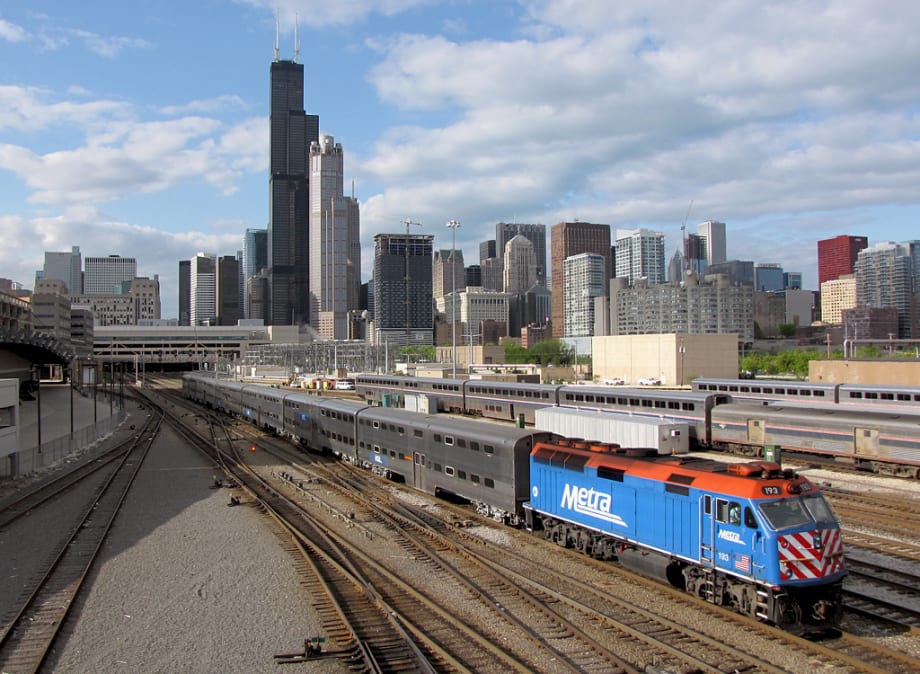
Photo courtesy Amtrak_russ
Photo courtesy Amtrak_russ
The Federal Railroad Administration (FRA) is launching a 45-day focused deep dive safety assessment of Chicago’s Metra in response to three incidents that have taken place in the last two weeks.
The FRA will focus on Metra’s program of operational tests and inspections for all its operating crews, with special emphasis on training, qualification and testing of locomotive engineers.
The assessment is similar to “Operation Deep Dive,” the recent safety assessment conducted after a series of accidents on Metro-North Rail Road that serves Connecticut, New York and New Jersey.
As a result, Metro-North was directed to address 25 specific recommendations covering eight safety critical concerns in an effort to mitigate risk and to begin a turnaround of the railroad’s safety culture.
“Safety is Metra’s top priority. We are in the process of completing our own internal investigations on these incidents,” said Metra CEO Don Orseno. “Metra contacted the FRA to inform them of our actions. We are fully committed to working with the FRA and welcome their review. We share a common goal of making commuter rail travel the safest mode of transportation.”
FRA investigators will focus on three recent incidents involving speeding and signal violations, which resulted in three Metra engineers losing their certifications. During the course of the investigation, FRA inspectors will:
Interview all affected employees.
Review event recorder tapes and video recordings.
Review operations testing records.
Review radio tapes.
Review Metra’s locomotive engineer qualifications certification program.
Investigators will also perform a comprehensive audit of Metra’s program of tests and inspections for its operating employees that will:
Analyze testing records for 2013 and 2014.
Review training, qualification and competency of testing officers.
Conduct testing sessions with Metra officers.
Conduct independent background reviews on Metra employees.
Perform speed checks.
In addition, FRA personnel will meet with labor leaders and Metra employees to listen to their concerns regarding these recent events.
More Management

METRO Opens Submissions for 2026 Motorcoach Awards
Nominations are now being accepted for METRO Magazine’s Operator of the Year and Innovative Operator of the Year awards.
Read More →
New York MTA Advances Final Contract for Second Avenue Subway Expansion
Contract Four is the largest in the Second Avenue Subway Phase 2 project and includes construction of station infrastructure, tracks, and signals for the subway expansion, MTA officials said. Work on Contract Four will begin in 2027.
Read More →
Transit Agencies Highlight Safety Gains at National Summit
Leaders from 15 major transit systems shared crime-reduction results and safety initiatives while discussing the role of continued federal support.
Read More →

NITA Names New Leadership, Expands Reduced-Fare Program at First Board Meeting
The new regional transit authority appointed its first board chair and interim executive director while extending reduced fares across CTA, Metra, and Pace for eligible riders.
Read More →
Beyond the Checklist: A Structured Approach to Transit Maintenance
Reliability-Centered Maintenance helps transit agencies move beyond routine checklists to focus limited resources on the assets and failures that have the greatest impact on safety, reliability, and service.
Read More →
APTA 2026 Nominating Committee Selects Leadership Slate, Names Chair and Vice Chair Nominees
Leadership changes will help shape the association’s priorities and its representation of the transportation industry during the 2026–2027 term.
Read More →
DART Launches Major Security, Fare Enforcement Initiative
The 90-day demonstration will deploy coordinated security teams at five light rail stations while testing controlled access and gathering data to guide future investments.
Read More →
Advancing Fare Collection Through Technology and Innovation
Learn about delivering 1300 gates at 91 stations while managing fare evasion. Explore the large scale deployment, solution customization and real-world results that affect the region. Prepare for deployment in your region now.
Read More →
Game Day in Motion: Moving Millions During the 2026 World Cup
Between packed transit stations and team motorcoaches, see how agencies and operators across North America tackled the transportation demands of the 2026 FIFA World Cup.
Read More →
Surface Transportation Extension Averts Shutdown, Leaves Transit Funding Gap
The stopgap keeps federal transportation programs moving, but missing advance funding could complicate the transit and rail projects agencies are planning next.
Read More →