




RELATED: $20M available to improve access to transit in communities
Americans overwhelmingly favor land use, zoning reg changes that support TOD
HNTB America THINKS survey also shows Americans willing to pay higher mortgages and rents to live in transit-oriented areas.
June 9, 2016
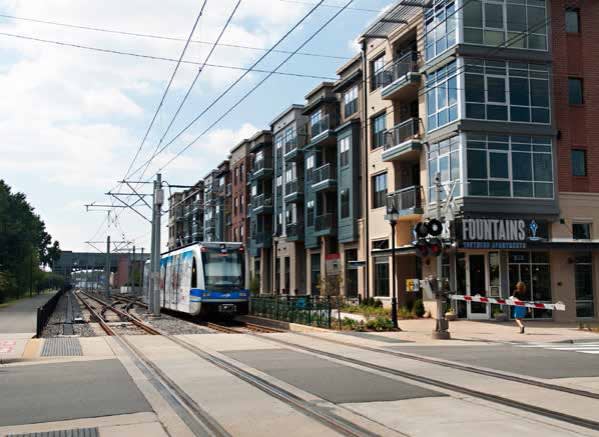
The Charlotte Area Transit System’s (CATS) LYNX Blue Line is the region’s first light rail service spurring development since it opened in 2007. Photo: CATS
3 min to read
The Charlotte Area Transit System’s (CATS) LYNX Blue Line is the region’s first light rail service spurring development since it opened in 2007. Photo: CATS
Nearly three in four Americans (73%) would support changes in land use or zoning regulations in their community that encourage transit oriented development, according to a new America THINKS national public opinion survey by HNTB Corp.
The survey, “Transit Oriented Development in America,” found that more than half (55%) of Americans so value the ability to get to work and play without using a vehicle that they are willing to pay more for their mortgage or rent in order to have this option. This is especially true among millennials* who are much more willing to pay more each month than older Americans (70% versus 49%).
The survey also found that the desire to live near public transportation has increased in the last five years among 29% of Americans. Millennials again take the lead with 36% who want to live near public transportation today more so than five years ago versus 25% of older Americans.
“The desire to more fully integrate lifestyle with mobility options is causing Americans to rethink their priorities about where they choose to live, and how they travel to work and play,” said Mike Sweeney, PE, HNTB sr. VP. “The willingness of people to pay more to live in a particular area in exchange for enhanced lifestyle and mobility options sends a clear message about the growing interest, value and importance of transit-oriented development. This fact will directly impact future decisions about the location and modes of transportation options that respond to these emerging trends.”

View of New York City's Hudson Yards looking South from the No. 7 subway station. Rendering: HudsonYards New York
According to the Transit Oriented Development Institute, TOD is a compact development within easy walking distance of transit stations that contains a mix of uses such as housing, jobs, shops, restaurants and entertainment. They are centered on high quality train systems, which greatly reduce the need for driving and energy consumption by up to 85%.
The America THINKS survey found that more than four in five (83 percent) of all Americans were as or more interested in living near accessible public transportation than they were five years ago, including 76% of Americans living in rural areas.
Proximity is key
According to the survey, over half (51%) of Americans agree the availability of good public transportation increases their interest in moving to and living in a particular area. Millennials are more likely to base their residence decisions on public transportation availability than older Americans (57% vs. 48%).
Similarly, almost half (47%) of Americans say being in close proximity to public transportation impacts choices about where they live, work and play. This is especially pronounced among millennials versus older Americans (54% vs. 44%).

The survey also found Americans believe numerous benefits result from transit-oriented development. These include reduced dependency on driving (57%); allowing residents to live, work and play in the same area (46%); reducing the area’s carbon footprint or negative environmental impact (44%); access to better life services and stimulating the local economy (both at 43%); better access between urban and suburban areas (42%); access to better entertainment or recreational services (39%); access to better jobs (37%); and revitalizing urban areas (30%).
“Public transportation agencies as well as state and local governments are at the front line of responding to these changes. With thoughtful planning and creativity that could include private sector partnerships, they will have the ability to create exciting new opportunities that will enhance peoples’ lives and build new communities for the future,” Sweeney said.
Click here to download a related factsheet.
About the survey
HNTB’s America THINKS “Transit Oriented Development in America” survey polled a random nationwide sample of 1002 Americans between April 6 and April 13, 2016. It was conducted by Kelton Global, which used an e-mail invitation and online survey. Quotas were set to ensure reliable representation of the entire U.S. population ages 18 and over. The margin of error is +/- 3.1 percent.
More Management

METRO Opens Submissions for 2026 Motorcoach Awards
Nominations are now being accepted for METRO Magazine’s Operator of the Year and Innovative Operator of the Year awards.
Read More →
New York MTA Advances Final Contract for Second Avenue Subway Expansion
Contract Four is the largest in the Second Avenue Subway Phase 2 project and includes construction of station infrastructure, tracks, and signals for the subway expansion, MTA officials said. Work on Contract Four will begin in 2027.
Read More →
Transit Agencies Highlight Safety Gains at National Summit
Leaders from 15 major transit systems shared crime-reduction results and safety initiatives while discussing the role of continued federal support.
Read More →

NITA Names New Leadership, Expands Reduced-Fare Program at First Board Meeting
The new regional transit authority appointed its first board chair and interim executive director while extending reduced fares across CTA, Metra, and Pace for eligible riders.
Read More →
Beyond the Checklist: A Structured Approach to Transit Maintenance
Reliability-Centered Maintenance helps transit agencies move beyond routine checklists to focus limited resources on the assets and failures that have the greatest impact on safety, reliability, and service.
Read More →
APTA 2026 Nominating Committee Selects Leadership Slate, Names Chair and Vice Chair Nominees
Leadership changes will help shape the association’s priorities and its representation of the transportation industry during the 2026–2027 term.
Read More →
DART Launches Major Security, Fare Enforcement Initiative
The 90-day demonstration will deploy coordinated security teams at five light rail stations while testing controlled access and gathering data to guide future investments.
Read More →
Sponsored•September 9, 2026
Advancing Fare Collection Through Technology and Innovation
Learn about delivering 1300 gates at 91 stations while managing fare evasion. Explore the large scale deployment, solution customization and real-world results that affect the region. Prepare for deployment in your region now.
Read More →
Game Day in Motion: Moving Millions During the 2026 World Cup
Between packed transit stations and team motorcoaches, see how agencies and operators across North America tackled the transportation demands of the 2026 FIFA World Cup.
Read More →
Surface Transportation Extension Averts Shutdown, Leaves Transit Funding Gap
The stopgap keeps federal transportation programs moving, but missing advance funding could complicate the transit and rail projects agencies are planning next.
Read More →