



Seattle aerial gondola system proposed
The system, which can move 1,800 passengers per hour each way, would link Seattle’s waterfront with downtown’s convention center.

The proposed gondola system, patterned after other systems around the world, would travel a half mile and feature three stations, eight support columns and will be funded solely by private investment.
Photo courtesy VIA Architecture
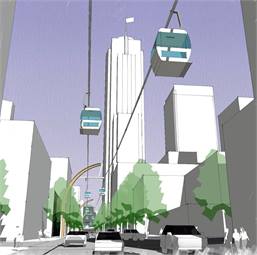
The proposed gondola system, patterned after other systems around the world, would travel a half mile and feature three stations, eight support columns and will be funded solely by private investment.
In March, a Seattle developer announced plans to build an aerial gondola system that would carry passengers from the Washington State Convention Center down Union Street to the waterfront, with a stop at Pike Place Market.
The gondola system is being proposed by Kyle Griffith, whose family has owned Pier 57 for more than 60 years and built the Great Wheel, a 175-foot tall Ferris wheel, in June 2012 to attract more visitors.
“My father has had the idea for the gondola system almost as long as my family has owned Pier 57,” explained Griffith. “We have this cliff separating the Pike Place Market part of town and the rest of downtown from the waterfront, making it a difficult route to traverse back and forth. To have a mode of transportation that gets people up and down that big elevation change was always something he thought would be a good thing to have.”
The proposed gondola system, patterned after other systems around the world, would travel a half mile and feature three stations, eight support columns and will be funded solely by private investment.
“It is a 100% privately-funded project,” said Griffith. “There is no taxpayer money. No risk to the city. If it doesn’t get the ridership we project, we will have to take it down at our costs, which will be worked out ahead of time before we are allowed to put it up.”
The system would be powered by a highly efficient, electrically-powered cable drive that can move 1,800 passengers per hour each way, with eight-passenger cars departing every 16 seconds and provide a much-needed link to businesses along the route.
“If you look at Seattle, we have never had any east/west transportation in the history of our city,” said Griffith. “We are kind of built like an hourglass and everything goes north/south but because of the elevation changes when going east to west, there are no good transportation connections.”
Griffith added the gondola has gotten positive feedback from businesses along the route, including the Seattle Aquarium and the Washington State Convention Center, and also has several environmental benefits since it runs on electricity and would take hundreds of vehicles off the road. The system’s fare structure would be based on a sliding scale, with daily commuters and tourists paying different prices.
Griffith’s plan is to have the gondola built by 2016, but is contingent on the demolition of a viaduct and the status of Sound Transit’s tunneling project, which are just two of several construction projects planned for the area.
“We can’t get our system going until the viaduct is out of the way, but it is also dependent on the tunnel boring machine being finished as well,” Griffith said. “What we are trying to do is get the project through the regulatory processes and permits and order the equipment. Following that, our plan is to have the towers, foundations and as much as we can in place, then string the cables and hang the gondolas so we can be up and going soon after the pathway is open.”
Currently, there are 16 urban gondolas in operation around the world with more than 30 also in planning.
In Portland, Ore., the Portland Aerial Tram connects two campuses of the Oregon Health Sciences University and has carried more than one million passengers per year since it opened in 2007.
As of press time, Griffith’s proposal is going through the permitting process.
More New Mobility

From Hardware to Digital Partner: Luminator Charts Its Next Chapter
CEO Magnus Friberg discusses Luminator’s shift toward becoming a digital partner, the growing importance of software and interoperability, and how AI can help agencies improve operations and passenger experience.
Read More →
Biz Briefs: Alstom Lands Canadian Contract, LYT to Supply California TSP, and More
In METRO's latest installment, we take a look at recent news from Complete Coach Works, Beep, FlixBus, and more partnerships making headlines across the transportation sector.
Read More →
CharterUP’s Armir Harris on Technology, AI, and the Future of Group Mobility
In a recent episode of METROspectives, CharterUP Founder/CEO Armir Harris discussed the company’s evolution from an online charter bus marketplace into a technology platform supporting public- and private-sector mobility and much more.
Read More →
Jacksonville’s NAVI Project Charts a New Course for Autonomous Public Transportation
Through its NAVI program, JTA is showing how autonomous vehicles, intelligent infrastructure, and coordinated operations can work together to deliver everyday public transportation.
Read More →
Biz Briefs: Luminator Marks Milestone and More
From manufacturers and suppliers to transit agencies and motorcoach operators, these updates offer a snapshot of the projects, partnerships and business moves driving the industry forward.
Read More →
New Tricks for Old Bureaucracies: Joshua Schank on Making Transit Innovation Stick
Former LA Metro Chief Innovation Officer Joshua Schank discusses why good ideas aren't enough, how transit agencies can overcome resistance to change, and why today's challenges demand more innovation.
Read More →
How DART's GoPass Is Redefining Regional Mobility
Serving 14 transit agencies, GoPass simplifies multimodal travel by allowing riders to plan, pay for, and manage an entire trip through one app.
Read More →
Biz Briefs: OCTA Taps Clean Energy for Hydrogen Station, Stadler to Supply Via Rail Vehicles, and More
From manufacturers and suppliers to transit agencies and motorcoach operators, these updates offer a snapshot of the projects, partnerships and business moves driving the industry forward.
Read More →CharterUP Expands Into New Mobility and Autonomous Transportation
Vice President of New Mobility Stephen Joos discusses how CharterUP is leveraging its nationwide transportation network, technology platform, and autonomous vehicle partnerships to expand into workforce mobility, campus shuttles, and transit solutions.
Read More →
METRO Magazine Announces 2026 Innovative Solutions Awards Winners
Projects Recognized for Advancing Mobility Through Technology, Accessibility, Workforce Innovation, and Operational Excellence
Read More →