




Don Brown Bus Sales
Located in Johnstown, N.Y., Don Brown Bus Sales has been in business for 40-plus years and has well over 400 new and pre-owned school, commercial and specialty vehicles in stock at all times. The company sells buses in all 50 states, as well as in an estimated 14 different countries. For more information, visit www.buscrazy.net.
What a Bus Dealer Can Do For You
Whether you are a private operator with hundreds of vehicles, a community paratransit provider or a local church group, chances are you will purchase your bus from a dealer.
September 2, 2015
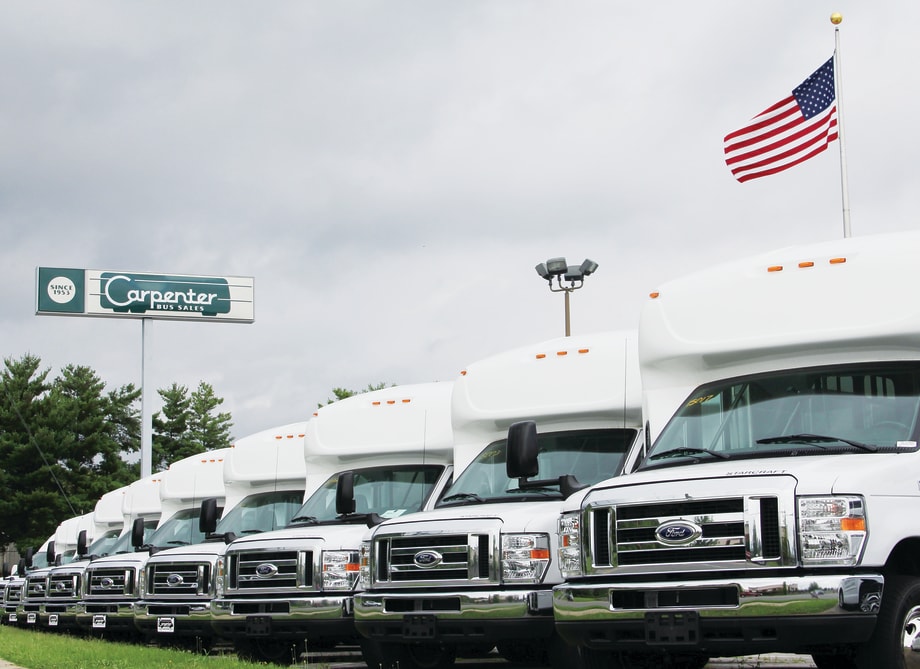
Since 1953, Franklin, Tenn.’s Carpenter Bus Sales has been a major provider of new buses as well as used buses for shuttle service companies, schools, daycare centers, churches and senior care centers.
Photo: Carpenter Bus Sales
4 min to read
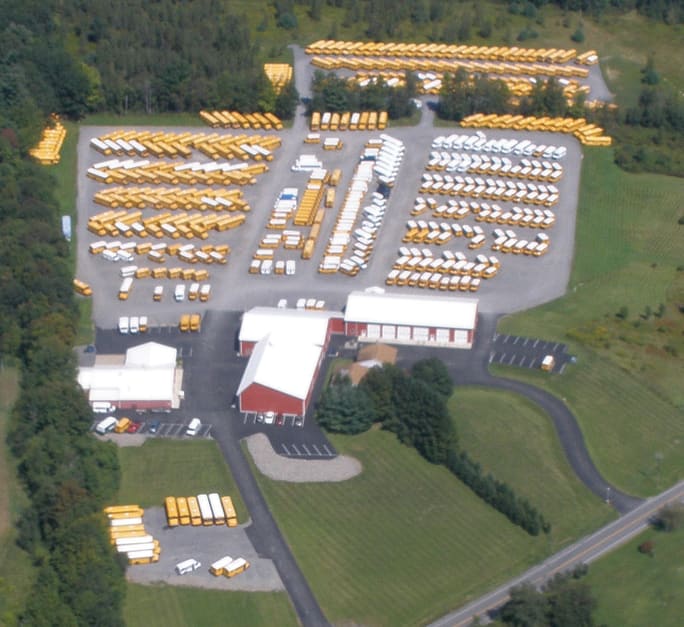
With well over 400 new and pre-owned vehicles in stock at all times, Don Brown Bus Sales sells buses in all 50 states, as well as in an estimated 14 different countries.
Photo: Don Brown Bus Sales
For many, purchasing an automobile can be a nerve-racking experience. However, when making a six-figure investment into a vehicle that will be the cornerstone of your business’ newest contract, the shopping experience is even more intense.
Whether you are a private operator with hundreds of vehicles, a community paratransit provider or a local church group, chances are you will purchase your bus from a dealer. Outside of just selling you a bus, though, dealers provide a wealth of knowledge, services, and experience that can help simplify the process and ensure you choose the right vehicle to fit your needs.
Product Knowledge
There are many bus companies and hundreds of bus models out there, so perhaps the top benefit a bus dealer can provide is product knowledge.
“So much of the bus-buying process comes down to building trust between dealer and customer. And, so much of that trust happens when the customer truly knows that dealer is thinking, ‘what’s best for my customer?’ Rather than ‘what’s best for me?’” says Gerrit Gustafson, marketing director for Carpenter Bus Sales. “I think they call that ‘the Golden Rule.’”
The best way to build that trust is the dealer’s ability to share the vehicle history and vehicle manufacturer information when discussing the market and value of the buses they are searching for.
“Our sales team can counsel operators and other customers about the best time to turn a unit in, what people are buying, and what is working and trending in the marketplace,” says Scott Duffy, director, sales, for Don Brown Bus Sales.
Both Duffy and Gustafson agree that although their seasoned operators know the business inside/out, there’s always knowledge or help a dealer can impart, which will help with buying decisions.
“Our operators are very smart business people. We work with them intimately to find the best fit for their needs in the timeliest manner possible,” Duffy explains.
A dealer’s product knowledge probably comes most into play, then, when the unseasoned or first-time buyers visit the dealership to make a purchase.
“A church generally only buys a bus every six or eight years, and the ones who are in charge of purchasing may never have bought a bus before,” says Gustafson. “For them, there is much more of an educational process required. They may not know that drivers for buses over 15 passengers will need a commercial driver’s license. They probably don’t know who the various bus manufacturers are. And regularly, they are just getting an idea of what a good reliable bus will cost.”
Since most of the time an operator will purchase a bus to satisfy a specific contract, a dealer’s product knowledge can help a buyer understand what vehicle can best suit the needs of that contract based on such factors as lifecycle, cost and insurance.
Services
For the most part, bus dealers are like a one-stop shop, providing a range of services from financing to upfitting vehicles.
“One of the main benefits our customers tell us they appreciate is the extended new bus warranty,” Gustafson explains. “We provide, at no additional cost, a five-year/60,000-mile bumper-to-bumper warranty on every new bus we sell. We also offer, at a minimal cost, an upgraded seven-year/70,000-mile warranty. This assures them of worry-free operation of the bus year after year.”
Dealerships also offer financing options, from leasing to buying, and can even help those operators who may not have pristine credit get into the vehicle they like.
Dealerships, such as Don Brown Bus Sales, also have a full service center that provides the best service to its customers if there are issues in the field. Normally, when clients have issues with their equipment it requires as close to instant help as possible and the dealership does everything it can to attain that type of support, Duffy explains.
“We can service myriad chassis and body issues because we are one of the largest stocking dealers in the Northeast and Mid-Atlantic and have the ability to ship parts immediately,” he says.
The service center also enables Don Brown to purchase and freshen up used vehicles to either get them ready for sale on the lot or to fill an existing customer’s pre-owned needs.
Relationships
Finally, maybe the most important benefit a dealer can provide is a working relationship with somebody who is uniquely able to provide buyers with a commodity that is vital to their business.
By forging a relationship with a dealer who has knowledge of vehicles on the market, it can ultimately help operators build the purchasing process into their business plans.
“We have many resources that allow us to help clients with trade-ins,” says Duffy. “Our vast network of customers who are always looking for used vehicles, can normally make an offer on units that our clients are trying to sell so that they can move in to something new. We can also help by keeping our eyes and ears on the market and alert an operator when there’s a vehicle they have been looking for becomes available.”
Subscribe to Our Newsletter
More Management

METRO Opens Submissions for 2026 Motorcoach Awards
Nominations are now being accepted for METRO Magazine’s Operator of the Year and Innovative Operator of the Year awards.
Read More →
New York MTA Advances Final Contract for Second Avenue Subway Expansion
Contract Four is the largest in the Second Avenue Subway Phase 2 project and includes construction of station infrastructure, tracks, and signals for the subway expansion, MTA officials said. Work on Contract Four will begin in 2027.
Read More →
Transit Agencies Highlight Safety Gains at National Summit
Leaders from 15 major transit systems shared crime-reduction results and safety initiatives while discussing the role of continued federal support.
Read More →

NITA Names New Leadership, Expands Reduced-Fare Program at First Board Meeting
The new regional transit authority appointed its first board chair and interim executive director while extending reduced fares across CTA, Metra, and Pace for eligible riders.
Read More →
Beyond the Checklist: A Structured Approach to Transit Maintenance
Reliability-Centered Maintenance helps transit agencies move beyond routine checklists to focus limited resources on the assets and failures that have the greatest impact on safety, reliability, and service.
Read More →
APTA 2026 Nominating Committee Selects Leadership Slate, Names Chair and Vice Chair Nominees
Leadership changes will help shape the association’s priorities and its representation of the transportation industry during the 2026–2027 term.
Read More →
DART Launches Major Security, Fare Enforcement Initiative
The 90-day demonstration will deploy coordinated security teams at five light rail stations while testing controlled access and gathering data to guide future investments.
Read More →
Sponsored•September 9, 2026
Advancing Fare Collection Through Technology and Innovation
Learn about delivering 1300 gates at 91 stations while managing fare evasion. Explore the large scale deployment, solution customization and real-world results that affect the region. Prepare for deployment in your region now.
Read More →
Game Day in Motion: Moving Millions During the 2026 World Cup
Between packed transit stations and team motorcoaches, see how agencies and operators across North America tackled the transportation demands of the 2026 FIFA World Cup.
Read More →
Surface Transportation Extension Averts Shutdown, Leaves Transit Funding Gap
The stopgap keeps federal transportation programs moving, but missing advance funding could complicate the transit and rail projects agencies are planning next.
Read More →