



Related: Bus Wi-Fi system considerations for transit systems
What You Need to Know about Passenger Wi-Fi
Three solution providers give best practices for connecting passengers and giving public and private transportation operations a competitive edge.
by Janna Starcic, Executive Editor
January 25, 2016
Choosing Wi-Fi equipment that is robust and developed specifically to withstand the mobile environment is key.
8 min to read

Choosing Wi-Fi equipment that is robust and developed specifically to withstand the mobile environment is key.
Internet connectivity is expected everywhere as people are increasingly becoming more and more used to being connected wherever they are. The latest figures from Ericsson show global mobile data consumption has increased by 55% over the past 12 months. “We are experiencing this trend firsthand, having doubled data delivery to our customers in the same period,” says Stellan Ohrn, president of technology company Icomera US Inc.
“We always talk about the opportunity to increase productivity while traveling — this doesn’t just mean ‘work’ productivity, but ‘social’ productivity, too,” Ohrn says. “If there is no way for passengers to maximize their productivity during their journeys, they may consider driving instead.”
“I think everybody in transportation understands that passengers are only going to want to feel more connected while being transported, to the same degree as if they are in their living room,” says REI’s VP, Sales, Curtis Routh.
Rob Taylo, CEO of Singlepoint Communications agrees. “Today, rail and bus agencies [and coach operations] with passenger Wi-Fi enjoy a competitive edge. However, Wi-Fi will be an increasingly expected element in the public transportation experience, as riders enjoy staying connected wherever they go,” he says.
San Antonio’s VIA Metropolitan Transit is one of many fleet operations that have added Wi-Fi as a passenger amenity. “VIA wanted to enhance the rider experience, attract choice riders and add amenities for its loyal riders with the implementation of free 4GLTE Wi-Fi in its entire fleet and facilities,” VIA Communications Manager Lorraine Pulido says.
Since implementation of Wi-Fi access, the agency has received a lot of positive feedback from its riders, Pulido says. VIA’s customers are now able to check e-mail, view news, weather and other Web services before they reach their destination. Some of the heaviest use is on routes utilized by college students, she says. Customers can also use VIA’s GO VIA app to check schedules and to plan transfers and return trips.
As the demand for Wi-Fi services on public or private transportation systems continues to grow, it’s important for operators to consider essential elements before equipping their fleets. We spoke to the aforementioned suppliers of Wi-Fi systems — Icomera, REI and Singlepoint — to find out what transportation operations need to know.
1. Robust Equipment
Passenger Wi-Fi systems are basically comprised of a cellular router, typically installed in a luggage compartment or communications closet, and an antenna, which is mounted onto the vehicle.
One of the key qualifications for a Wi-Fi system is choosing equipment that is robust and developed specifically to withstand the mobile environment. “It’s one thing to put a router in your house that’s in a climate-controlled environment that doesn’t move,” says Routh. “It’s an entirely different thing to put it on a bus that has vibration and is dirty and is meant to last for years and be subject to extreme heat and cold.”
REI uses routers that have undergone certain power conditioning to ensure they are able withstand harsh environments, he adds. Equipment needs to be tested for vibration, heat and cold, Routh says. “If a branch hits an antenna on the top of a bus, you don’t want it to explode into a thousand pieces.” It comes down to education, he adds. “People need to understand that it’s one thing to buy something that’s just for facilities and something for mobile.”
In addition to selecting “ruggedized” equipment, it’s also essential to find a system that will support a wide range of power, Singlepoint’s Taylo says. “[This] is important considering the range of power found on various models of buses and trains.”
2. Managing Bandwidth
In terms of the data plan, some Wi-Fi equipment suppliers can provide the data plan, or the operation or transit property can engage a provider such as Sprint, AT&T or Verizon for their own data plan subscription. “In most cases, it just comes down to which is more economical,” Routh says.
Additionally, Taylo says it’s important to do research on which company offers the best cellular coverage in the areas where your vehicles travel. “Companies like ours offer services to assist with that research. Singlepoint’s MAX Transit is powered by software that will illustrate a ‘heat map’ of coverage and bandwidth along a driven route, which allows the operator to virtually experience what their passenger’s experience is like,” he says.
Once Wi-Fi service is up and running on your fleet, your customers are at liberty to utilize their handheld devices to access the Internet for a host of opportunities, including streaming services. Transit properties and coach operations need to be wary of “data-hogging” issues, where just as in your home, if one user is downloading a movie, it can potentially impact the service quality for other users.
Canadian bus service, Codiac Transpo experienced the “data-hogging” problem firsthand. After some customers reported slow Internet service, while others couldn’t connect at all, the agency began installing devices on buses that will block Internet streaming sites such as Netflix, YouTube and Internet radio, CBC News reported.
To that end, some companies offer tools that control the sites that customers can access and the amount of bandwidth used per customer device. One advantage of an onboard solution is the ability to manage your passengers’ experience so that everyone can enjoy using the service, says Icomera’s Ohrn.
“Everyone on your train, coach or bus is using the same bandwidth,” says Ohrn. “So, if one passenger is downloading large files or streaming a lot of media content, they are doing so at the other passenger’s browsing experience.”
Routh agrees, “That’s where you start getting issues of resolution or people being able to connect.” He adds, “That is the reason why on an airplane it is set up so you can access your email, but you can’t stream Netflix, or a similar type Web-based program.”
Additionally, Routh says, “You don’t want 50 or 60 people simultaneously streaming to some service, because frankly, it’s going to chew up [the property’s] data plan and cost them a ton of money.”

Solutions are available that control the sites that customers can access and the amount of bandwidth used per customer device.
3. Content control
Content filtering and control options on mobile routers also help prevent passengers from accessing potentially offensive websites. Routh says although REI’s routers allow companies to block certain sites, the best way for a property to manage it is to actually input the only websites or URLs they want to let people access.
“Whether you are a transit authority or a coach operation, if you are enabling people to connect to the Internet, then people will try to hold you accountable for any site that somebody is viewing,” Routh says. “So, the issue is how to provide that service in a way that people will be happy but also doesn’t leave the property open to issues of liability or lawsuits.”
4. Choosing right partner, scalable solution
Another key consideration before equipping your fleet with passenger Wi-Fi is choosing the right partner. It should be a company that is going to give you upfront program management and service. “We take the whole picture into account when we are proposing a solution,” Routh says. “Because today you may want something that gives your passengers connectivity, but a year from now, you might want it to also pull info from a DVR.”
For that reason, customers would want to buy a product or get a system that would be scalable for other functionalities. “You don’t want somebody to sell you a solution for today, but it doesn’t meet your needs 18 months from now,” Routh says.
Taylo agrees. “It’s definitely the case that you get what you pay for.” Purchasing a lower-priced system can mean having to upgrade in a year or two, or sacrificing functionality to save a buck. Technology moves fast, so says it’s important to look for solutions that allow for a simple upgrade path, he says. For example, Singlepoint’s MAX Transit solution features an externally accessible SIM card bank, allowing the operator to easily change out SIM cards in the event they need to either change cellular providers or replace a faulty SIM.
5. Future integration
Passenger Wi-Fi is only one piece of the puzzle. A full range of solutions can be integrated with Wi-Fi capabilities, including offloading CCTV or DVR footage, remote vehicle condition monitoring, passenger counting solutions, ticketing systems and eco-driving apps.
“The goal is to think beyond passenger Wi-Fi and consider what other systems/solutions can be powered by the onboard connectivity,” Taylo says.
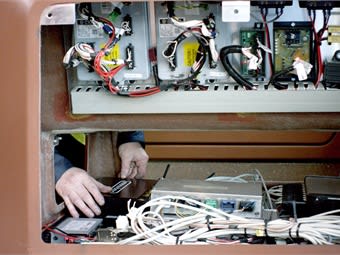
Fleets should buy a product or get a system that would be scalable for other functionalities down the road.
Services, ‘Infotainment’ options
Icomera: The company’s in-vehicle cellular routers utilize patented software for combining multiple networks to provide the fastest, reliable connection available for passengers. “Not all networks will be able to guarantee comprehensive coverage along all routes, which is why it’s advantageous to use an onboard Internet solution that can intelligently utilize the signals of multiple networks,” Ohrn, says. “Moreover, while many phones have 3G/4G cellular data, the majority of tablets and laptops do not, so these will still rely on Wi-Fi being offered.”
REI: REI’s new MegaMedia™ passenger entertainment system, which will debut in early 2016, is the answer to not having a cellular data plan at all, says Routh. The MegaMedia™ player is a self-contained unit that allows passengers to stream the latest HD movies and TV shows, as well as educational content. Fleet owners can choose from a variety of packages for the number of movies, etc., and can select how often they want to update that content package. Once the passenger boards the bus or coach, they simply download the app and select the content they want to watch. Recently, Routh says he spoke to transit property who was interested in using the player on its airport shuttle to showcase the history of the city and its key sites. “We can do all that, we just have to work with the property to develop the content and get it on the player,” he adds.
Singlepoint: Offers platforms that allow for things like “free but slow” Wi-Fi or “paid and fast Wi-Fi.” Also allows for advertising on supported models, offering a stream of revenue to transportation operators. Singlepoint’s new infotainment platform, Captiv8 Media can deliver news, sports, gossip channels and more, coupled with premium entertainment choices like newly released movies to bus or train passengers. This offering delivers a revenue stream to the operator, which will help offset operational costs, Taylo says.
Subscribe to Our Newsletter
More Management

METRO Opens Submissions for 2026 Motorcoach Awards
Nominations are now being accepted for METRO Magazine’s Operator of the Year and Innovative Operator of the Year awards.
Read More →
New York MTA Advances Final Contract for Second Avenue Subway Expansion
Contract Four is the largest in the Second Avenue Subway Phase 2 project and includes construction of station infrastructure, tracks, and signals for the subway expansion, MTA officials said. Work on Contract Four will begin in 2027.
Read More →
Transit Agencies Highlight Safety Gains at National Summit
Leaders from 15 major transit systems shared crime-reduction results and safety initiatives while discussing the role of continued federal support.
Read More →

NITA Names New Leadership, Expands Reduced-Fare Program at First Board Meeting
The new regional transit authority appointed its first board chair and interim executive director while extending reduced fares across CTA, Metra, and Pace for eligible riders.
Read More →
Beyond the Checklist: A Structured Approach to Transit Maintenance
Reliability-Centered Maintenance helps transit agencies move beyond routine checklists to focus limited resources on the assets and failures that have the greatest impact on safety, reliability, and service.
Read More →
APTA 2026 Nominating Committee Selects Leadership Slate, Names Chair and Vice Chair Nominees
Leadership changes will help shape the association’s priorities and its representation of the transportation industry during the 2026–2027 term.
Read More →
DART Launches Major Security, Fare Enforcement Initiative
The 90-day demonstration will deploy coordinated security teams at five light rail stations while testing controlled access and gathering data to guide future investments.
Read More →
Sponsored•September 9, 2026
Advancing Fare Collection Through Technology and Innovation
Learn about delivering 1300 gates at 91 stations while managing fare evasion. Explore the large scale deployment, solution customization and real-world results that affect the region. Prepare for deployment in your region now.
Read More →
Game Day in Motion: Moving Millions During the 2026 World Cup
Between packed transit stations and team motorcoaches, see how agencies and operators across North America tackled the transportation demands of the 2026 FIFA World Cup.
Read More →
Surface Transportation Extension Averts Shutdown, Leaves Transit Funding Gap
The stopgap keeps federal transportation programs moving, but missing advance funding could complicate the transit and rail projects agencies are planning next.
Read More →