



Empowering Employees Key for Top Maintenance Directors
Former DART VP, Maintenance, Michael Hubbell and Big Blue Bus’s Getty Modica took home the inaugural Maintenance Director of the Year Awards at BusCon 2018.
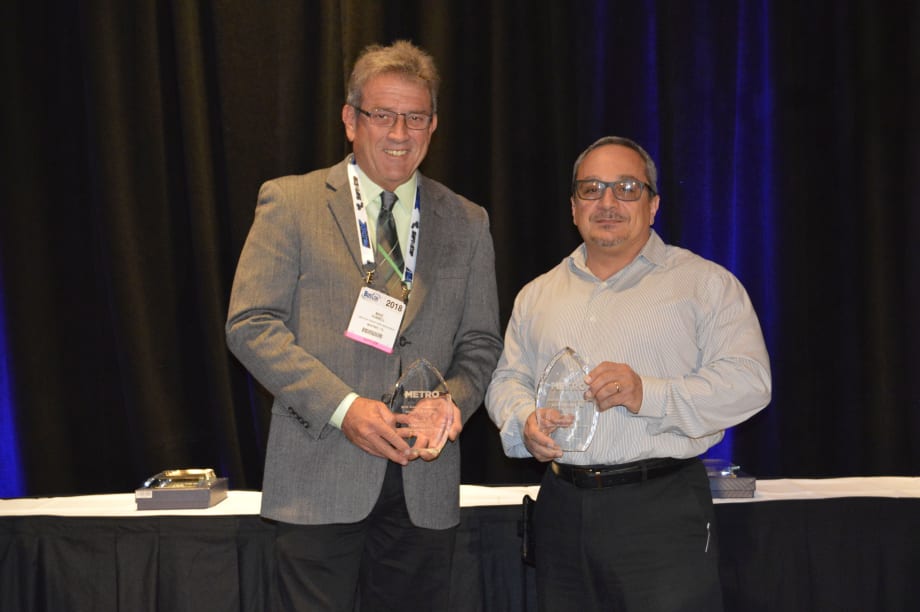
Michael Hubbell and Getty Modica were the winners of this year's inaugural Transit Maintenance Director of the Year Awards.
Michael Hubbell and Getty Modica were the winners of this year's inaugural Transit Maintenance Director of the Year Awards.
At BusCon held in Indianapolis, Oct. 1 to 3, 2018, METRO Magazine presented the inaugural Maintenance Director of the Year Award to two industry stalwarts who have gone above and beyond to run a great maintenance operation.
Criteria includes:
• Innovative best practices resulting in cost savings; increased vehicle uptime; shop efficiencies; the recruiting/hiring/retaining of staff; and/or an impact on safety.
• Improvements made through the better management of people, processes/assets, and/or financing/funding.
• Triennial Reviews.
For info on 2019 awards, contact alex.roman@bobit.com.

Hubbell
Michael Hubbell
Dallas Area Rapid Transit
Winning in the 501-vehicles and over category, the now-retired Michael Hubbell served most recently as VP, maintenance, for the Dallas Area Rapid Transit (DART), where he was responsible for a multimodal fleet that includes 650 New Flyer and ARBOC Specialty Vehicles buses and 163 Kinkisharyo light rail vehicles.
“It’s a very uncommon approach, but there are a few organizations that have their maintenance directors run both their bus and rail fleets,” explains Hubbell. “It’s really kind of balancing act of volume, the sheer size of the organization, and the skillset available. Once I developed the ability during my stop at Santa Clara VTA, it exponentially increased my marketability to come to Dallas.”
Hubbell landed at DART in late 1994 after beginning his career in 1976. During his tenure, the agency built the longest light rail system in North America, transitioned its bus fleet first to liquefied natural gas (LNG) then compressed natural gas (CNG), and put together a training program for the 19 different skill crafts involved in the maintenance of DART assets, which he says has served as a model for other agencies around the country. He also successfully developed and managed a long-range asset management program forecasting state of good repair requirements over a 20-year period for bus, light rail, and facilities assets valued at more than $5 billion, while allowing for financial capacity to support new capital construction over that same period.
“Mike is an inspirational leader, a mentor and a friend to everyone here at DART,” says Gary Thomas, DART president/executive director. “Over the past 23 years, those of us who have had the privilege of working with him know that DART is a better organization thanks to his contributions and dedication to our customers.”
Hubbell says a key to his time at DART has been identifying talent and empowering them to be successful on a day-to-day basis.
“I always had a philosophy of hiring people that were far smarter than I and coaching and supporting them to make sure they have the resources necessary to do their job,” he says. “It’s really a team effort. At times you have to manage your team, but more generally you are setting the pace and priorities and then getting out of the way and letting them do their job.”
Hiring the right people has also been key in DART’s maintenance team having successful careers with the ability to take advantage of opportunities as they exist. While at the agency, Hubbell developed and implemented a management succession program to prepare the organization for continuity of business and leadership to mitigate the risk of loss of knowledge due to approximately 32% of the maintenance management team reaching retirement eligibility over a five-year period.
To help build that succession program, Hubbell developed relationships with trade schools, military outplacement services, and colleges and universities, with many of his team members sitting on curriculum development boards to help transition or blend transit bus training into their heavy-duty truck maintenance programs.
Hubbell explains that while on recruiting trips he would be surprised that not many students had ever thought of working in the maintenance department of a transit agency, but would arrive at the agency after graduating motivated and skilled.
“They would come to us having dedicated 18 months of their life and with student loans to repay, so they had skin in the game and wanted to be successful,” he says. “We were also able to build a training program with the presumption that our technicians had a working basic knowledge in electrical theory, for instance, because somebody else already taught them that.”
Hubbell says that building a succession plan, especially for maintenance, is important for transit agencies as Baby Boomers continue to age out. He also says it’s important for those in management positions to continue to evolve as times change.
“Maintenance directors have to have the ability to continue to challenge themselves to avoid personal obsolescence,” he says. “You can’t make yourself obsolete, you have to stay current with where the organization is going, what other agencies are doing, and anticipate changes in equipment requirements and the like, and I think you have to do all of that because what you leave behind is as important as what you do while you are on the job.”

Modica
Getty Modica
Big Blue Bus
Succession planning has been important for Santa Monica, Calif.’s Big Blue Bus Transit Maintenance Manager Getty Modica, winner of the Maintenance Director of the Year Award, for transit agencies with 500 or fewer buses.
While at Big Blue Bus, Modica has implemented the Supervisory Training Education Program (S.T.E.P.) program, a leadership program that enables lead mechanics to receive mentorship and hands-on supervisory experience. Modica also hired a Maintenance Training Specialist, with whom he has developed a new training program, and a three-stage test to evaluate new hires.
“Roughly 30-percent of our maintenance staff was hired in the last five years, with many coming from the automotive industry. We have put together a comprehensive training program, to help give them the skills needed to be a transit mechanic,” Modica explains. “The program has been very successful, and in six months to a year, we can train an individual to perform 70-perecent of the work required; it typically takes two to three years to reach a competency of 95 percent.”
Modica and his team are also members of the Southern California Regional Transit Training Consortium (SCRTTC), an organization that offers a broad spectrum of transit training education. SCRTTC offers web-based training courses, which Big Blue Bus mechanics can access directly from the shop floor.
At Big Blue Bus, Modica manages a fleet of 195 buses with an average age of 4.7 years, outpacing the industry best practice of 8.5 years. Nationally recognized for its long-standing commitment to sustainability, Big Blue Bus’s entire fleet operates on renewable natural gas (RNG), which helps reduce its harmful nitrogen oxide (NOx) emissions by up to 90%.
Big Blue Bus aims to further reduce its fleet emissions by purchasing new buses equipped with near-zero engines, and retrofitting 30 others. In addition to the agency’s fixed-route fleet, Modica and his staff also procure and maintain its fleet of wheelchair accessible paratransit vehicles.
Building on the lessons learned from transitioning the fleet from diesel to natural gas, Modica is now leading the charge towards Big Blue Bus’s adoption of battery-electric buses. The agency will be among the first to operate a Gillig manufactured bus powered by the new Cummins electric propulsion system.
“We have a steep learning curve ahead of us, and I am certain mistakes will be made along the way, but we have a dedicated staff that will respect the technology and help advance it further,” says Modica. “Several years from now, battery-electric buses will be new standard, and engineers will be hard at work on technology that will serve as its successor. As a transit mechanic, you must to be able to adapt and evolve with new and emerging technologies that enable the industry to move forward.”
Modica adds that he is humbled by the METRO award, not only due to the nomination he received from his team, but his selection for the award by his peers.
“Throughout his 30-year career at Big Blue Bus, Modica has supported our agency’s vision of being a leader in innovation and sustainable transportation,” said Ed King, Director of Transit Services at Big Blue Bus. “As a champion of sustainability, he continuously pushes the needle forward for fleet technology, paving the way from diesel to natural gas, and now battery-electric buses. He’s accomplished all this while earning the respect and trust of his staff and colleagues.”
More Management

METRO Opens Submissions for 2026 Motorcoach Awards
Nominations are now being accepted for METRO Magazine’s Operator of the Year and Innovative Operator of the Year awards.
Read More →
New York MTA Advances Final Contract for Second Avenue Subway Expansion
Contract Four is the largest in the Second Avenue Subway Phase 2 project and includes construction of station infrastructure, tracks, and signals for the subway expansion, MTA officials said. Work on Contract Four will begin in 2027.
Read More →
Transit Agencies Highlight Safety Gains at National Summit
Leaders from 15 major transit systems shared crime-reduction results and safety initiatives while discussing the role of continued federal support.
Read More →

NITA Names New Leadership, Expands Reduced-Fare Program at First Board Meeting
The new regional transit authority appointed its first board chair and interim executive director while extending reduced fares across CTA, Metra, and Pace for eligible riders.
Read More →
Beyond the Checklist: A Structured Approach to Transit Maintenance
Reliability-Centered Maintenance helps transit agencies move beyond routine checklists to focus limited resources on the assets and failures that have the greatest impact on safety, reliability, and service.
Read More →
APTA 2026 Nominating Committee Selects Leadership Slate, Names Chair and Vice Chair Nominees
Leadership changes will help shape the association’s priorities and its representation of the transportation industry during the 2026–2027 term.
Read More →
DART Launches Major Security, Fare Enforcement Initiative
The 90-day demonstration will deploy coordinated security teams at five light rail stations while testing controlled access and gathering data to guide future investments.
Read More →
Advancing Fare Collection Through Technology and Innovation
Learn about delivering 1300 gates at 91 stations while managing fare evasion. Explore the large scale deployment, solution customization and real-world results that affect the region. Prepare for deployment in your region now.
Read More →
Game Day in Motion: Moving Millions During the 2026 World Cup
Between packed transit stations and team motorcoaches, see how agencies and operators across North America tackled the transportation demands of the 2026 FIFA World Cup.
Read More →
Surface Transportation Extension Averts Shutdown, Leaves Transit Funding Gap
The stopgap keeps federal transportation programs moving, but missing advance funding could complicate the transit and rail projects agencies are planning next.
Read More →