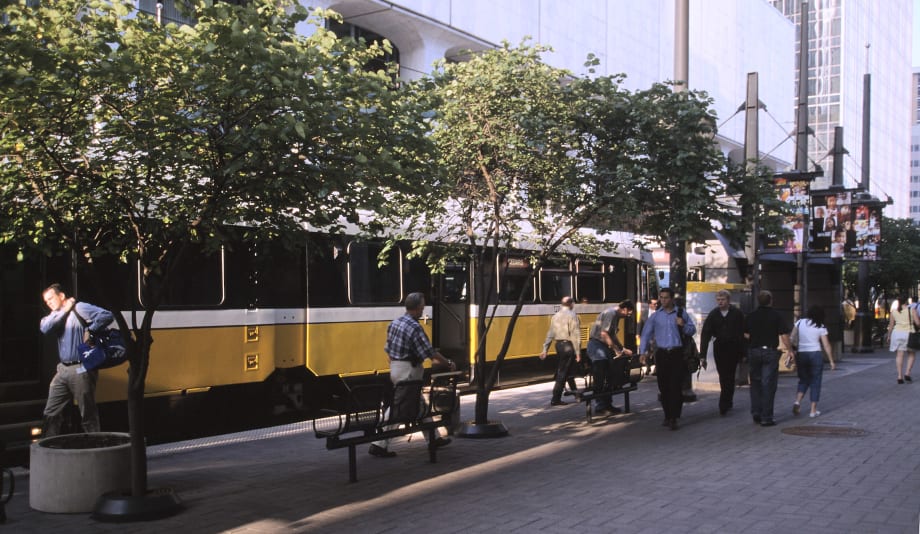
One study found that DART’s capital spending on light rail was almost $5.63 billion, or $4.7 billion in inflation-adjusted 2013 dollars. During that time, the expansion generated $7.4 billion in regional economic activity. Meanwhile, TOD investment has totaled $5.3 billion since the system's 1996 debut.
The region’s long-term investment in the Dallas Area Rapid Transit (DART) light rail system has generated more than $7.4 billion in regional economic impact, according to a new study of the agency’s capital spending between 2003 and 2013.
The study examined $4.7 billion invested thus far in the light rail system expansion, which includes the 28-mile Green Line from southeast Dallas to Farmers Branch and Carrollton and the 14-mile Orange Line through Irving.
Ad Loading...
Along the Blue Line, DART added a stop at Lake Highlands Station and a 4.5-mile extension from downtown Garland to Rowlett. At the peak of construction in 2010, DART was responsible for more than a quarter of all light rail construction in North America.
“Even through difficult economic times, DART has demonstrated its ability to boost the North Texas economy through its capital spending, daily operations and attracting private investment,” said Terry L. Clower, Ph.D., director of the Center for Economic Development and Research at the University of North Texas (UNT), which released the study.
In the 11-year period studied, the agency grew the light rail network from 44 miles and 34 stations to 85 miles and 61 stations.
The rapid growth resulted from considerable investment. The UNT study notes that DART’s capital spending on light rail was almost $5.63 billion, or $4.7 billion in inflation-adjusted 2013 dollars. During that time, the expansion generated $7.4 billion in regional economic activity, as measured in direct indirect and induced spending — a notable 157% return on investment.
Spillover spending and economic activity have generated $236 million in revenue for state and local taxing jurisdictions from sales and use taxes, property taxes, fees for licenses and permits, and other government revenue.
Ad Loading...
Meanwhile, a second UNT study found that more than $5.3 billion in private-capital transit-oriented development projects have been built, are under construction or are planned near DART’s light rail stations since the debut of DART Rail in 1996. Additionally, office properties located within .25 mile of a station command an average 13.9% higher lease rate.
The study examines DART Rail’s positive impact on property development and extends the research to consider the effect on commercial lease rates.
Researchers evaluated developments located within 0.25 mile of a DART Rail station and found that the station area outperformed those in comparable control locations in each of five major property types. New developments built between 1993 and 2013 in close proximity to light rail totaled more than $1.5 billion in valuation, compared with roughly $600 million in control areas.
Of those completed projects, more than $751 million are multifamily residential developments; office developments total $224 million. Retail developments are worth $393 million, with Mockingbird Station and The Shops at Park Lane the most notable examples. Industrial and single-family properties also were more plentiful near rail stations.
Beyond the property value, estimated tax contributions for development located near DART stations exceed $36 million annually, more than twice the $14 million estimated in the control group areas.
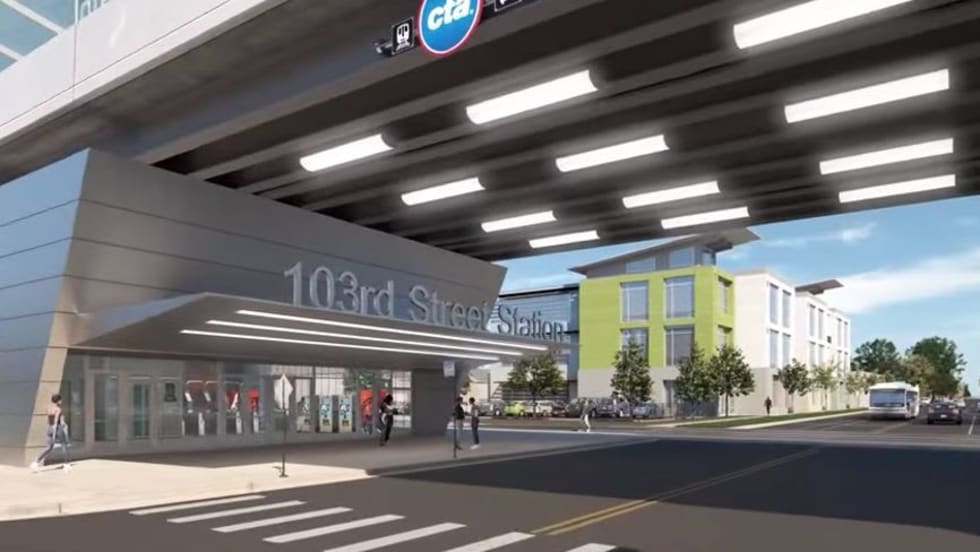
The Red Line Extension Project will provide the Far South Side of Chicago with rapid rail transit for the first time by extending the Red Line by 5.5 miles from 95th Street to 130th Street, including the construction of four new Red Line stations at 103rd, 111th, Michigan, and 130th streets.
While recognizing regional economic constraints and continuing to improve service, the budget increases the jurisdictional subsidy to less than 1.8%, significantly below the inflation rate and the 3% regional target, said agency officials.
Coalition leaders outline priorities for preserving bus funding, maintaining competitive grants, and ensuring flexibility for transit agencies nationwide.
In the coming months, the parties will develop an interlocal agreement for the city’s annexation into Community Transit’s district. The proposal will be considered by the Everett City Council and the Community Transit board this fall, said officials.
A $6.5 million investment will bring station improvements, rider-friendly features, and workforce opportunities as CTA prioritizes safer, more welcoming transit spaces.
In this Consultant Roundtable, AECOM’s transit market leader for the Americas discusses how agencies can align teams, manage complexity, and prepare for the next generation of transit infrastructure and service delivery.
Legislation would expand funding for training, apprenticeships, and workforce development as agencies face staffing shortages and evolving technology demands.