



Mobile app helps MTS move San Diego Comic-Con attendees
Comic-Con — a five-day celebration of popular art and entertainment at the annual convention along downtown San Diego’s scenic bay front — attracts 130,000 attendees and the San Diego Trolley system handles more than 215,000 extra passenger trips during the festivities.

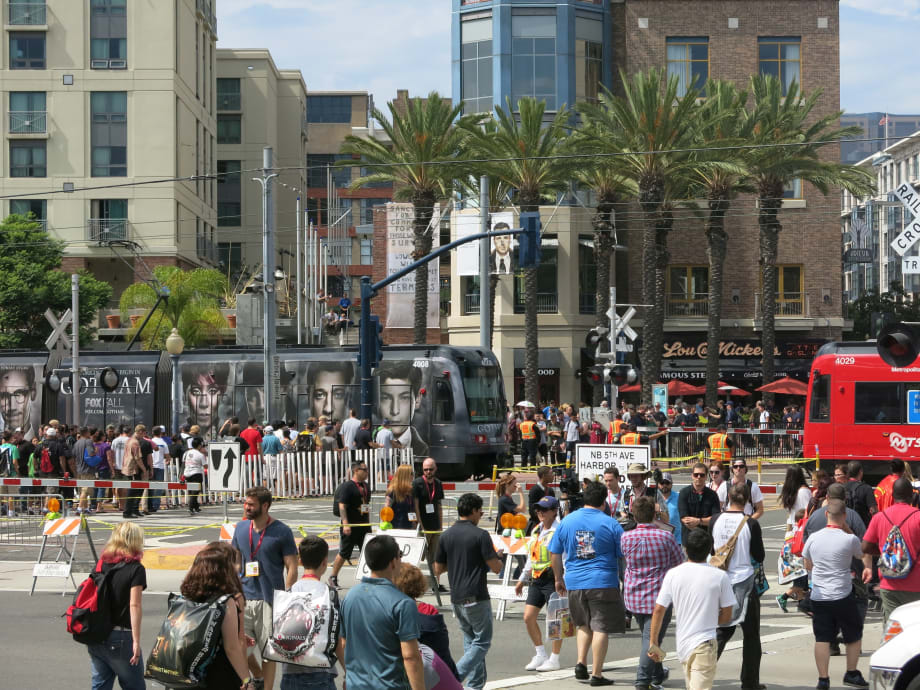
Riders entering and exiting Trolley at Gaslamp Quarter station.
Riders entering and exiting Trolley at Gaslamp Quarter station.
In late July, it’s not uncommon to see Klingons, Darth Vader, Spiderman and Superwoman all boarding the Trolley at the same time in downtown San Diego. Comic-Con — a five-day celebration of popular art and entertainment at the annual convention along downtown San Diego’s scenic bay front — attracts 130,000 attendees and the San Diego Trolley system handles more than 215,000 extra passenger trips during the festivities.
PHOTO GALLERY:MTS Service at San Diego Comic Con
To help Comic-Con passengers avoid long Trolley ticket lines and provide a convenient ticket purchasing option, MTS introduced mTicket — a mobile ticketing app that puts the Trolley ticket vending machine in the pocket of the passenger.
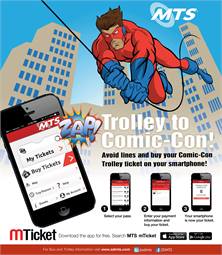
Artwork for mTicket advertising
Mobile ticketing options are becoming more popular for transit agencies across the U.S., including the Massachusetts Bay Transportation Authority, New Jersey Transit, Dallas Area Rapid Transit and TriMet in Portland, Ore. Fare systems professionals predict that up to 25% of sales will eventually come through mobile ticketing options.
RELATED:San Diego adds historic trolley to fleet
MTS first introduced mTicket in 2013 for San Diego Chargers and San Diego State Aztec football games. Comic-Con was the third step for the mTicket pilot program in the San Diego market.
“We thought this was a good tech-savvy audience and that many Comic-Con passengers would embrace this option,” said Rob Schupp, director of marketing and communications at MTS. “The biggest challenge was making them aware that mobile ticketing was available.”
The MTS marketing and communications team used aggressive outreach tactics to boost awareness for mTicket leading up to Comic-Con week. mTicket promotions began about two weeks ahead of Comic-Con, including clever comic-themed artwork for stations and ticket vending machines, advertisements in local papers, outdoor signage at select Trolley stations, social media sharing, blog posts through popular Comic-Con bloggers and on-air television network interviews.
“Riding the Trolley to Comic-Con is always part of news coverage, but mTickets gave us a news hook that really boosted coverage. We were on all the major television news station in San Diego,” added Schupp.
The marketing campaign paid off. There were more than 4,100 ticket sales transactions totaling nearly $58,800 in value. Sales started immediately after it was announced and took off two days prior to the festivities.
“mTickets were just one of the ways people could buy their fares,” Schupp said. “We also printed commemorative tickets that are always real popular with collectors. And, of course, ticket vending machines were the workhorse in terms of volume. But when it was all said and done, about ten percent of our volume was in mTickets, which was a big success for our first year.”
More Management

METRO Opens Submissions for 2026 Motorcoach Awards
Nominations are now being accepted for METRO Magazine’s Operator of the Year and Innovative Operator of the Year awards.
Read More →
New York MTA Advances Final Contract for Second Avenue Subway Expansion
Contract Four is the largest in the Second Avenue Subway Phase 2 project and includes construction of station infrastructure, tracks, and signals for the subway expansion, MTA officials said. Work on Contract Four will begin in 2027.
Read More →
Transit Agencies Highlight Safety Gains at National Summit
Leaders from 15 major transit systems shared crime-reduction results and safety initiatives while discussing the role of continued federal support.
Read More →

NITA Names New Leadership, Expands Reduced-Fare Program at First Board Meeting
The new regional transit authority appointed its first board chair and interim executive director while extending reduced fares across CTA, Metra, and Pace for eligible riders.
Read More →
Beyond the Checklist: A Structured Approach to Transit Maintenance
Reliability-Centered Maintenance helps transit agencies move beyond routine checklists to focus limited resources on the assets and failures that have the greatest impact on safety, reliability, and service.
Read More →
APTA 2026 Nominating Committee Selects Leadership Slate, Names Chair and Vice Chair Nominees
Leadership changes will help shape the association’s priorities and its representation of the transportation industry during the 2026–2027 term.
Read More →
DART Launches Major Security, Fare Enforcement Initiative
The 90-day demonstration will deploy coordinated security teams at five light rail stations while testing controlled access and gathering data to guide future investments.
Read More →
Advancing Fare Collection Through Technology and Innovation
Learn about delivering 1300 gates at 91 stations while managing fare evasion. Explore the large scale deployment, solution customization and real-world results that affect the region. Prepare for deployment in your region now.
Read More →
Game Day in Motion: Moving Millions During the 2026 World Cup
Between packed transit stations and team motorcoaches, see how agencies and operators across North America tackled the transportation demands of the 2026 FIFA World Cup.
Read More →
Surface Transportation Extension Averts Shutdown, Leaves Transit Funding Gap
The stopgap keeps federal transportation programs moving, but missing advance funding could complicate the transit and rail projects agencies are planning next.
Read More →