



Calif.'s Torrance Transit marks 75 years
Agency unveiled commemorative TAP cards, the regional smart card system launched by L.A. Metro.

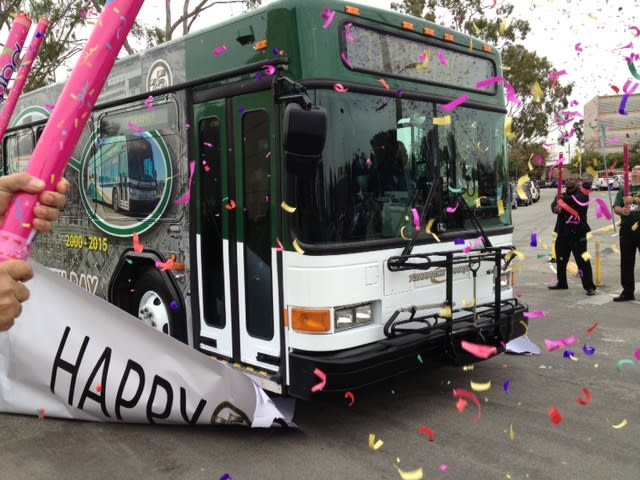
Torrance Transit unveiled a special branded "birthday" bus for the event.
Torrance Transit unveiled a special branded "birthday" bus for the event.
Southern California-based Torrance Transit recently celebrated its 75th anniversary. To mark the occasion, the agency also announced it is joining Los Angeles Metro's regional TAP smart card system.
The TAP system is an initiative of Metro, which developed and manages the regional automated transit revenue collection system.
The commemorative event was attended by local officials, including Torrance Mayor Patrick J. Furey, who talked about the transit operation's start using three leased buses to help replace service in the city when the Pacific Electric Railcar ceased operation.
"Those foks were truly visionaries," Furey said of Torrance Transit's founding leadership. He went on to extoll the agency's accomplishments during its 75 years, citing its 4 million yearly ridership to their adoption of hybrid electric vehicles and the forthcoming 15,000-square-foot transit center.

Transit Director Kim Turner.
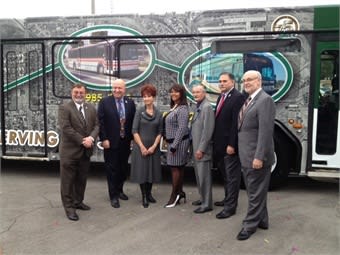
Transit Director Kim Turner (center) is joined by local officials for a photo opp.
Transit Director Kim Turner talked about how the agency "was there to get people where they wanted to go." She also thanked her "great team of employees" and thanked the other agencies in the Los Angeles region they interact with, as well as Torrance Transit's customers.
She added, "But most of all, we [thank] our customers who ride Torrance Transit each and every day."
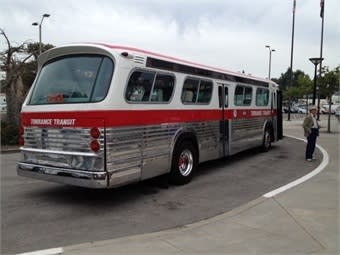
A vintage Torrance Transit bus was on display.
More Management

METRO Opens Submissions for 2026 Motorcoach Awards
Nominations are now being accepted for METRO Magazine’s Operator of the Year and Innovative Operator of the Year awards.
Read More →
New York MTA Advances Final Contract for Second Avenue Subway Expansion
Contract Four is the largest in the Second Avenue Subway Phase 2 project and includes construction of station infrastructure, tracks, and signals for the subway expansion, MTA officials said. Work on Contract Four will begin in 2027.
Read More →
Transit Agencies Highlight Safety Gains at National Summit
Leaders from 15 major transit systems shared crime-reduction results and safety initiatives while discussing the role of continued federal support.
Read More →

NITA Names New Leadership, Expands Reduced-Fare Program at First Board Meeting
The new regional transit authority appointed its first board chair and interim executive director while extending reduced fares across CTA, Metra, and Pace for eligible riders.
Read More →
Beyond the Checklist: A Structured Approach to Transit Maintenance
Reliability-Centered Maintenance helps transit agencies move beyond routine checklists to focus limited resources on the assets and failures that have the greatest impact on safety, reliability, and service.
Read More →
APTA 2026 Nominating Committee Selects Leadership Slate, Names Chair and Vice Chair Nominees
Leadership changes will help shape the association’s priorities and its representation of the transportation industry during the 2026–2027 term.
Read More →
DART Launches Major Security, Fare Enforcement Initiative
The 90-day demonstration will deploy coordinated security teams at five light rail stations while testing controlled access and gathering data to guide future investments.
Read More →
Advancing Fare Collection Through Technology and Innovation
Learn about delivering 1300 gates at 91 stations while managing fare evasion. Explore the large scale deployment, solution customization and real-world results that affect the region. Prepare for deployment in your region now.
Read More →
Game Day in Motion: Moving Millions During the 2026 World Cup
Between packed transit stations and team motorcoaches, see how agencies and operators across North America tackled the transportation demands of the 2026 FIFA World Cup.
Read More →
Surface Transportation Extension Averts Shutdown, Leaves Transit Funding Gap
The stopgap keeps federal transportation programs moving, but missing advance funding could complicate the transit and rail projects agencies are planning next.
Read More →