



MTA New York City Transit President Bianco to retire
Carmen Bianco, 63, became acting president of New York City Transit in April 2013 and was permanently appointed to the position in September 2013 following a nationwide search. He had previously served since March 2010 as sr. VP, Department of Subways.

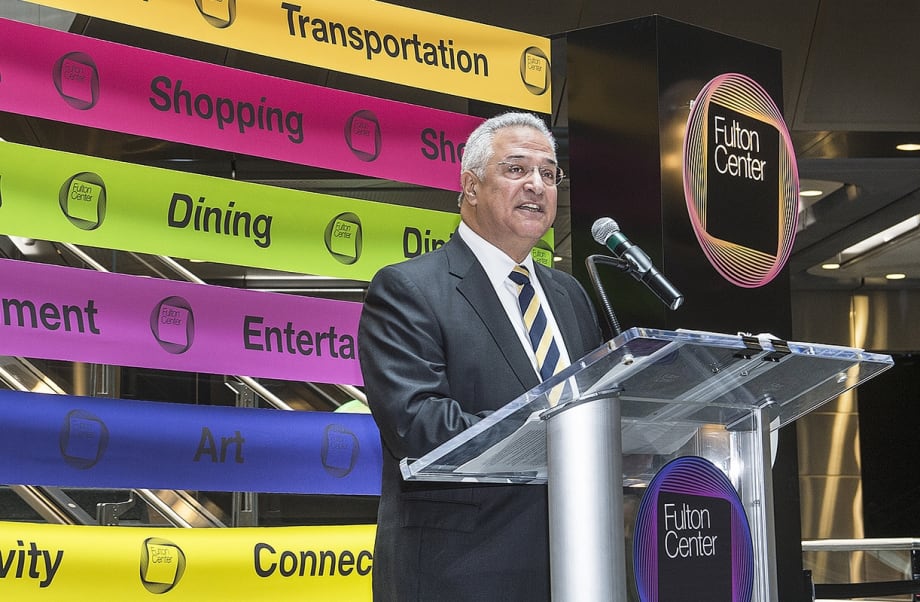
MTA NYCT President Carmen Bianco speaking at the unveiling of the Fulton Center transit and retail hub. Photo: Metropolitan Transportation Authority / Patrick Cashin
MTA NYCT President Carmen Bianco speaking at the unveiling of the Fulton Center transit and retail hub. Photo: Metropolitan Transportation Authority / Patrick Cashin
Carmen Bianco, president of Metropolitan Transportation Authority (MTA) New York City Transit (NYCT), announced he plans to retire later this year from his position running the largest mass transit system in North America. In his time as president, Bianco transformed the agency’s organizational culture to align management strategies, enhance safety and improve customer service to advance the subways, buses, paratransit and Staten Island Railway in New York City.
Bianco and his team guided the agency through significant snowstorms, Hurricane Irene and Superstorm Sandy, which took a critical toll on significant areas of the 110-year-old infrastructure. Despite more than $4 billion in Sandy-related damage, 80% of subway service was restored within five days.
As NYCT works to deliver consistent service to daily ridership that has steadily expanded to more than 8.2 million people, Bianco’s leadership team is planning service for the future by evaluating ways to deliver higher-capacity, more environmentally friendly and technologically advanced trains and buses, and improved levels of customer service.
“There is no more challenging job in the American transportation industry than keeping New York City moving every day and positioning it well to serve our customers for decades to come,” Bianco said. “It has been a privilege to lead our 48,000 employees who work so hard around the clock. I owe each of them a debt of gratitude, and it’s been an honor to have served New York City Transit.”
Bianco, 63, became acting president of NYCT in April 2013 and was permanently appointed to the position in September 2013 following a nationwide search. He had previously served since March 2010 as sr. VP, Department of Subways.
“Carmen Bianco is a one-of-a-kind leader as well as a trusted friend, and while I understand why he is ready to retire now, we will all miss his detailed experience, his thoughtful perspective and his constant drive to make transit better for both our customers and our employees,” said MTA Chairman/CEO Thomas F. Prendergast. “Through initiatives like establishing the FASTRACK program for subway maintenance and aggressively bringing new technology into the system, Carmen made the organizational culture of New York City Transit reflect the priorities that our customers expect. He will be missed.”
Bianco was the seventh person to serve as New York City Transit President since the position was created in 1980. He previously served as head of New York City Transit’s Department of System Safety from 1991 to 1995. Bianco has also held senior safety positions at Amtrak and NJ Transit.
Bianco has submitted a retirement letter effective in August 2015, to allow the MTA to conduct a nationwide search for his replacement and ensure a seamless transition.
More Management

APTA Honors 2026 Award Winners, Hall of Fame Inductees at TRANSform & EXPO
Innovations in autonomous and zero-emission transportation, standout transit systems, and industry leadership took center stage among this year's honorees.
Read More →
7 Ways to Build a Better Transit Internship Program
Lessons from DRPA/PATCO’s approach to creating a meaningful internship experience—and developing the next generation of transportation professionals.
Read More →
Scenes from APTA TRANSform & EXPO 2026
Transit leaders, manufacturers, and industry professionals gathered in Chicago to explore new technologies, share ideas, and discuss the future of public transportation.
Read More →
Building Stronger Leaders, More Resilient Transit Teams
Dr. Carol Parker Walsh discusses leadership development, employee retention, workplace culture, and preparing transit’s workforce for AI and automation.
Read More →
APTA 2026 TRANSform & EXPO Kicks Off in Chicago
After 45 years, APTA returns to Chicago with a focus on next-generation fleets, AI, connected transit networks, and the funding strategies shaping public transportation’s future.
Read More →
New York MTA Warns Federal Tariffs Could Add $1 Billion to Rolling Stock Costs
The agency said tariffs on specialized imported components could reduce the purchasing power of its $23 billion investment in new subway cars, railcars, and buses.
Read More →
From the Show Floor: What Happened at APTA TRANSform & EXPO 2026
See the latest product launches, partnerships, technology updates, and transit industry announcements from APTA TRANSform & EXPO in Chicago.
Read More →
How Valley Metro Is Balancing Transit Growth With the Rider Experience
The APTA award-winning agency is pairing rapid system expansion with investments in workforce, safety, technology, and the fundamentals of transit service.
Read More →
Bus Tech Talk: Keeping Transit Technicians Ahead of the Technology Curve
In this episode of Bus Tech Talk, Complete Coach Works’ Business Development Manager Mark Hollenbeck and METRO’s Executive Editor Alex Roman sit down with Obed Mejia, Senior Technical Trainer for Bus Maintenance, at LA Metro to discuss how rapidly evolving bus technology is changing the maintenance shop — and the skills technicians need to keep pace.
Read More →
Michael Schneider Joins Paslay Group to Expand Transportation Practice
The longtime transportation executive will help Paslay Group grow its advisory and program management work across transit, highway, and other infrastructure sectors.
Read More →