




RELATED: Senate leaders reject Gov. Baker's MBTA fiscal control plan
Gov. Baker unveils $83 million MBTA winter resiliency plan
Calls for investments this summer and over the next five years in snow removal equipment, infrastructure upgrades and operations during harsh weather to improve service reliability.
June 5, 2015
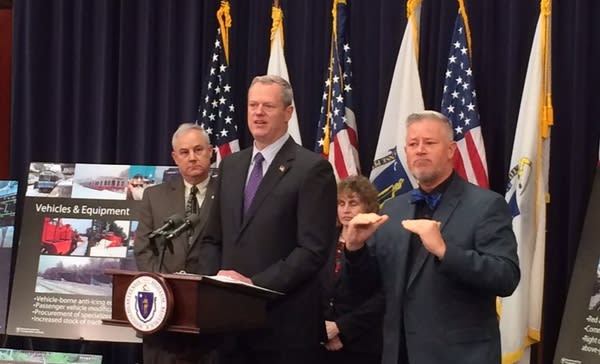
Massachusetts Governor Charlie Baker during press conference.
Courtesy MBTA
4 min to read
Massachusetts Governor Charlie Baker during press conference.
Courtesy MBTA
Governor Charlie Baker unveiled an $83 million plan to make Massachusetts Bay Transportation Authority (MBTA) buses and trains more resilient during extreme weather. The MBTA Winter Resiliency Plan calls for investments this summer and over the next five years in snow removal equipment, infrastructure upgrades and operations during harsh weather to improve service reliability. Governor Baker also stressed the need for legislative action on An Act for a Reliable, Sustainable MBTA to secure long term improvements at the T.
“In the event of another harsh winter, it is critical we are prepared. We also hope the legislature will act before the end of this session to deliver the reforms necessary to address the underlying financial and management challenges at the MBTA,” said Governor Baker. “These investments and contingency plans are important for day-to-day operations and emergency service. But, without the flexibility and dedicated oversight of a Fiscal Management and Control Board and the reforms we outlined, the T will continue to fail its stress tests for commuters and taxpayers who deserve a reliable world class transit system.”
The new resiliency plan was developed based on recommendations by an American Public Transportation Association (APTA) peer review of the MBTA’s winter operations in April, while a special panel appointed by the Governor reviewed and made recommendations to fix the MBTA’s deeper structural, financial and operational problems.
“We learned last winter that in addition to structural reforms, the MBTA needs meaningful improvements to its snow resiliency efforts, including upgrades to infrastructure, operations and equipment,” said Interim MBTA GM Frank DePaola. “As we continue to work with the administration and our peer agencies to improve service reliability, we look forward to implementing these plans that are essential to reducing the amount and length of service disruptions during severe weather.”
The $82.7 million plan will be funded through $62 million in federal formula funds for capital investments, $10 million in non-federal, MBTA capital funds, and $11.7 million in operating funds. The plan will be presented to the MassDOT Board for approval next week and focus on the following priorities to more effectively mitigate the frequency, length and magnitude of system disruptions to public transit during severe weather.
Infrastructure
Third rail replacements and heater upgrades on vulnerable outdoor sections of the Red and Orange Lines.
Snow fence installation along the Red and Orange Lines to mitigate snow drift accumulation.
Repairs to vehicle maintenance facilities and structures to further maximize recovery efforts.
Emergency power generators to supplement existing subway and facility power as needed.
Track access improvements for larger snow removal and track work equipment on the Red Line.
Equipment
New and rehabilitated specialized snow removal equipment to increase removal capacity and reduce use of passenger vehicles.
For passenger vehicles, vehicle-borne anti-icing equipment, modifications to air and propulsion system resiliency and an increased stock of traction motors to improve availability.
Operations
Additional snow removal contract services, as needed, to remove snow and ice at stations, facilities and other critical operations areas.
Training and staffing of a Field Inspection Team to be deployed during weather events to monitor staff and contractor field activities clearing snow and returning tracks to an operational status.
Adoption of incident management software in coordination with the MassDOT Highway Division to track deployment of snow removal operations across the system.
Formal establishment of an as needed inmate snow removal assistance program with the Department of Corrections to augment and streamline the services provided this winter.
Further coordination of interagency planning with the Massachusetts Emergency Management Agency, state agencies and local municipalities to identify efficiencies and synergies in snow removal.
Similar resiliency enhancements to the commuter rail network.
Revisions to the MBTA’s severe winter weather operations protocols and customer notification practices to ensure more information, customer safety and the protection of equipment and facilities.
The right-of-way improvements on the Orange and Red Lines will be scheduled to occur this summer and fall and the MBTA will notify customers of any service impacts required to enable the upgrades as these projects are implemented.
In April, Governor Baker filed legislation based on the special panel’s recommendations to establish a Fiscal Management and Control Board (FMCB) and Chief Administrator to oversee the MBTA’s operations and finances, create capital plans and expand the MassDOT Board. An Act for a Reliable, Sustainable MBTA also introduces reporting and audit requirements and lifts procurement restrictions on the MBTA.
More Management

FTA Ends Direct Oversight of MBTA Safety Actions
The federal agency closed its remaining special directive to the Massachusetts Department of Public Utilities following a safety review that began in 2022.
Read More →
Report: Transit Bus Manufacturing Supports 34,100 Jobs, $5.1B in GDP
The “Buses Mean Business” report examines the transit bus manufacturing industry’s economic footprint, supply chain, and rising demand for vehicle replacements.
Read More →
LIT Marks 10-Year Milestone at Annual Summit
Hosted by the COTA from September 10 to 13, the Summit carried the theme “Celebrating 10 Years of Excellence, Leadership, and Impact,” with every part of the program honoring the people, agencies, and partners who built LIT over its first decade.
Read More →

People Movement: Dan Dipert Coaches Adds Third-Generation Leader, Keolis Names New Valley Metro VP/GM, and More
In this edition, we also cover recent appointments and announcements at the Wabtec, SilverRide, HNTB, and more, showcasing the individuals helping to shape the future of transportation.
Read More →
METRO Opens Submissions for 2026 Motorcoach Awards
Nominations are now being accepted for METRO Magazine’s Operator of the Year and Innovative Operator of the Year awards.
Read More →
New York MTA Advances Final Contract for Second Avenue Subway Expansion
Contract Four is the largest in the Second Avenue Subway Phase 2 project and includes construction of station infrastructure, tracks, and signals for the subway expansion, MTA officials said. Work on Contract Four will begin in 2027.
Read More →
Transit Agencies Highlight Safety Gains at National Summit
Leaders from 15 major transit systems shared crime-reduction results and safety initiatives while discussing the role of continued federal support.
Read More →
NITA Names New Leadership, Expands Reduced-Fare Program at First Board Meeting
The new regional transit authority appointed its first board chair and interim executive director while extending reduced fares across CTA, Metra, and Pace for eligible riders.
Read More →
Beyond the Checklist: A Structured Approach to Transit Maintenance
Reliability-Centered Maintenance helps transit agencies move beyond routine checklists to focus limited resources on the assets and failures that have the greatest impact on safety, reliability, and service.
Read More →
APTA 2026 Nominating Committee Selects Leadership Slate, Names Chair and Vice Chair Nominees
Leadership changes will help shape the association’s priorities and its representation of the transportation industry during the 2026–2027 term.
Read More →