



Q&A with SF Muni's Ed Reiskin
As head of Muni, Edward D. Reiskin has the responsibility for more than 5,000 employees, a $1 billion annual operating budget, and a $3 billion capital budget. He rides the system every day, bringing the perspective as a customer to his role as leader of the agency.

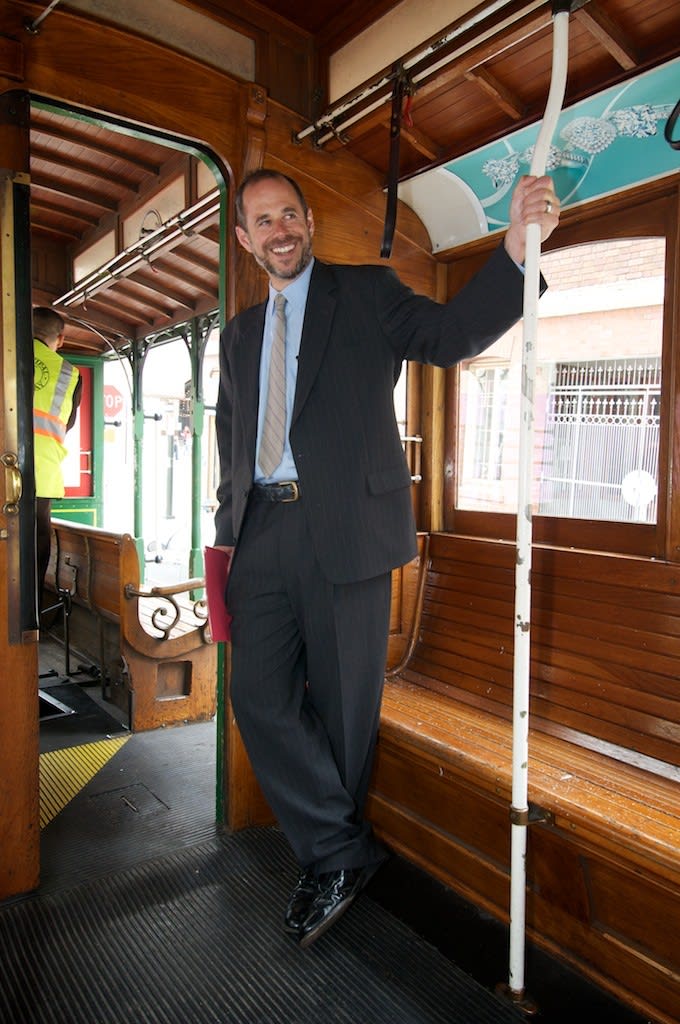
Muni is one of the oldest public transit agencies in America and the largest in the Bay Area, currently carrying more than 200 million riders per year and 700,000 boardings on an average weekday. The agency’s fleet includes historic streetcars, modern light rail vehicles, diesel buses, alternative-fuel vehicles, electric trolley coaches and the world famous cable cars.
As head of Muni, Edward D. Reiskin has the responsibility for more than 5,000 employees, a $1 billion annual operating budget, and a $3 billion capital budget. He rides the system every day, bringing the perspective as a customer to his role as leader of the agency. METRO spoke with Reiskin about his work and where he’d be if he weren’t in transit.
What is your favorite aspect of your job?
Transportation really impacts your quality of life here. What I love is the ability to be working on something and trying to make improvements that really matter to people so that you can really see tangible changes, both good and bad, as a result of your work.
What project or initiative are you most proud of?
In terms of transit, I think the Muni Forward program, which is a really comprehensive overhaul and an improvement of transit service in San Francisco. It’s just getting underway, but it’s a significant achievement. It’s a systematic approach to Muni service in the city.
Outside of transit, our city has adopted a policy called Vision Zero, which is a goal to eliminate traffic fatalities in San Francisco by 2024. There’s a lot of work that we are doing in terms of redesigning the streets, education and outreach, enforcement, and working across city agencies and with community partners to seek to achieve this important goal that people shouldn’t be dying in our streets just trying to get around town. I feel good about the work we are doing toward that goal.
Growing up, what career path did you see yourself following?
I thought I’d be a doctor. Then I realized I don’t like being around sick people or hospitals. It probably wasn’t a good call for me (laughing).
What’s your typical workday like?
First thing, I check the status of the transit system and any things that might have gone awry overnight. I usually start off the morning in the office and the day is generally meetings with my staff and other stakeholders, as well as a fair bit of meetings at City Hall. I try to get out and about as much as I can to meet with and talk with employees of the agency. It’s a big agency and a lot of the folks on the front line are the ones who are closest to the work and have some of the best ideas on how we can do our work better.
What pivotal moment has gotten you where you are today?
I guess what kind of got me interested in urban and public sector work was [when I worked] for a nonprofit environmental consulting firm. [We] did some environmental justice analysis, demonstrating how facilities that were creating pollution were concentrated very disproportionately in low income neighborhoods. I decided that I wanted to focus my energies on work that I could do to address those kinds of inequities and make life in cities better for people who live in them, particularly people who don’t have as much choice in where they live.
Who/what system in the transit industry inspires you?
I’m a transit geek. I love all trains and buses. The big systems are impressive to me — the New York MTA. I was in France this summer and riding the Paris Metro was a really pretty phenomenal experience.
I think there are a lot of great agencies a lot of great professionals in this industry. Just here in the Bay Area, I feel very fortunate to work with the likes of Grace Crunican, who runs BART. The larger transit agencies in the region meet once a month, and I get tremendous value out of just sharing and collaborating with the other folks who are doing this work.
What are your favorite pastimes?
I like spending time with my family, walking around San Francisco and reading. I prefer fiction, but I’ve been reading a lot more nonfiction lately. Right now, I’m reading the history of Chinatown. It actually has quite a bit of transit history, too.
If you weren’t in transit…
Some sort of city management job. That’s what I did before transit.
More Management

METRO Opens Submissions for 2026 Motorcoach Awards
Nominations are now being accepted for METRO Magazine’s Operator of the Year and Innovative Operator of the Year awards.
Read More →
New York MTA Advances Final Contract for Second Avenue Subway Expansion
Contract Four is the largest in the Second Avenue Subway Phase 2 project and includes construction of station infrastructure, tracks, and signals for the subway expansion, MTA officials said. Work on Contract Four will begin in 2027.
Read More →
Transit Agencies Highlight Safety Gains at National Summit
Leaders from 15 major transit systems shared crime-reduction results and safety initiatives while discussing the role of continued federal support.
Read More →

NITA Names New Leadership, Expands Reduced-Fare Program at First Board Meeting
The new regional transit authority appointed its first board chair and interim executive director while extending reduced fares across CTA, Metra, and Pace for eligible riders.
Read More →
Beyond the Checklist: A Structured Approach to Transit Maintenance
Reliability-Centered Maintenance helps transit agencies move beyond routine checklists to focus limited resources on the assets and failures that have the greatest impact on safety, reliability, and service.
Read More →
APTA 2026 Nominating Committee Selects Leadership Slate, Names Chair and Vice Chair Nominees
Leadership changes will help shape the association’s priorities and its representation of the transportation industry during the 2026–2027 term.
Read More →
DART Launches Major Security, Fare Enforcement Initiative
The 90-day demonstration will deploy coordinated security teams at five light rail stations while testing controlled access and gathering data to guide future investments.
Read More →
Advancing Fare Collection Through Technology and Innovation
Learn about delivering 1300 gates at 91 stations while managing fare evasion. Explore the large scale deployment, solution customization and real-world results that affect the region. Prepare for deployment in your region now.
Read More →
Game Day in Motion: Moving Millions During the 2026 World Cup
Between packed transit stations and team motorcoaches, see how agencies and operators across North America tackled the transportation demands of the 2026 FIFA World Cup.
Read More →
Surface Transportation Extension Averts Shutdown, Leaves Transit Funding Gap
The stopgap keeps federal transportation programs moving, but missing advance funding could complicate the transit and rail projects agencies are planning next.
Read More →