



Jobs to Move America launches as independent national nonprofit
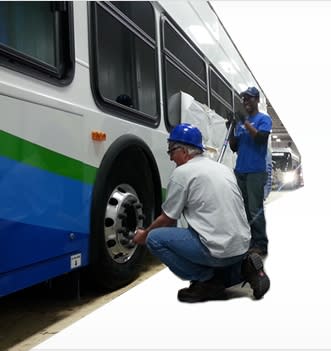
Organization was created in 2013 to re-envision the potential for reviving U.S. manufacturing jobs for underserved communities via public transit.

Jobs To Move America
Jobs To Move America
Jobs to Move America (JMA), an organization dedicated to advocating for jobs in transit manufacturing announced its launch as an independent national non-profit organization.
JMA, originally a national campaign nurtured at the Los Angeles Alliance for a New Economy (LAANE), was created in 2013 to re-envision the potential for reviving U.S. manufacturing jobs for underserved communities via public transit. JMA piloted the U.S. Employment Plan, a policy tool, in L.A. and Chicago so transit agencies could enhance jobs and economic development related to public transportation investment. The success in both cities rapidly expanded into campaigns at other cities’ agencies across the nation.
U.S. DOT Secretary Anthony Foxx recently released a letter encouraging transportation stakeholders to use innovative contracting approaches — like the one developed by JMA — to leverage public funds to create jobs and opportunities for disadvantaged communities.
“When we started JMA, we quickly realized that this was a movement that had national and global reach,” said Madeline Janis, executive director of Jobs to Move America.
LAANE Executive Director Roxana Tynan commented, “We’re incredibly proud to have incubated JMA, whose grand vision and strategic work in L.A. will set a new national standard of good jobs for those building the rail cars and buses of our future.”
Jobs To Move America
“Our public transportation dollars really should 'go the distance.’ The Federal Surface Transportation Act of 2015 provides more than $300 billion that can help regions around the country build cleaner public transit systems while creating a large number of good jobs. That’s the kind of forward-thinking approach local governments like Los Angeles County want to put in place,” said L.A. County Supervisor Sheila Kuehl.
An opening reception will be held at JMA’s new national office based at the Los Angeles Cleantech Incubator (LACI). “The LA Cleantech Incubator is thrilled to have JMA join us at the new La Kretz Innovation Campus as part of our growing Transportation Cluster. We look forward to working together to connect the expansion of public transit to economic development here in LA,” said Ben Stapleton, LACI’s Vice President of Facilities and Operations.
More Management

METRO Opens Submissions for 2026 Motorcoach Awards
Nominations are now being accepted for METRO Magazine’s Operator of the Year and Innovative Operator of the Year awards.
Read More →
New York MTA Advances Final Contract for Second Avenue Subway Expansion
Contract Four is the largest in the Second Avenue Subway Phase 2 project and includes construction of station infrastructure, tracks, and signals for the subway expansion, MTA officials said. Work on Contract Four will begin in 2027.
Read More →
Transit Agencies Highlight Safety Gains at National Summit
Leaders from 15 major transit systems shared crime-reduction results and safety initiatives while discussing the role of continued federal support.
Read More →

NITA Names New Leadership, Expands Reduced-Fare Program at First Board Meeting
The new regional transit authority appointed its first board chair and interim executive director while extending reduced fares across CTA, Metra, and Pace for eligible riders.
Read More →
Beyond the Checklist: A Structured Approach to Transit Maintenance
Reliability-Centered Maintenance helps transit agencies move beyond routine checklists to focus limited resources on the assets and failures that have the greatest impact on safety, reliability, and service.
Read More →
APTA 2026 Nominating Committee Selects Leadership Slate, Names Chair and Vice Chair Nominees
Leadership changes will help shape the association’s priorities and its representation of the transportation industry during the 2026–2027 term.
Read More →
DART Launches Major Security, Fare Enforcement Initiative
The 90-day demonstration will deploy coordinated security teams at five light rail stations while testing controlled access and gathering data to guide future investments.
Read More →
Advancing Fare Collection Through Technology and Innovation
Learn about delivering 1300 gates at 91 stations while managing fare evasion. Explore the large scale deployment, solution customization and real-world results that affect the region. Prepare for deployment in your region now.
Read More →
Game Day in Motion: Moving Millions During the 2026 World Cup
Between packed transit stations and team motorcoaches, see how agencies and operators across North America tackled the transportation demands of the 2026 FIFA World Cup.
Read More →
Surface Transportation Extension Averts Shutdown, Leaves Transit Funding Gap
The stopgap keeps federal transportation programs moving, but missing advance funding could complicate the transit and rail projects agencies are planning next.
Read More →