




Related: Chicago adds new elevator status alerts system
Chicago Transit to move forward with South Side transit investment
The new 95th Street Terminal is a $280 million project that will completely rebuild the Red Line South’s busiest station to create a safer, more-efficient environment for transit riders while creating a signature statement for the South Side.
June 20, 2016
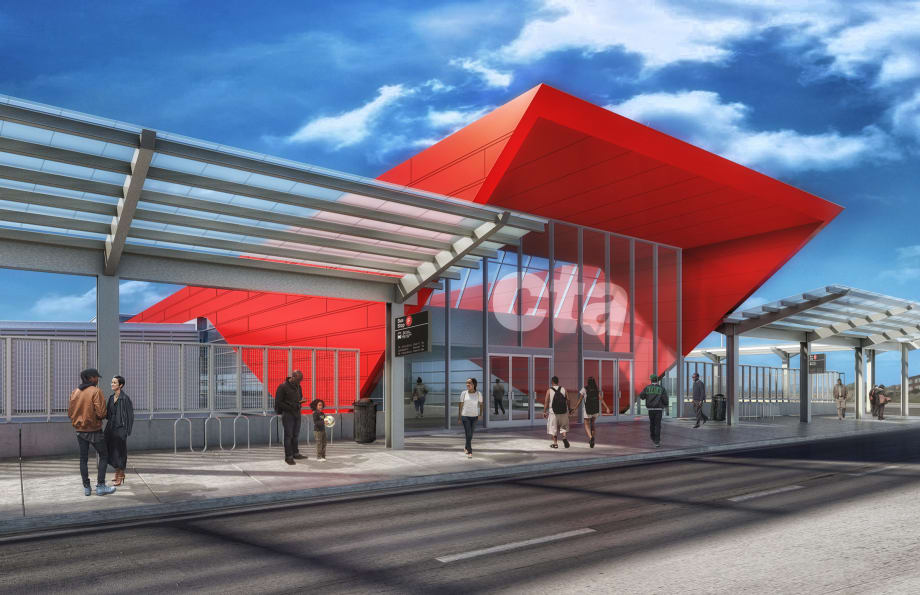
North terminal view in daylight - conceptual artist's rendering
4 min to read
North terminal view in daylight - conceptual artist's rendering
Chicago Transit Authority (CTA) officials finalized a bold, vibrant design for the new 95th Street Terminal — a $280M project to completely rebuild the Red Line South’s busiest station to create a safer, more-efficient environment for transit riders while creating a signature statement for the South Side.
The CTA also said it is preparing to launch the first of several bus and rail enhancements that will be rolled out this summer and fall to improve transit service on the South Side, a plan announced by Mayor Rahm Emanuel and CTA last month.
“In building a new, state-of-the-art CTA transit hub for the South Side, Mayor Emanuel and I strongly believe that form and function are both very important to this project,” said CTA President Dorval R. Carter. “This terminal will provide a safer, more convenient and pleasant commuting environment for the 20,000-plus customers who pass through 95th each day, complementing the additional South Side rail and bus improvements we plan to roll out starting next week through the fall months.”
The new 95th Street Terminal design is a refinement of previous designs for the bus and rail terminal. The new designs present a much bolder architectural statement, befitting what will be the signature station of the CTA system.
The 95th Street project will expand and greatly improve the terminal, which is one of CTA’s busiest, with 24-hour Red Line service and more than 1,000 CTA and Pace bus trips on a typical weekday. This work will help improve the movement of train traffic in and out of the 98th yard and through the 95th Terminal which services the Red Line, which is the CTA’s busiest rail line.
The design, developed with the project’s general contractor Paschen Milhouse Joint Venture IV and architectural firm exp US services, keeps all of the terminal’s primary design elements, including covered bus bays and pedestrian walkways to provide protection from the weather as well as the pedestrian bridge that will connect the two terminal buildings to be located on the north and south sides of 95th Street.
The design has been refined to include the distinct red color of the station exterior, which will serve as an iconic identifier to CTA’s busiest rail line, and other modifications to the design throughout the station.
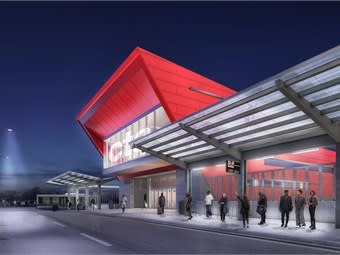
South terminal view at night - conceptual artist's rendering
Customers will begin to enjoy the new station beginning in 2017. CTA began the construction on the foundation of the new terminal in 2014, which will be located along the Dan Ryan Expressway at 95th Street, where the current 95th station is located. Construction of the new south terminal building begins this summer. The new south terminal will be completed in 2017 and the new north terminal building will open in 2018.
South Side Bus and Rail Enhancements
The first of CTA planned improvements to bus and rail service on the South Side and Far South Side will begin Monday, June 20, when service on the #26 South Shore Express is extended into the weekday morning and evening hours. Northbound morning service will begin earlier at 4:20 a.m. Southbound service will begin more than an hour earlier with the first trip leaving Chicago/Michigan at 1:10 p.m. and the last southbound trip will depart downtown at 9:20 p.m., a total of an additional three hours of evening service for customers.
Additionally, the CTA this fall will increase the frequency of Green Line service on the Cottage Grove and Ashland/63rd branches during the morning and evening rush periods.
These improvements are the latest among several enhancements over the past year designed to improve bus and rail service. In December 2015, the Mayor and President Carter reintroduced express service on the #9 Ashland and #49 Western bus routes, two of CTA’s busiest bus routes. Also in December, the CTA and Chicago Department of Transportation launched Loop Link, a first-of-its-kind corridor connecting the West Loop commuter rail stations with the heart of the Loop and Michigan Avenue.
Featuring dedicated bus lanes, bus-only traffic signals and raised-platform stations along Washington and Madison Streets, Loop Link was designed to provide faster, more reliable travel times and an improved customer experience. In March, the Mayor and CTA unveiled the first-ever Bus Tracker arrival-time displays at 51 rail stations, an expansion of CTA’s most-popular technology for customers. CTA also announced it will soon begin pilot bus routes on the #11 Lincoln and #31 31st routes.
More Management

LIT Marks 10-Year Milestone at Annual Summit
Hosted by the COTA from September 10 to 13, the Summit carried the theme “Celebrating 10 Years of Excellence, Leadership, and Impact,” with every part of the program honoring the people, agencies, and partners who built LIT over its first decade.
Read More →
People Movement: Dan Dipert Coaches Adds Third-Generation Leader, Keolis Names New Valley Metro VP/GM, and More
In this edition, we also cover recent appointments and announcements at the Wabtec, SilverRide, HNTB, and more, showcasing the individuals helping to shape the future of transportation.
Read More →
METRO Opens Submissions for 2026 Motorcoach Awards
Nominations are now being accepted for METRO Magazine’s Operator of the Year and Innovative Operator of the Year awards.
Read More →

New York MTA Advances Final Contract for Second Avenue Subway Expansion
Contract Four is the largest in the Second Avenue Subway Phase 2 project and includes construction of station infrastructure, tracks, and signals for the subway expansion, MTA officials said. Work on Contract Four will begin in 2027.
Read More →
Transit Agencies Highlight Safety Gains at National Summit
Leaders from 15 major transit systems shared crime-reduction results and safety initiatives while discussing the role of continued federal support.
Read More →
NITA Names New Leadership, Expands Reduced-Fare Program at First Board Meeting
The new regional transit authority appointed its first board chair and interim executive director while extending reduced fares across CTA, Metra, and Pace for eligible riders.
Read More →
Beyond the Checklist: A Structured Approach to Transit Maintenance
Reliability-Centered Maintenance helps transit agencies move beyond routine checklists to focus limited resources on the assets and failures that have the greatest impact on safety, reliability, and service.
Read More →
APTA 2026 Nominating Committee Selects Leadership Slate, Names Chair and Vice Chair Nominees
Leadership changes will help shape the association’s priorities and its representation of the transportation industry during the 2026–2027 term.
Read More →
DART Launches Major Security, Fare Enforcement Initiative
The 90-day demonstration will deploy coordinated security teams at five light rail stations while testing controlled access and gathering data to guide future investments.
Read More →
Sponsored•September 9, 2026
Advancing Fare Collection Through Technology and Innovation
Learn about delivering 1300 gates at 91 stations while managing fare evasion. Explore the large scale deployment, solution customization and real-world results that affect the region. Prepare for deployment in your region now.
Read More →