



Fla. transit agencies collaborate on cross-agency fare app
The pilot app offers a three-day, $11 unlimited pass usable across Hillsborough Area Regional Transit Authority and Pinellas Suncoast Transit Authority bus lines.

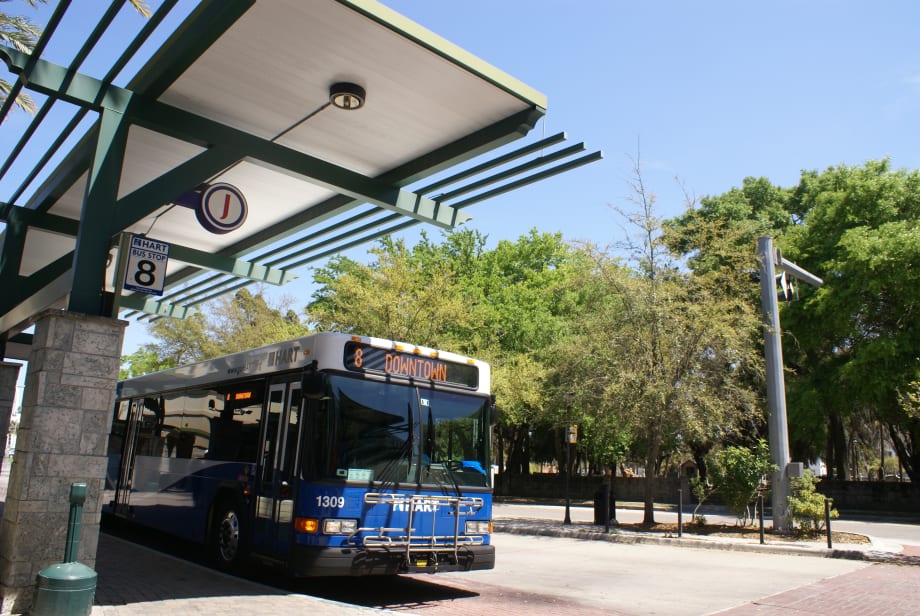
Photos Courtesy HART
Photos Courtesy HART
Story by Katherine Fleming
In an effort to modernize and streamline fare payment processing systems, Tampa Bay, Fla.-area transit agencies have created an app that allows passengers to use a single payment method across multiple agencies and types of transport.
The pilot app offers a three-day, $11 unlimited pass usable across Hillsborough Area Regional Transit Authority (HART) and Pinellas Suncoast Transit Authority (PSTA) bus lines. It has been so well-received that the agencies have decided to continue its use until a more robust app, which will offer more options, is made available in summer 2018.
The project was spearheaded by HART and PSTA, with additional stakeholders including Pasco County Public Transportation, Hernando County Transit, and Sarasota County Area Transit. Three other transits were involved initially, but dropped out. The app was developed by mobile developer Bytemark, with INIT completing systems integration.
The agencies decided to release the limited version of the app to test their systems, troubleshoot, and help the public get used to the concept before releasing the full app. The test version is a simple flash pass. “You get on the bus, show it to the driver and touch the pass, and the animation changes color to show it’s real,” explains Lucien Campillo. The final app will be scanned by a validator. It will have more options, allowing users to plan trips and purchase any fare type from any of the participating agencies, as well as store value in their accounts.
Campillo said that the impetus for the project came when the agency was considering how to update their fare boxes, which were over 30 years old.
“They did it across the region because they thought funding would be easier to find,” he explained.
HART and PSTA put in the bulk of the funding, and the project received grants from the Florida Department of Transportation and the Tampa Bay Area Regional Transportation Authority.
The app will make transit more convenient for passengers, especially as the region develops new transportation options. “It’s going make transit very seamless,” said Campillo. “There are new modes of transit coming here — ferries, possibly light rail, they're talking about a gondola in St. Petersburg — and they all need ways to collect fares.”
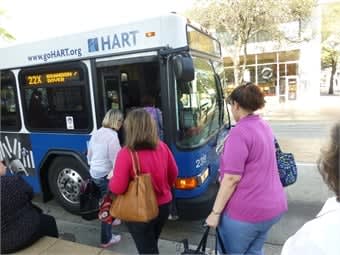
When passengers pay with the app rather than fumbling for the right change, boarding times can shorten by half or more, which reduces costs associated with bus idling, lessens carbon emissions, and helps vehicles stay on schedule.
In addition to increasing convenience, using the app results in cost savings for the agencies involved. When passengers pay with the app rather than fumbling for the right change, boarding times can shorten by half or more, which reduces costs associated with bus idling, lessens carbon emissions, and helps vehicles stay on schedule. Institutions or companies that offer transit cards for their employees will be able to manage accounts through the app, and universities that pay for transit cards for students can be billed by usage, saving money for the taxpayer as well.
Campillo said assembling the right team and making sure all groups were represented was critical to the project. The important factor was “understanding who has to be involved in the project team from the very beginning — making sure all the functions were represented through the agencies that were participating,” he said.
The app has been well-received by the public during the testing, according to Campillo.
“We were very impressed by how many people got it immediately and how many people started buying the product on it,” he said. “We were surprised by how few customer service calls we had to do, how well-received it was, and how exponential growth is continuing over the test period, so far.”
More Management

METRO Opens Submissions for 2026 Motorcoach Awards
Nominations are now being accepted for METRO Magazine’s Operator of the Year and Innovative Operator of the Year awards.
Read More →
New York MTA Advances Final Contract for Second Avenue Subway Expansion
Contract Four is the largest in the Second Avenue Subway Phase 2 project and includes construction of station infrastructure, tracks, and signals for the subway expansion, MTA officials said. Work on Contract Four will begin in 2027.
Read More →
Transit Agencies Highlight Safety Gains at National Summit
Leaders from 15 major transit systems shared crime-reduction results and safety initiatives while discussing the role of continued federal support.
Read More →

NITA Names New Leadership, Expands Reduced-Fare Program at First Board Meeting
The new regional transit authority appointed its first board chair and interim executive director while extending reduced fares across CTA, Metra, and Pace for eligible riders.
Read More →
Beyond the Checklist: A Structured Approach to Transit Maintenance
Reliability-Centered Maintenance helps transit agencies move beyond routine checklists to focus limited resources on the assets and failures that have the greatest impact on safety, reliability, and service.
Read More →
APTA 2026 Nominating Committee Selects Leadership Slate, Names Chair and Vice Chair Nominees
Leadership changes will help shape the association’s priorities and its representation of the transportation industry during the 2026–2027 term.
Read More →
DART Launches Major Security, Fare Enforcement Initiative
The 90-day demonstration will deploy coordinated security teams at five light rail stations while testing controlled access and gathering data to guide future investments.
Read More →
Advancing Fare Collection Through Technology and Innovation
Learn about delivering 1300 gates at 91 stations while managing fare evasion. Explore the large scale deployment, solution customization and real-world results that affect the region. Prepare for deployment in your region now.
Read More →
Game Day in Motion: Moving Millions During the 2026 World Cup
Between packed transit stations and team motorcoaches, see how agencies and operators across North America tackled the transportation demands of the 2026 FIFA World Cup.
Read More →
Surface Transportation Extension Averts Shutdown, Leaves Transit Funding Gap
The stopgap keeps federal transportation programs moving, but missing advance funding could complicate the transit and rail projects agencies are planning next.
Read More →