



MARTA Focused on Providing a High-End Customer Experience
In 2016, voters passed a $2.5 billion ballot measure to increase both MARTA bus and rail service.

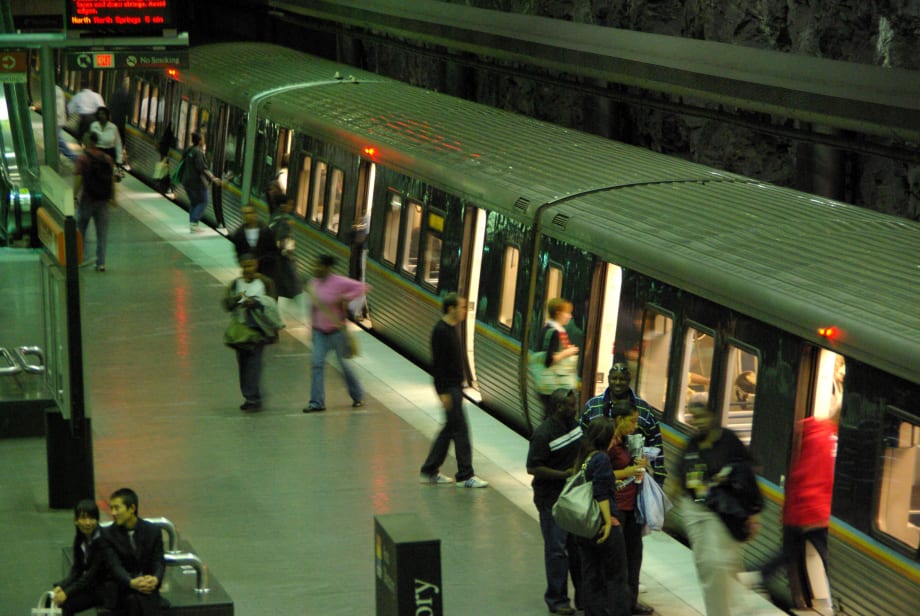
All photos courtesy MARTA
All photos courtesy MARTA
When GM/CEO Keith Parker took the helm at the Metropolitan Atlanta Rapid Transit Authority (MARTA) about five years ago, he was faced with not only financial issues but also a poor customer perception of the agency.
“When Mr. Parker came in, he was faced with an agency that within five years would be financially insolvent,” explains Assistant GM Ben Limmer. “Immediately, he instituted internal and external initiatives in order for MARTA to fix its financial outlook.”
Flip community perception
Along with that, Parker and his team began to flip the perception of the agency in the community by concentrating on being more customer friendly.
This was done by the agency striving to give the customer a high value for the fares they were paying, which began with making both its bus and rail services safer. To do this, Parker instituted a campaign to reduce undesirable behavior on its system, while asking customers to help contribute to the safety via its “See Something, Say Something” app.
“The program really had a significant impact at MARTA,” Limmer says. “In fact, we now have the second lowest number of Part I crimes out of any large transit agency in the country, according to the FBI.”
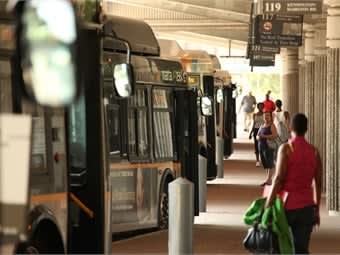
As part of its bus service revamp, MARTA has begun purchasing buses of varying sizes to better accommodate the lines being served.
Ballot box support
That work showed itself at the ballot box in 2014, with Clayton County voters passing a sales tax to expand MARTA services for the first time ever, just two years after a ballot measure to raise sales taxes 1% to fund regional transportation projects was soundly defeated.
In 2016, a measure to raise $2.5 billion for more MARTA service passed by an overwhelming 72%, while a complementary referendum, which will generate $300 million to fund Atlanta road improvements, including completion of the Atlanta Beltline, a former railway corridor that will link dozens of Atlanta neighborhoods, was passed with 68% of the vote.
“I think what we did was listen to the community, stakeholders, and businesses in the area, and from that, we were able to effectively develop plans to help support these proposed transit referendums.” Limmer explains. “Certainly, by fixing MARTA’s books and being a safe system, as well as getting creative with the expansion of amenities and other tech initiatives, I think Mr. Parker was also able generate a lot of faith in MARTA in both Clayton County and Atlanta. And, if MARTA continues being a good steward of public dollars, we will continue to gain the faith of other stakeholders, such as those in Fulton and DeKalb counties.”
Service revamp
Since the victories at the ballot box in 2014 and 2016, MARTA has begun revamping its services to better serve ridership.
“MARTA launched a comprehensive operations analysis in 2014, with the goal to determine what the most effective and efficient use of MARTA’s existing and future transit resources and identify service implementation strategies to align with future ridership, as well as existing ridership, needs,” Limmer says. “MARTA was also focused on maximizing resources to the greatest extent possible, while reducing overall costs.”
While some of the recommendations from the study included increased rail service, a bulk of the recommendations involved the agency’s bus system, which led to a complete revamp of bus services.
“The key recommendation was to adopt different tiers or types of transit service that better serve lifestyle transit markets, and develop routes that were appropriate for the communities that they were serving,” Limmer says. “Basically, what that meant was to use larger vehicles on our more heavily travelled routes and smaller vehicles for some of our lower density or residential services that we provide.”
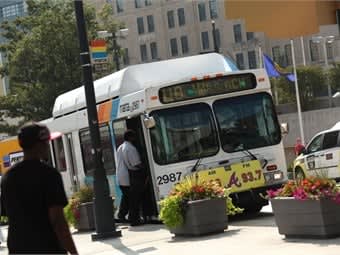
MARTA has made a commitment to have a low- or no-emissission bus fleet.
Rather than launch the revamped bus service all at once like Houston and Baltimore did, MARTA decided to rollout the bus service modifications over a couple of years.
“We modify bus service three times a year, so we just aligned the changes with our usual bus service modifications.” Limmer says.
Fleet additions
As part of its bus service modifications, MARTA has begun adding 60-foot New Flyer Xcelsior articulated buses and 30-foot Vicinity buses from Grande West Transportation. It is also continuing to transition its fleet from diesel to CNG and has tested electric buses.
“MARTA has made a commitment to have a low- or no-emission fleet, so the electric pilot program was very successful for us,” says Limmer. “We are also continuing to replace our fleet with CNG buses, so we are really just exploring all of our fleet options moving forward.”
Halfway into its bus revamp, Limmer says that the program has so far been a success.
“It’s been very positive for us, because again it allows us to make more efficient use of our limited resources,” he says. “Also, through our Community Circulator services, we’ve been able to connect new parts of our service area that have never had a direct connection to MARTA before.”
Multimodal options
To provide even more connections and help solve the first-, last-mile conundrum, MARTA has teamed with Transportation Network Companies, like Uber and Lyft, to provide discounted rides to and from its rail stations. It has also partnered with the City of Atlanta to install bikeshare systems adjacent to the agency’s rail stations.
Additionally, Limmer adds that the Atlanta and Fulton County also each passed a local option sales tax increase to fund non-transit mobility projects to improve accessibility and facilitate things such as bicycle usage.
“The tax increases will fund such things as fixing sidewalks to connect to MARTA rail stations and instituting bicycle lanes to provide safe and enhanced access for bicyclists to use our bus and rail systems,” Limmer says. “These types of extra but very highly coordinated and connected investment points are what we’re really excited about at the agency.”
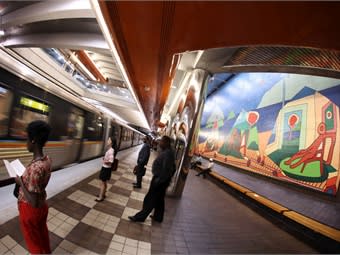
In addition to improving safety on the system, MARTA has also launched a public arts program at rail stations, as well as fresh produce kiosks.
Rail initiatives
Building on the safety and accessibility to its rail line, MARTA also currently has three Transit Oriented Development projects under construction at underutilized MARTA Park & Ride lots, which will include residential, retail, and some office space.
“Through this program, we are really looking to continue to make the highest and best use of our land assets at MARTA rail stations,” Limmer explains.
On top of that, MARTA is also implementing some technological advances, including the installation of a new audio/video information system, which will enable customers to know when their next train is arriving and if there are any safety or service alerts. The agency is also working on a mobile ticketing project that will enable customers to pay for all of its services through an app on their smartphone, instead of using their Breeze smart card.
Building on improving the customer experience at rail stations, MARTA also began offering live music, launched a new public arts program, added fresh produce kiosks, and even has a soccer field located at one of the stations.
“A few years ago our Five Points Rail Station was just a connecting point for our North-South and East-West lines, but now customers can see live jazz, buy produce, and if they have time, play a little soccer before catching their train,” Limmer says. “It is certainly exciting that we are thinking about the whole transit experience and not just taking the train from one point to another.”
More Management

LIT Marks 10-Year Milestone at Annual Summit
Hosted by the COTA from September 10 to 13, the Summit carried the theme “Celebrating 10 Years of Excellence, Leadership, and Impact,” with every part of the program honoring the people, agencies, and partners who built LIT over its first decade.
Read More →
People Movement: Dan Dipert Coaches Adds Third-Generation Leader, Keolis Names New Valley Metro VP/GM, and More
In this edition, we also cover recent appointments and announcements at the Wabtec, SilverRide, HNTB, and more, showcasing the individuals helping to shape the future of transportation.
Read More →
METRO Opens Submissions for 2026 Motorcoach Awards
Nominations are now being accepted for METRO Magazine’s Operator of the Year and Innovative Operator of the Year awards.
Read More →

New York MTA Advances Final Contract for Second Avenue Subway Expansion
Contract Four is the largest in the Second Avenue Subway Phase 2 project and includes construction of station infrastructure, tracks, and signals for the subway expansion, MTA officials said. Work on Contract Four will begin in 2027.
Read More →
Transit Agencies Highlight Safety Gains at National Summit
Leaders from 15 major transit systems shared crime-reduction results and safety initiatives while discussing the role of continued federal support.
Read More →
NITA Names New Leadership, Expands Reduced-Fare Program at First Board Meeting
The new regional transit authority appointed its first board chair and interim executive director while extending reduced fares across CTA, Metra, and Pace for eligible riders.
Read More →
Beyond the Checklist: A Structured Approach to Transit Maintenance
Reliability-Centered Maintenance helps transit agencies move beyond routine checklists to focus limited resources on the assets and failures that have the greatest impact on safety, reliability, and service.
Read More →
APTA 2026 Nominating Committee Selects Leadership Slate, Names Chair and Vice Chair Nominees
Leadership changes will help shape the association’s priorities and its representation of the transportation industry during the 2026–2027 term.
Read More →
DART Launches Major Security, Fare Enforcement Initiative
The 90-day demonstration will deploy coordinated security teams at five light rail stations while testing controlled access and gathering data to guide future investments.
Read More →
Advancing Fare Collection Through Technology and Innovation
Learn about delivering 1300 gates at 91 stations while managing fare evasion. Explore the large scale deployment, solution customization and real-world results that affect the region. Prepare for deployment in your region now.
Read More →