



HART CEO to lead Pittsburgh Port Authority
During Katharine Eagan's tenure, from 2010 to 2015, ridership increased over 20% and farebox recovery increased over 25%.

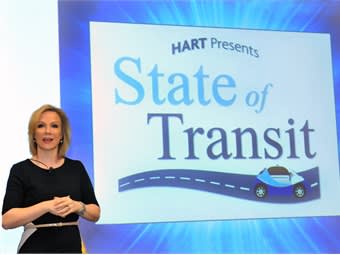
Katharine Eagan will depart HART after nearly eight years of service, leaving behind a legacy of innovation and a strong foundation for future growth, officials said. Photo courtesy of HART
PITTSBURGH — Hillsborough Area Regional Transit Authority (HART) CEO Katharine Eagan is leaving the Tampa, Fla.-based transit agency and taking on a new position as the Port Authority's CEO, the Pittsburg Post-Gazette reported.
Eagan has a five-year contract with a $230,000 base salary.
For the full story, click here.
In a press release, HART announced that Eagan will depart the agency after nearly eight years of service, leaving behind a legacy of innovation and a strong foundation for future growth.
Eagan joined HART as its CEO in 2009. During her tenure, from 2010 to 2015, ridership increased over 20% and farebox recovery increased over 25%.
Since taking the helm as CEO, Eagan has worked with the HART Board of Directors to balance the Authority's budget, improve efficiencies, implement innovative transit solutions, and enhance the overall customer experience. HART has greatly expanded public-private partnerships with entities such as MegaBus, Red Coach, Coast Bike Share, Yellow Cab, and TransDev, and HART is continuing to pursue partnerships that provide travel options beyond traditional buses.
In November 2016, HART partnered with Innovation Place and various sponsors to add four Tesla X model vehicles into the HART HyperLINK program. Donations from these sponsors paid for the entire cost of placing these all-electric vehicles into service in the University of Tampa area.
Recently, HART selected Stantec/Coast Autonomous team to provide Autonomous Mobility Services for the Marion Street Transitway. The Autonomous Shuttle coming to the Marion Street Transitway in early 2018 is funded by the Florida Department of Transportation and will be the first implementation in the United States of a driverless transit vehicle on open public streets.
With a long history of accomplishments and accolades, Eagan was awarded the Florida Diversity Council's 2016 Powerful and Influential Women award and WTS 2016 Woman of the Year by Women in Transportation Seminar. She was a finalist for the Tampa Bay Business Journals' Businesswoman of the Year award in 2014 and 2016 and the winner in 2016 in the Economic Development category.
Eagan will be taking on a transit leadership role in a new community; an announcement will be forthcoming.
More Management

LIT Marks 10-Year Milestone at Annual Summit
Hosted by the COTA from September 10 to 13, the Summit carried the theme “Celebrating 10 Years of Excellence, Leadership, and Impact,” with every part of the program honoring the people, agencies, and partners who built LIT over its first decade.
Read More →
People Movement: Dan Dipert Coaches Adds Third-Generation Leader, Keolis Names New Valley Metro VP/GM, and More
In this edition, we also cover recent appointments and announcements at the Wabtec, SilverRide, HNTB, and more, showcasing the individuals helping to shape the future of transportation.
Read More →
METRO Opens Submissions for 2026 Motorcoach Awards
Nominations are now being accepted for METRO Magazine’s Operator of the Year and Innovative Operator of the Year awards.
Read More →

New York MTA Advances Final Contract for Second Avenue Subway Expansion
Contract Four is the largest in the Second Avenue Subway Phase 2 project and includes construction of station infrastructure, tracks, and signals for the subway expansion, MTA officials said. Work on Contract Four will begin in 2027.
Read More →
Transit Agencies Highlight Safety Gains at National Summit
Leaders from 15 major transit systems shared crime-reduction results and safety initiatives while discussing the role of continued federal support.
Read More →
NITA Names New Leadership, Expands Reduced-Fare Program at First Board Meeting
The new regional transit authority appointed its first board chair and interim executive director while extending reduced fares across CTA, Metra, and Pace for eligible riders.
Read More →
Beyond the Checklist: A Structured Approach to Transit Maintenance
Reliability-Centered Maintenance helps transit agencies move beyond routine checklists to focus limited resources on the assets and failures that have the greatest impact on safety, reliability, and service.
Read More →
APTA 2026 Nominating Committee Selects Leadership Slate, Names Chair and Vice Chair Nominees
Leadership changes will help shape the association’s priorities and its representation of the transportation industry during the 2026–2027 term.
Read More →
DART Launches Major Security, Fare Enforcement Initiative
The 90-day demonstration will deploy coordinated security teams at five light rail stations while testing controlled access and gathering data to guide future investments.
Read More →
Advancing Fare Collection Through Technology and Innovation
Learn about delivering 1300 gates at 91 stations while managing fare evasion. Explore the large scale deployment, solution customization and real-world results that affect the region. Prepare for deployment in your region now.
Read More →