



NY MTA buses lost 100 million passenger trips since 2008, report says
The average New York City Transit bus travels 7.4 miles per hour along its local, SBS, and express routes — slowest among the seventeen largest bus companies in the nation, according to a city comptroller report.

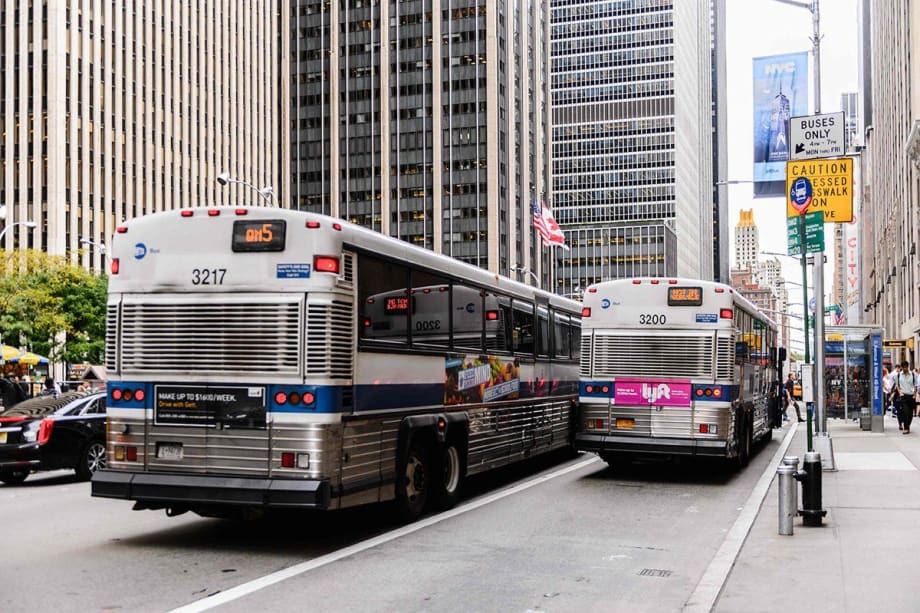
The size and scope of New York City’s bus system is unparalleled, with 5,700 buses, 330 routes, and 15,000-plus stops serving well over two million passengers each day. Photo: Anton Ivanov/Shutterstock.com
The size and scope of New York City’s bus system is unparalleled, with 5,700 buses, 330 routes, and 15,000-plus stops serving well over two million passengers each day. Photo: Anton Ivanov/Shutterstock.com
In the last eight years, the MTA bus system lost 100 million passenger trips while buses traveled at the slowest speeds in the country among large cities, according to a new report released today by New York City Comptroller Scott M. Stringer. The decline in ridership is not surprising, given routes that are often slow, unreliable, long, meandering, confusing, congested, and poorly connected, according to the Comptroller’s report, The Other Transit Crisis: How to Improve NYC’s Bus System. The report also found that the rapid decline in New York City’s bus service over the last decade disproportionately impacts immigrant and lower-income New Yorkers, since they make up the highest share of city bus riders.
The size and scope of New York City’s bus system is unparalleled, with 5,700 buses, 330 routes, and 15,000-plus stops serving well over two million passengers each day — more than the combined daily ridership of LIRR, MetroNorth, PATH, and New Jersey Transit. Yet, Comptroller Stringer’s analysis shows alarming deterioration.
MTA buses are now the slowest in the nation among large cities. In fact, bus service can often be slower than walking speed.
The average New York City Transit bus travels 7.4 miles per hour along its local, SBS, and express routes — slowest among the seventeen largest bus companies in the nation, according to the report.
The typical New York City bus spends only half its time in-motion/in-traffic. Another 21 percent is spent at red lights and 22 percent at bus stops.
Average bus speeds vary dramatically among the boroughs, with the slowest average speeds in Manhattan (5.5mph), Brooklyn (6.3mph), and the Bronx (6.5mph). This is significantly lower than local routes in Queens (8.1mph) and Staten Island (11.4mph).
As service has deteriorated, ridership has plummeted.
The MTA bus system has lost 100 million passenger trips in the last eight years. That decline is most prevalent in Manhattan, where ridership is down 16 percent since 2011, and Brooklyn, which has seen a four percent decline over the same time period.
MTA Bus Ridership, 2006-2016
This decline is happening at a time when NYC’s economy – and commuting patterns – are changing, with increased job growth outside of Manhattan that necessitates new routes.
NYC subways were largely built to bring workers to Manhattan. But residents of every borough are now more likely to commute within their home borough rather than to Manhattan, making an efficient, well-planned bus system even more important.
From 2006 to 2016, the number of jobs located in Brooklyn jumped by 49 percent, in the Bronx by 35 percent, in Queens by 34 percent, and in Staten Island by 27 percent — but only 5 percent in Manhattan. As a result, the share of New York City jobs located outside of Manhattan rose from 35 percent to 42 percent over this period.
The changing jobs geography means residents of every borough are now more likely to commute within their home borough than to
As new employment centers emerge outside of Manhattan, the bus system has not kept pace.
As new employment centers emerge outside of Manhattan, the bus system has not kept pace. Compared to the average city neighborhood, in total there are 12 neighborhoods (and two airports) that offer significantly more jobs but remain significantly underserved by bus and subway service.
Neighborhoods like Williamsburg, Morris Park, Norwood, Greenpoint, Glen Oaks, Red Hook, and the two Queens airports are among the top neighborhoods that remain underserved by a declining bus system.
Bus commuters are diverse and tend to be lower income than the City generally.
The average personal income of bus commuters is $28,455 — far lower than subway commuters and employed New Yorkers as a whole.
55 percent of bus riders are foreign born, and 75 percent are New Yorkers of color.
Table 1: Profile of New York City Commuters
Bus Commuters Subway Commuters All New Yorkers Median Income (of employed) $28,455 $40,000 $38,840 Bachelor’s Degree or Higher (Age 25+) 31% 48% 36% Share of Working Population that is age 60+ 12% 8% 10% Parent (age 16+) with Children at Home 42% 33% 36% Single Parent (age 16+) 17% 10% 12% Foreign Born 55% 49% 41% Person of Color 75% 66% 67% Work in Healthcare, Hospitality, Retail, Food Services, or Cultural industries 49% 38% 38%
United States Census Bureau. American Community Survey 2011-2015 5-Year Estimates.
Long and meandering bus routes occur because the MTA often fails to follow its own design standards, schedules, and protocols.
In order to keep buses moving, the MTA aims to locate bus stops at least 750 feet apart. This “stop-spacing” standard is very low compared to other major cities, and yet it is applied very loosely by the MTA. On ten routes, for instance, bus stops are spaced more than 1,200 feet apart, or nearly double the standard, which can make access difficult for seniors and the disabled. Meanwhile, 30 percent of routes do not maintain even this minimum standard. In fact, among Manhattan bus routes, the average distance between bus stops is 757 feet, barely higher than the recommended minimum.
The MTA has expressly acknowledged that long and meandering bus routes are inefficient and unreliable. Yet bus routes remain highly circuitous, with over 38 making at least 15 turns and the average Staten Island route making 13. City-wide, the average local route is 6.8 miles long and in Staten Island, 10.6 miles.
Based on the MTA’s own 12-year replacement cycle for buses, the average age of vehicles should be 6 years. In fact, the average age of an MTA bus is 7.8 years, and 22 percent are still on the road after a dozen years.
NYC’s bus system is also hampered by a fractured management structure that needs to be better coordinated.
The bus system’s management is divided between two agencies: New York City Transit Bus and the MTA Bus Company.
The operating costs per passenger for the NYCT Bus ($3.98) and MTA Bus Company ($5.48) ranked them 7th and 14th among the 17 largest city bus companies in the United States.
Both the MTA and City DOT have struggled to implement new technologies and core amenities that could improve the speed and reliability of bus service, including Select Bus Service (SBS) and Transit Signal Priority (TSP).
To improve the City’s bus system, Comptroller Stringer’s report calls for a series of reforms, including a comprehensive review of the bus network to better align with new job centers and changing neighborhood demographics, and enhanced coordination between the MTA and City DOT. Comptroller Stringer is calling on the City and the MTA to do the following:
The MTA Bus Company and New York Transit Bus should better coordinate their operations, particularly scheduling, planning, and depot divisions, to increase efficiency and better serve riders.
In consultation with surrounding neighborhoods, the MTA, DOT, and Department of City Planning should initiate a comprehensive review of the bus network to better align with changing commuting patterns, as other cities like Houston, Baltimore, and Portland have already accomplished.
In consultation with surrounding neighborhoods, the MTA should review stop-spacing on all of its routes and reform its stop-spacing guidelines to better balance the speed, reliability and accessibility of its bus routes.
The MTA should increase the frequency of buses in “off-peak” hours and overhaul its scheduling guidelines in order to better service the rapid growth of the health, hospitality, retail, food services, and cultural sectors.
The DOT and MTA should improve coordination and expedite the implementation of Transit Signal Priority along bus routes.
The DOT should improve the maintenance, enforcement, and design of bus lanes and place greater emphasis on bus lanes outside of SBS corridors.
More Management

Utilimarc Launches SmartReplace to Optimize Fleet Replacement Decisions
AI-powered SmartReplace helps fleets prioritize vehicle replacements, model budget scenarios, and build more defensible long-term strategies.
Read More →
APTA Honors 2026 Award Winners, Hall of Fame Inductees at TRANSform & EXPO
Innovations in autonomous and zero-emission transportation, standout transit systems, and industry leadership took center stage among this year's honorees.
Read More →
7 Ways to Build a Better Transit Internship Program
Lessons from DRPA/PATCO’s approach to creating a meaningful internship experience—and developing the next generation of transportation professionals.
Read More →
Scenes from APTA TRANSform & EXPO 2026
Transit leaders, manufacturers, and industry professionals gathered in Chicago to explore new technologies, share ideas, and discuss the future of public transportation.
Read More →
Building Stronger Leaders, More Resilient Transit Teams
Dr. Carol Parker Walsh discusses leadership development, employee retention, workplace culture, and preparing transit’s workforce for AI and automation.
Read More →
APTA 2026 TRANSform & EXPO Kicks Off in Chicago
After 45 years, APTA returns to Chicago with a focus on next-generation fleets, AI, connected transit networks, and the funding strategies shaping public transportation’s future.
Read More →
New York MTA Warns Federal Tariffs Could Add $1 Billion to Rolling Stock Costs
The agency said tariffs on specialized imported components could reduce the purchasing power of its $23 billion investment in new subway cars, railcars, and buses.
Read More →
From the Show Floor: What Happened at APTA TRANSform & EXPO 2026
See the latest product launches, partnerships, technology updates, and transit industry announcements from APTA TRANSform & EXPO in Chicago.
Read More →
How Valley Metro Is Balancing Transit Growth With the Rider Experience
The APTA award-winning agency is pairing rapid system expansion with investments in workforce, safety, technology, and the fundamentals of transit service.
Read More →
Bus Tech Talk: Keeping Transit Technicians Ahead of the Technology Curve
In this episode of Bus Tech Talk, Complete Coach Works’ Business Development Manager Mark Hollenbeck and METRO’s Executive Editor Alex Roman sit down with Obed Mejia, Senior Technical Trainer for Bus Maintenance, at LA Metro to discuss how rapidly evolving bus technology is changing the maintenance shop — and the skills technicians need to keep pace.
Read More →