



5 Ways to Trim Motorcoach Insurance Costs
How much money an operator can save depends on how they manage risk and improve their hiring and training practices. The first step is finding a carrier they can forge a partnership with to establish a safety culture at their operation.
Photo courtesy MCI
Photo courtesy MCI
How much money an operator can save depends on how they manage risk and improve their hiring and training practices. The first step is finding a carrier they can forge a partnership with to establish a safety culture at their operation.
1. Shop Around
Typically, before a customer books their trip or event with you they have already shopped several other operations, often basing their decision on who offers the lowest price. One common complaint by many operators, however, is that a customer should shop not only on price but on several other factors, including safety record and quality of equipment. So, when you’re looking for an insurance carrier, why would you settle on merely who can offer the lowest price?
“Insurance is a very strange product that you need. You have to have it and pray you don’t need it, but when you do, you better have an insurance company that knows how to handle a claim,” says Shriver Insurance’s Charlie Shriver, a 43-year veteran in the industry. “There are some fly-by-nighters out there, no doubt about it. You need to be sure to find a company that dots its I’s and crosses its T’s.”
An important factor to look for when shopping is the company’s history and their presence in the industry. Do they know the motorcoach market? If not, look for somebody who knows the motorcoach market and what your operation’s specific needs may be.
You may also want to talk to a host of insurance companies to find the best fit for you, rather than settling quickly. An important factor is finding a company you can work with as a partner, rather than view as an adversary, according to National Interstate Assistant VP/National Marketing Manager Michelle Silvestro.
“You may not think about it, but insurance is probably one of your operation’s top three expenses, so spend more time weighing options than you do planning your vacation,” she says. “I know insurance is a necessary evil, but there is lots of savings to be had if an operator pays more attention and is diligent.”
It is also a good idea to take plenty of time to shop insurance carriers. It is a necessary expense and you know it has to be renewed each year, so why put it off until the last minute?
“I like to refer to it as the tyranny of the urgent: we don’t always prioritize what’s most important, we only get done what has to be done soonest,” says Shriver. “The problem with that mentality is that all of a sudden one of the most important things, in this case insurance, becomes something you have to try and take care of in a day or two, but can’t.”
Finally, while operators appreciate the loyalty of their customers, loyalty to an insurance provider that isn’t working with you can cost money. If you are not happy with your insurance partner, it’s OK to look for a better fit, explains Shriver.
“If you are doing everything right and still not getting a price you feel is just, then maybe it is time you start to look around,” he says.
2. Tell Your Story
Insurance companies predict the future based on the past, so every year when preparing to quote an operator an insurance price, they will examine your operation’s incidents over the last five years as well as the type of work you do — where you go and what kind of services you provide, e.g. charter, tour, intercity.
“It is a pretty extensive process,” says Silvestro. “Obviously, the stakes are pretty high. Every time a coach leaves a yard, there is a potential for a $5 million claim, or more, if the insurance company writes a policy with higher limits.”
During the underwriting process, insurance companies will also ask their clients, or potential clients, to provide information on their fleets, safety programs and the guidelines they follow, as well as a driver list.
“Underwriters crave information, so you have to really separate yourself [during the process] from the pack and emphasize all of the positive things you are doing that should earn your operation a better price,” says Lancer Sr. VP Randy O’Neill. “If you can document your safety history as well as the safety programs you have in place when you are submitting an application, you have to sort of pound your own chest a bit and distinguish yourself from everyone else who is out there.”
In short, point out the things you are doing in terms of safety that are positively impacting the number of incidents your operation is having. It will be discussed later in “Manage Your Risk,” but are you instituting new training programs, more stringently vetting the drivers you hire, or eliminating dangerous routes or driving during times where the number of incidents are known to increase? Tell your insurance carrier, and more importantly, document how those safety programs or programmatic changes are having an impact.[PAGEBREAK]
3. Realize there are no discounts
Have you bought a new car or renewed your auto policy lately? There are plenty of discounts to be had for everything from anti-lock brakes to airbags, the distance you travel on a yearly basis to where you park your vehicle, and whether you have LoJack installed to the type of degree you received. But know this: while it is great to have electronic on-board recorders (EOBRs), cameras, and lane departure or electronic stability control technology installed on your vehicles, simply having them will not earn you a discount on your insurance.
“The main idea is to have less fatalities and less accidents, and there is a lot of technology out there that can help play a role in that, but the operators have to know how to use them,” says Silvestro. “When an operator calls us and says they have installed cameras on all their vehicles, for example, and asks for a discount, you have to ask them how they are using them. You can have every bell and whistle out there, but if you don’t use and manage it to make sure you are getting better, then it is kind of irrelevant.”
In other words, it’s nice to have all the latest safety technologies on board, but learning how to make use of them to train and retrain your drivers is of paramount importance.
“It is one thing to simply install technology, such as EOBRs, but an operator has to analyze the data that is captured by these devices,” says O’Neill. “The hidden benefit, or perhaps the most important benefit of EOBRs and cameras, is they paint a picture of your drivers’ behavior. Do they drive at excessive speeds? Why did they brake hard? The supervisor, or safety manager at larger operations, need to be reviewing this information, and when they see something they don’t like, sit down with the driver and get things straightened out.”
In short, equip your vehicles with all the latest safety technologies, but remember they are only as valuable to your operation as you make them. While they can be used to prove who was at fault should an accident occur, operators have more near-misses than costly incidents. Simply having cameras and EOBRs onboard your motorcoaches doesn’t make your operation safer. You have to use them as a teaching tool as well as a way to manage your drivers and their behaviors. You can’t be on the vehicle with them at all times, but you can at least know what they are doing while they are out on the road and use that information to increase safety.
4. Use Tools the Insurance Company Provides
One reason it is important to shop for the right insurance company is they will become your partner in ensuring you are providing the safest transportation services possible.
“We have a division of our company called Safety, Claims and Litigation Services whose sole purpose is to help our customers with their safety programs,” Silvestro says. “We have a video library, online training tools and several other options for operators to use, but they have to use them. It all comes down to them having a culture of safety or not in their organization, because if they think it’s all fluff, the people underneath them are going to take the same attitude.”
Meanwhile, Lancer has 10 regional safety managers around the nation who will work directly with owners or their safety managers to develop safety programs, conduct driver meetings and go over training materials free of charge.
“We realize improving safety isn’t going to happen just because we and our customer hope it will happen,” O’Neill says. “We are very hands on in helping operators make it happen by providing them the tools they need. If we see they are having a particular type of problem with their drivers or the routes they run, we will work with them in trying to figure out a solution.”
Approximately 12 years ago, Lancer was also out front in the study of driver fatigue and how such things as circadian rhythms and sleep apnea can impact a driver’s performance.
“We spent a lot of time and money investigating driver fatigue by going through our records and seeing there was a direct correlation between fatigue and the types of accidents that tend to be horrendous, such as rollovers,” O’Neill explains. “As a result, we developed a lot of materials, such as videos and booklets, back when the subject was unpopular in the passenger transportation industry.”
Today, driver fatigue and its many causes is widely acknowledged as an issue, and Lancer’s driver fatigue training materials are key in helping operators and drivers understand the issue as well as what they can do to ensure safety.
5. Manage Your Risk
Truth be told, if you ignore everything else, risk management is the key step in ensuring your insurance premiums are as low as they can possibly be.
“Key to us for our customers is risk management. That is what we talk to our customers about the most: managing their fleets and drivers and making sure they are doing everything they can to be safe,” says Silvestro.
One key to managing risk includes hiring, retaining, training and retraining drivers.
“Hire the best drivers you can, train them to be better and pay them properly so you can keep them,” says Shriver. “Many times, operators say they need to save money so they can buy a new motorcoach, but maybe a better idea is paying drivers and buying a new motorcoach every other year.”
Silvestro adds hiring the right drivers pays off in many ways.
“When it comes down to it, the more accidents an operator has, the more expensive it is going to be to insure their vehicles,” she says. “You can only tell drivers so much to take care of themselves and eat right, so we try to talk to our companies about who they are hiring. It’s important to make sure when you are hiring you are choosing the best possible candidates and not your next workers comp claim.”
After hiring the best drivers you can, it is also important to manage the trips you send them out on. Insurance experts suggest avoiding dangerous trips or asking drivers to drive throughout the night, particularly in the early morning hours, as much as possible.
“You hear all about the accidents on snowy roads in the middle of the night where the bus went off the road and rolled over; the risk is higher when you travel under those conditions,” says Silvestro. “So, what’s the answer, don’t do it? If you can afford to not take on that type of business, you definitely have to think about it.”
Even if you have taken on these types of trips for years, the term “bad things happen to good people” exists for a reason, she adds.
RELATED: "Combating Driver Fatigue An Uphill Battle."
More Motorcoach

METRO Opens Submissions for 2026 Motorcoach Awards
Nominations are now being accepted for METRO Magazine’s Operator of the Year and Innovative Operator of the Year awards.
Read More →
Biz Briefs: Alstom Lands Canadian Contract, LYT to Supply California TSP, and More
In METRO's latest installment, we take a look at recent news from Complete Coach Works, Beep, FlixBus, and more partnerships making headlines across the transportation sector.
Read More →
Biz Briefs: RIPTA Unveils New Frontrunners, Clevland RTA Adds New Siemens, and More
In METRO's latest installment, we take a look at recent news from Siemens, Prevost, Dodge, and more partnerships making headlines across the transportation sector.
Read More →
People Movement: Holly Arnold Joins Transdev and More
In this edition, we also cover recent appointments and announcements at Pace, CamTran, MCI, and more, showcasing the individuals helping to shape the future of transportation.
Read More →
ABA Report: Motorcoach Travel Generates $161.6B Economic Impact
The 2025 analysis finds motorcoach travel supported nearly 900,000 jobs and generated $28 billion in federal, state, and local taxes.
Read More →
CharterUP’s Armir Harris on Technology, AI, and the Future of Group Mobility
In a recent episode of METROspectives, CharterUP Founder/CEO Armir Harris discussed the company’s evolution from an online charter bus marketplace into a technology platform supporting public- and private-sector mobility and much more.
Read More →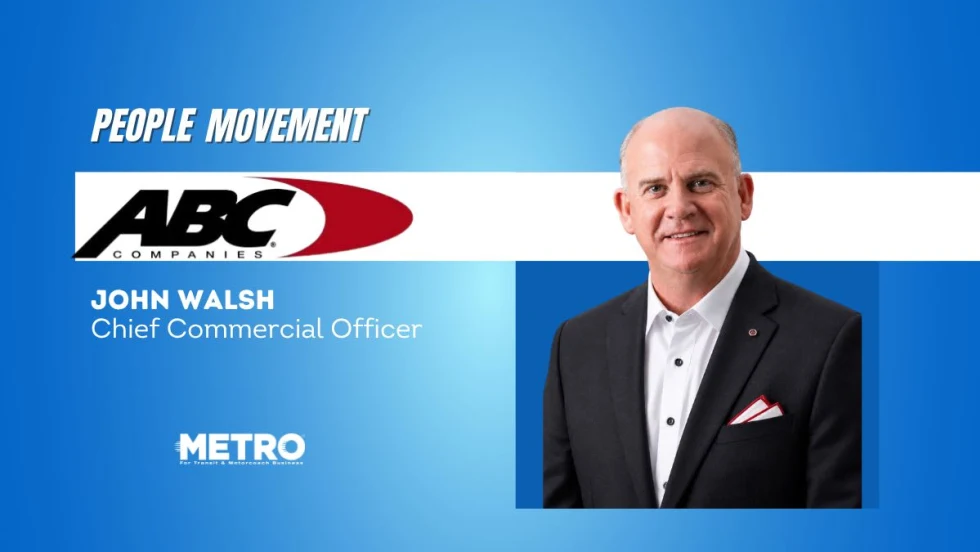
People Movement: ABC Names John Walsh as Chief Commercial Officer
In this edition, METRO also covers recent appointments and announcements at the DART, STV, and more, showcasing the individuals helping to shape the future of transportation.
Read More →
From Surviving to Thriving: Building Stronger Transportation Organizations
Bus Business Consultants founder Brian Dickson shares lessons on leadership, organizational health, and creating options for long-term success in a changing transportation industry.
Read More →
Biz Briefs: Luminator Marks Milestone and More
From manufacturers and suppliers to transit agencies and motorcoach operators, these updates offer a snapshot of the projects, partnerships and business moves driving the industry forward.
Read More →
ABAF Study Reveals Growing Insurance Crisis for Motorcoach Operators
Preliminary findings show 98% of operators faced premium increases over the past five years, while shrinking insurer participation is putting added pressure on businesses and customers.
Read More →