



San Francisco to charge employee shuttle operators to use stops
Under the new rule, employee shuttle bus providers would pay a fee and only be allowed to use approved public transit bus stops in the city.
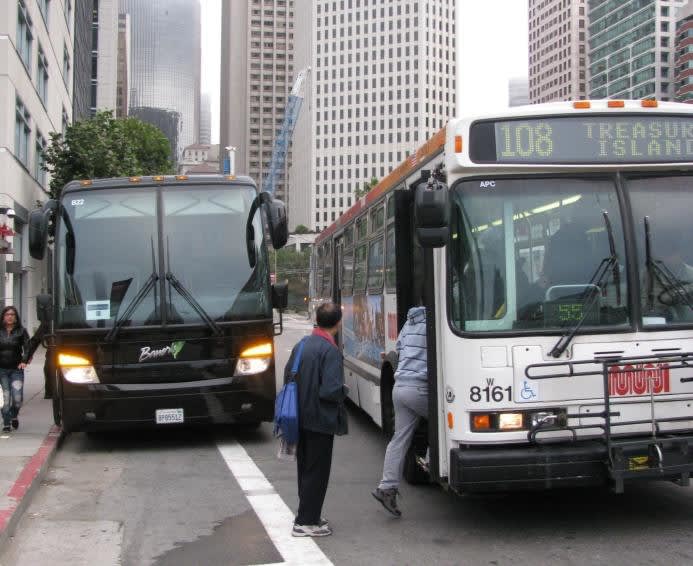
Photo courtesy SFMTA
Photo courtesy SFMTA
Employee shuttle buses for Silicon Valley tech firms, which have become a symbol of income disparity in San Francisco, will soon be charged for using public bus stops. The agreement, which had been in the works for months and was announced in early January, took on added urgency as protesters blocked Google buses in San Francisco and Oakland, according to a San Francisco Chronicle report.
Following more than a year of collaborative work, the group, which includes the San Francisco Municipal Transportation Agency (SFMTA), Mayor Ed Lee, Genentech, Google, Apple, Facebook, Bauer’s Intelligent Transportation and the Bay Area Council, came to a broad consensus on a package of policy recommendations allowing commuter shuttles to use a limited network of approved Muni zones, as part of an 18-month pilot program.
The pilot program includes:
Charging a daily fee based on the number of stops a shuttle provider or employer makes to fully cover the SFMTA’s cost of administering and enforcing the program and includes private investment to improve select stops. Fees are estimated to raise tens of thousands of dollars monthly to the largest transportation providers.
Approval of 200 bus stops to be used by providers.
Private shuttle providers will pay to use Muni bus zones, based on a per stop, per day, cost recovery schedule. Due to Proposition 218, the SFMTA cannot create a fee structure that goes beyond the cost to provide such a service or policy.
Providers would operate in accordance to agreed-upon guidelines, such as yielding to Muni and pulling to the front of the zone making more room for other vehicles and avoiding steep and narrow streets.
The agency would enforce these rules to ensure only participating companies are using shared zones. It will be illegal to use all other bus zones.
Each commuter shuttle will be issued a unique identification placard so enforcement personnel can easily identify vehicles.
Providers would share data with SFMTA to ensure that location information is available for complaint follow-up, enforcement and to support the agency’s transportation system management.
“How we deal with shuttles now is not sustainable and this proposal gives the board an opportunity to vote on a policy that increases safety, reduces impacts on Muni, provides more information, improves the flow of traffic and reduces driving simultaneously,” said Tom Nolan, chairman of the SFMTA board of directors.
Currently, issues are resolved on a case-by-case basis, which is not sustainable or effective in managing this mode of transportation. The private shuttles predominantly use Muni bus zones, without any coordination with Muni and this can lead to delays on the transit system.
The city does not have complete information about which shuttles operate where and this makes it difficult and time consuming to follow up on inquiries and complaints.
The proposal was set to be taken to the SFMTA board in late January. If the board takes action, the SFMTA will ask shuttle providers to propose stops for inclusion into the bus zone network and will ask San Francisco residents for their input to determine specific bus zones that can be used. Final plans would then be approved by public hearing in late spring.
More Motorcoach

METRO Opens Submissions for 2026 Motorcoach Awards
Nominations are now being accepted for METRO Magazine’s Operator of the Year and Innovative Operator of the Year awards.
Read More →
Biz Briefs: Alstom Lands Canadian Contract, LYT to Supply California TSP, and More
In METRO's latest installment, we take a look at recent news from Complete Coach Works, Beep, FlixBus, and more partnerships making headlines across the transportation sector.
Read More →
Biz Briefs: RIPTA Unveils New Frontrunners, Clevland RTA Adds New Siemens, and More
In METRO's latest installment, we take a look at recent news from Siemens, Prevost, Dodge, and more partnerships making headlines across the transportation sector.
Read More →
People Movement: Holly Arnold Joins Transdev and More
In this edition, we also cover recent appointments and announcements at Pace, CamTran, MCI, and more, showcasing the individuals helping to shape the future of transportation.
Read More →
ABA Report: Motorcoach Travel Generates $161.6B Economic Impact
The 2025 analysis finds motorcoach travel supported nearly 900,000 jobs and generated $28 billion in federal, state, and local taxes.
Read More →
CharterUP’s Armir Harris on Technology, AI, and the Future of Group Mobility
In a recent episode of METROspectives, CharterUP Founder/CEO Armir Harris discussed the company’s evolution from an online charter bus marketplace into a technology platform supporting public- and private-sector mobility and much more.
Read More →
People Movement: ABC Names John Walsh as Chief Commercial Officer
In this edition, METRO also covers recent appointments and announcements at the DART, STV, and more, showcasing the individuals helping to shape the future of transportation.
Read More →
From Surviving to Thriving: Building Stronger Transportation Organizations
Bus Business Consultants founder Brian Dickson shares lessons on leadership, organizational health, and creating options for long-term success in a changing transportation industry.
Read More →
Biz Briefs: Luminator Marks Milestone and More
From manufacturers and suppliers to transit agencies and motorcoach operators, these updates offer a snapshot of the projects, partnerships and business moves driving the industry forward.
Read More →
ABAF Study Reveals Growing Insurance Crisis for Motorcoach Operators
Preliminary findings show 98% of operators faced premium increases over the past five years, while shrinking insurer participation is putting added pressure on businesses and customers.
Read More →